zondag 3 april 2016

Defining dancehall

This is in essence a post about definition. Specifically in reggae music. Jamaica’s reggae music originated in Jamaica around 1968, developed from earlier Jamaican genres Ska and Rocksteady. Such a complicated genealogy covering only one decade (Ska arose around 1959, Rocksteady around 1965, Reggae around 1968) points at the vibrancy of Jamaica’s music industry. This is especially the case considering Jamaica is a small island with then maybe about 2,4 million inhabitants.

Yet many things began to happen in Kingston and Jamaica in the 1960s and after. Many people invested in the music industry as a way out of poverty and ghetto living, investing either with saved money, or – when without money - with effort and/or talent. Considering the island’s size, remarkably many recording studios arose in Jamaica, with the emphasis on the capital Kingston. Over a 100, increasing (with also home studios by those having funds for it), so I heard, up to around 200 “recording studios” as such in the present.

SOUND SYSTEMS

This very vibrancy depended on recording possibilities, but just as well on the phenomena of “sound systems” – simply put: mobile discotheques – and “dance halls”. What Jamaicans call(ed) Dancehalls were in fact outside, open-air patio-like squares surrounded by walls and buildings, so were not “halls” in the very literal sense. Sound systems played at dance halls, being thus the place where local music was first tested with a local audience. Organically and from the ground up, the way I think it should be. Quite different (and better, I opine) from what in time developed in Western (US, Europe) pop music cultures: big companies manipulating tastes and publicity to get certain promoted musical acts sold, for more profit. Local audience’s tastes or input are in this latter system virtually ignored and gagged. The good thing about the Jamaican Dancehall tradition in turn is that it procures an authentic connection to local tastes. Record spinners (selectors) of Sound Systems adapted to the audience’s response at dancehalls, eventually.

This is where there also may be the only down side, I think. There is music, are songs that are inherently of high quality, in my opinion. Those songs may at the time not fit that particular audience’s mood or expectation, but with a different mind-set, the song can become enjoyable. The selector spins for the audience and patrons, that is true, but the audience must cooperate a little bit as well. This being said, I overall can understand that over time selectors at dancehalls adapted in the music they play to what the audience seemed to want. That in itself is okay and democratic, preventing too much elitarianism in tastes.

DANCEHALL AS PLACE

So, the Dancehall is an important “place”, a locale in Jamaican music. Later it became applied to a separate genre within Reggae or, as some put it, a separate Jamaican genre derived from Reggae. I noted in Jamaica (where I went in 2006 and 2008) that public media discussed regularly songs in the Reggae Chart (songs deemed most popular at the time), while there was another Dancehall Chart. Thus, these were treated as clearly separate genres. It seems, therefore that in Jamaican culture – among many people, at least – the distinction between Reggae on the one hand, and Dancehall on the other, as separate genres was well-defined and clear-cut, by 2008.

Of course, Dancehall as separate genre (or subgenre, or however defined) developed earlier. Important, informative reference books about Reggae and Jamaican music (I can mention the comprehensive guide ‘The rough guide to reggae’ – 2001 - by Steve Barrow and Peter Dalton) describe the history of it tracing it partly back to the course of the 1980s. Different works mostly trace it to the 1980s at least, sharing often the mentioning of Wayne Smith’s then innovative digital, Casio-based ‘Under Me Sleng Teng’ (1984) song as starting point of Digital Reggae or Dancehall.

Yet, not so much of Dancehall as genre. That is where the definition turns out to be not so clear-cut as thought. The mentioned ‘Rough Guide To Reggae’ has separate chapters on Roots Reggae, Dub, and on Dancehall (non-digital Dancehall) and also Ragga (the digital phase). Steve Barrow and Peter Dalton associate the Dancehall genre’s development as such as Dee Jays (not record spinners, but rather rhythmic talking/"Toasting" vocalists), putting their improv vocals on existing instrumental versions at Dancehalls, as part of Sound Systems. This went on already in the 1970s, with U Roy being the first to actually record such Toasting on existing music on in the early 1970s, but preceded by many Toasters at Sound Systems and Dancehalls, even already in the 1960s. This had become common by the 1970s, when what became known as Roots Reggae - often with singing and Rastafari-inspired- or “cultural” - held sway and was popular in Jamaica, even at the same venues. Roots Reggae was then played and appreciated at the Dancehall, making terming the subgenre after a place all the more problematic. Or problematic.. maybe it’s better to say “confusing” or, more positively, “flexible”, as Selectors and Dee jay’s had to be flexible to please the audiences. Dancehall is, after all, a “place” more than a musical genre with specific musical characteristics.

DANCEHALL AS MUSICAL GENRE

Or it was in the past, at least. In the later 1980s one can say, but still with nuances, a distinctive style, musically had developed, independent of where played: instruments used, rhythmically, melodically, lyrically, studio aspects, etcetera etcetera. This became known as Dancehall music.

However, even then – and up to now – it is not such a clear-cut definition . In the remainder of this post I focus on how Dancehall as Jamaican genre (or subgenre) is defined in some major works and by main reggae scholars (these actually exist). I try to answer the question that consciously or subconsciously lives in the minds of many reggae fans, I imagine: the difference between Roots Reggae and Dancehall. Some reggae fans think they know (at a rational level) the difference between these types of Reggae/Jamaican music, others more or less, vaguely “sense” or “feel” that difference. Still noting that difference and preferring the one over the other, always or during some moods or life stages.

RUB-A-DUB AND RAGGA

In fact, the distinction is not that clear. One development instrumental in Dancehall as genre, most writers agree on this, is that already existing music, from songs recorded in the past being reused/recycled – read: sung over – again, inaugurated a new period in Jamaican music. This became more and common, relating as much to creativity as to economics, since it was cheaper. Studio musicians remained active in the 1980s – the Roots Radics became influential for instance – but often repeated or reworked existing rhythms, or were at least influenced by new technologies. Sugar Minott was around 1980 one of the first to do a “do-over” album, singing new songs on already existing music/riddims, from Studio One in this case. Other artists followed: some more singing, some more rhythmically Toasting: Yellowman, Barrington Levy, Eek-A-Mouse and others, all coming up in the 1980s.

Interestingly, in the article/chapter on Jamaican music, ‘The loudest island in the world’, by Gregory Salter, part of the 2000 collective volume ‘World Music : the rough guide’ (with chapters on different countries/areas world wide and their popular music), on Jamaican music, Salter points at the crucial role in this development of producer Henry “Junjo” Lawes, who worked with Yellowman, Sugar Minott and others, though he produced some great Roots Reggae records in the 1980s as well.

In the already mentioned work ‘The rough guide to reggae’ by Steve Barrow and Peter Dalton the importance of Lawes as well as others is mentioned as well. Also, Barrow and Dalton describe how “deejaying” or singing over often existing riddims (Lawes also helped develop “new”, or original riddims/instrumental music, must be said) led the way to what would become the genre Dancehall. They point out that this was not that new, as reuse of riddims occurred also in the 1970s in Jamaica. In general, though, they indicate that from the 1980s the “riddim” (reused) and the producer became more important, whereas the 1970s Roots Reggae era in Jamaica was relatively more “artist-centered”. Several works point out that the Dancehall phase in Jamaica was also a focus away from the more internationally oriented Roots Reggae era of the 1970s (with Bob Marley and others of course having reached international fame), toward the local, Jamaican dancehalls.

As much is described in the very readable book ‘Reggae and Caribbean music’ (2001), by Dave Thompson. This book devotes a “genre profile” to Dancehall, explaining in it how lyrical changes toward less-than-conscious or –spiritual themes, were in time balanced by a “return” to Rastafari-inspired and “conscious” lyrics. These are broad lines and not incorrect per se, but it must be pointed out that some artist kept their lyrics “conscious” throughout, at times adapting in a musical sense to Dancehall or Ragga.

“Relatively” is an important term here. Over time other changes took place, reflecting inevitably social and political changes within Jamaica. “Slackness” lyrics, about boasting, sex, or (gun) violence - though often more humorous than cynical – became common among many artists, including Yellowman, Shabba Ranks, and General Echo. Many criticized this as a moral downturn, away from Rastafari inspiration and “roots and culture”.

Yet, in the same decade many Rastafari-inspired, “cultural” lyrics still were recorded in Jamaica: only, again, “relatively” less, and less popular among parts of the audience, more in search of either spectacle or fun. That many of those artists associated with Slackness still occasionally used Rastafari or “socially critical” terminology, was seen as inauthentic or fake by some, while others conclude that boundaries cannot be drawn that sharp in Jamaican culture, or perhaps in humans in general.

People, individuals change furthermore. Both Capleton and Buju Banton (and others) started out mainly with party or Slackness lyrics, before turning more to “conscious” Rastafari-inspired lyrics in later stages of their career. They were part of the New Roots movement lyrically, along with Sizzla and others.

DIGITAL

Meanwhile, there has been further digital influences and other strictly musical changes within Jamaica, irrespective of lyrics. Purely technically and musically, a genre as Digital Dancehall had developed: this also became known as “Ragga”. In a work aimed at musicians (drummers) named ‘Jamaica: your pasport to a new world of music’ (2009) by Pete Sweeney and Nathaniel Gunod, the authors describe the basic drum and rhythm characteristics of both Dancehall and Ragga. Regarding the latter they point at the “syncopated” snare drum (with similarities to Soca and Calypso) as a characteristic of Ragga, which is furthermore, they say, exclusively electronic (Dancehall only partly). Live drummers playing Ragga therefore have to be “computer-like” tight and precise, they hereby stress.

More – too – simplified they in turn describe the preceding stage of Dancehall mainly on the basis of Wayne Smith’s ‘Under Me Sleng Teng’ (1984), I already mentioned. So, mainly electronic. They describe Dancehall as relatively more “dance-oriented”.

This again goes to show the difficulty in defining Dancehall. Early 1980s songs by Barrington Levy or Eek-a-Mouse were according to many Dancehall, or called “Rub-a-Dub”. They were, however, not that much more digital than what came before. Sly and Robbie with e.g. Black Uhuru and Ini Kamoze made some classic songs, with already some more digital influences.

ROCKERS RHYTHM

More interesting, I think, is how the Rockers rhythm played by drummers - developed in the later 1970s - eventually helped shape early Rockers rhythms, giving a different rhythmic feel, that nonetheless still combined well with the Rastafari message and spirituality (notable in Black Uhuru’s lyrics, later Hugh Mundell lyrics, Mighty Diamonds a.o.).

The Rockers drum pattern basically adds a bass drum beat on the first count of a 4/4 beat, combining with a sharper snare drum beat on the Third count (already there in earlier “One Drop” reggae rhythms since the early 1970s). This gave the Rockers rhythm a more insistent, dynamic feel. Later in the 1980s some producers made the Rockers rhythm faster to increase this effect, with more beats-per-minute. Therefore some describe electronic Ragga as faster and digital, but rhythmically still Rockers Reggae-based. No matter how “digital” and computerized it sounds. One only has to count faster.. that’s the trick.

Before this, Rockers rhythms – inaugurated by musicians Sly Dunbar & Robbie Shakespeare – began around 1976, still with a Roots Reggae vibe. The Mighty Diamonds’ album ‘Right Time’ from 1976 is known as the first reggae album with a Rockers rhythm as drum pattern. Few would consider this a Dancehall-like album, and not just because the Mighty Diamonds sing with harmonies and don’t deejay, or because the riddims are original, but also because the “feel” or “vibe” is overall of Roots Reggae.

Changes in time, however, and experiments with the Rockers rhythm: - making the music “sparser”, more strongly focussed on drum and bass, Dub effects, more digital effects, making rhythms faster, more Deejaying than singing - eventually would give these Rockers Reggae-based rhythms a reworked place in what would be known as Rub-a-Dub reggae, Dancehall, but also Ragga (Digital Dancehall). I think this purely rhythmical approach in analyzing this change is interesting. Listening from this perspective, there is a musical connection (apart from vocal choices, lyrics or production aspects) between the songs ‘Right Time’ (1976) by the Mighty Diamonds (backed by Sly & Robbie), Yellowman or Eek-a-Mouse songs from the later 1980s, say Eek-A-Mouse’s ‘Wa Do Dem’, backed by the Roots Radics, and – with a leap in time – purely digital tunes from recent times: by the likes of Ward 21, e.g. Capleton’s ‘Who Dem/Slew Dem’ (on the 1999 Bellyas Riddim) and other songs. All are built around a Rockers Reggae base, with emphasis on beats 1 and 3 (of 4/4), with the bass drum on the first count.

This may not be obvious to all. Yet, this Rockers base is what makes the Digital Dancehall rhythm distinctive from other Caribbean “digital” genres (Soca, Zouk), and connects it to earlier Reggae. This difference one also “feels” when dancing to it.

AFRICAN AESTHETIC

What I find most interesting about this is that it shows an underlying African aesthetic. This seems in line with the Rastafari movement, that arose in Jamaica (in the 1930s) to regain an African pride and connection, away from European enforced dominance. Despite some Slackness and non-Rasta lyrics, it is in another way a reconnection to African musical principles. Of course, also Rastafari lyrics are now sung/chatted on such digital Ragga/Dancehall riddims, but even if lyrics are not so conscious or socially critical, do not talk about Africa or Blackness, or are even negative and enunciating clear non-Rasta values (materialism, violence, crime), an African musical and cultural aesthetic is still there. Despite this, one might say. Not just the basic (rockers) rhythm, but also the syncopic elements and “counter-rhythms” have African origins.

DANCE

Also the fact that music (Dancehall) is “dance-focussed” is African. Music and dancing are traditionally in sub-Saharan Africa intertwined. Music is meant mostly to dance to. The separation between listening to music on the one hand, and dancing to it on the other, stems from European, not African culture, anthropologists have explained again and again. Sure, African music has not just rhythm, but also roles for melodies and harmony, yet is normally strongly percussive/rhythmic and meant to dance to. This applies to the polyrhythms-based musical cultures of “forest Africa” where many slaves came from who were brought to the West/Caribbean (Ghana, South-Nigeria, Benin region, Congo region), but also more subtly to “Griot Africa” with more string instruments and (reworked) Islamic influences, i.e. the Mali, Guinee and Senegambia regions. I mentioned these differences in other blog posts of mine. Comparing traditional music from Islamic countries like, say, Iraq, Iran, or in North Africa to traditional Griot music by the Bambara people in the also mostly nominally Islamic South of Mali, one notes a few similarities, but even more differences, especially regarding rhythm and what can be called “percussiveness”, being more emphasized in the case of the African South Mali or Guinee regions. Common drum instruments like the Djembe or Dundun (a two-sided bass drum) in/from the Guinee region have also become internationally better known by now.

Roots Reggae came to include of course more types of musical instruments, more melody, and a European-derived chords/harmony-focus, yet also a maintained, crucial role for rhythm. The same applies to earlier Jamaican genres like Rocksteady. Many Rocksteady songs have good melodies and instrumentation, as does much 1970s Reggae, but at the same time the same “good melodic and harmonic songs” are rhythmically very good too, and certainly danceable (maybe slower, but danceable).

The distinction that some within the reggae world make between valuable, “spiritual” music on the one hand, and “music just to dance to” is problematic, I find. Such distinctions are made in other genres as well. Often is meant that the “rhythm” is better or more interesting than the lyrics or melody, which at times can be the case. I know examples of such songs too, with cliché or nonsensical lyrics, but with strong rhythms.

As a generalized statement, however, I think it is too simplified. Also when looking at present-day Dancehall and Ragga from Jamaica. Artists like Capleton, Sizzla, Lutan Fyah, Jah Mason (and others) have musically Digital Dancehall/Ragga songs, but with Rastafari and conscious lyrics. Certainly danceable, musically and vocally more rhythm-focussed, as well as the dynamic, faster tempo of the Digital Dancehall riddim, adding some “energy” to the lyrical message. Interestingly, this expresses an African retention returning, namely of the connection between dance (rhythm) and spirituality.

Such a connection is much less known in European/Western musical culture (certainly in this form), which also influenced Jamaican music a bit.

woensdag 2 maart 2016

Employment in reggae lyrics

Employment, job - or otherwise said “labour relations” - issues tend to end up as the proverbial “elephants in the room” in many social debates internationally. That is: determinant and heavy, yet ignored and avoided. There are social debates, especially political ones, where this is not the case of course. Politicians habitually adress it rhetorically as well as with policies. This tends to be partisan and ideological, hindering a truly philosophical reflection. Reflection, for instance, on workers’ required dependency on employers during most days of the week, and on those days on most waking hours. Such philosophical, critical reflections exist solely on the margins, it seems, in present-day Western society.

Some progressive movements or political parties, such as certain Left-wing and Green parties, recently started to support a standard 32-hours work week standard, instead of the now standard 40-hours. This was formulated in election programmes as well, along with arguments related to limiting unemployment, freeing more time for family, social or “care” activities, or environmental reasons.

In many Western societies that 40-hours work week only really started to become the legal standard in the 1960s, and gradually at that. Before that employers could exploit much more and worse (with work weeks of about 75 hours), as workers had little social protection. This improved somewhat over time, although 48-hours work week remained common, and it took some time (1960s/1970s) until the Saturday became another standard day off, alongside Sunday, in countries like Britain, the Netherlands, France, Germany, or the US.

It is interesting to note that the Jamaican-born, Black empowerment proponent and intellectual Marcus Garvey (1887-1940), was in his time a relatively early advocate of the shortening of the standard work week to 40 hours (then close to 50), meaning more free time, and representing a quite progressive step for the time.

For the remainder of this post, I will continue more or less with a related, though more modern Jamaican topic. Namely, the discussion of “employment/labour relations”-related issues in lyrics of Jamaican Reggae music. This last theme happens to be a topic I have gained a lot of knowledge about in the course of time.

HISTORY

In some sense, slavery is to work what rape is to sex. It problematizes and dehumanizes what should not be, causing disharmony and insecurity within humans: the result of psychological traumas. Of course, the history of African-Jamaicans is one with slavery, explaining their very presence in Jamaica, after brutal and forced transports from Africa. Racially based social injustice continued after slavery was abolished in 1848, with a structurally, disadvantaged position of Afro-Jamaicans, meant to remain on the lower orders of society, excluded from higher classes, or at most working for them in a dependent position.

From this perspective, after the abolition of slavery, “work” or “employment” remained heavily problematic for Afro-Jamaicans, even if necessary for income and to pay the costs. Among poorer classes, unemployment was high, meaning for many ghetto dwellers a recurring battle for survival in poverty, sometimes trying different things, legal or illegal..just to get by. Some chose a life of crime.

Formal unemployment rates among Jamaican poor people often rose to majoritarian percentages (around or above 50%), even if not taking into account the common informal, unregistered jobs and income sources. Still, unemployment was high and problematic – and unequally spread - as in other developing countries, and explaining of course much of the poverty.

RASTAFARI

The Rastafari movement arose among poor Afro-Jamaican people since the 1930s, and alongside certain Africa-oriented social and spiritual ideas, also strove to self-sufficiency from the oppressive system, to thus be also more independent, e.g. with own agricultural endeavors.

This whole context, the Rastafari movement, and other social movements in Jamaica, influenced many Reggae lyrics. There is a strong Rastafari influence on not all, but many Reggae lyrics, especially increasing since the Roots Reggae era began in the early 1970s. Social criticism is part of this, but was there even before the 1970s in Jamaican popular music lyrics. Themes like poverty, oppression, living in the ghetto, and violence and hardship recur in Reggae lyrics, as many readers may know. I discussed such lyrical themes in earlier posts on this blog.

What I set out to do here, however, is to focus on how regular “jobs”, or employment as such, are discussed in reggae lyrics. The ordinary 40-hours work week jobs as e.g. worker, tradesman, at an office, in a factory, on the land or otherwise “on the grind”.

Reggae musicians are by definition active in the music “industry”, which for most of them is also a “job” providing needed income. Music as a way out of the ghetto. This might be a known fact. The for a long time quite exploitative practice of parts of the Jamaican music industry, plus difficulties of reaching a large audience, caused, however, that many Jamaican musical artists could not live off their music alone. This was to differing degrees even the case regarding quite well-known names, selling and touring in Europe and elswhere, such as Dennis Brown, Gregory Isaacs, Toots & the Maytals, Burning Spear and others. Music was an important source of income for them, but did not make them comfortably rich, far from it. Many therefore invested their time in music in different ways (recording others, own sound system, own studio etcetera), looking at possibilities in the extensive Jamaican music industry. Just as many, though, had other (non-music) jobs besides their musical activities, if they could find it. If not, they were essentially poor, mainly jobless people with only a meagre income through music, helping them just to get by, on a day-to-day basis.

Due to these characteristics, one should, I think, not assume that Jamaican musicians or artists are detached from the reality of most labourers that work in other, non-creative 9 to 5 (office/factory) jobs to maintain families. Reggae, as other Black music genres, are in that sense different from the “detached artiste” in the European Classical tradition.

Jamaican musicians, like other artists, may try to make a living out of what they like and inspires them (make music, derived from their own culture), but due to circumstances they can have no “spoiled”, or “lazy” life in Jamaica, with total freedom, and little structural effort or demands. They can, but would have too little income.

Partly for that reason, themes like laziness, regular jobs, vacancy, (un)employment, low-paying (factory or other) jobs, conflicts with bosses, a.o. recur in Reggae lyrics as well, and not just lyrics about conflicts with others within the music industry itself. Besides this, even if the income from music would be sufficient, many reggae artists still remember “where they came from”, i.e. from among the poor people.

CONTEXT

As poverty is a recurring theme in Reggae, so are other social problems, such as criminality and violence, as found in the ghetto, and in disadvantaged parts of Jamaica. Evidently, there is a direct link with employment: not able to find regular jobs easily. Not enough jobs created in different sectors. As in other developing countries, many rural dwellers move to the big city, Kingston, hoping for economic improvement from underdeveloped rural areas, some seeking employment in specific sectors. The North Coast of Jamaica also has developed a tourism industry that employed Jamaicans from the entire island.

The workings of the Jamaican economy must hereby be understood. To this day, race continues to play a role in social inequality, interlinked with class. This of course is a heritage of the colonial and slavery history. As elsewhere, family connections, or “people you know”, are influential too. Blacks remain at the bottom of the ladder: even when the majority of the Jamaican population. Unfortunately it still applies: the whiter, the more European the better. White Jamaicans, but also “Brown” people, with visible European and African ancestors (estimated at about 15% of the Jamaican poulation), therefore tend to have more favourable positions, better, higher jobs than more Black people (of mainly African descent) in Jamaica. So do minorities of Arab, Chinese or other descent. These in turn seek to procure this position within their family, thus continuing their socioeconomic advantage. That’s the way of the world, one cynically (if realistically) can say. Black Jamaican ghetto residents may try to find a job in certain companies owned by these powerful families and groups. Discrimination even based on the place of residence (downtown, ghetto areas) is however common during these job application procedures.

EXAMPLES

Examples abound within reggae lyrics, maybe too numerous too mention. I can, however, give some representative examples, or describe common threads. Not unlike I have done on other blog posts. My previous one – on the use of the güiro instrument in reggae – also provided much more examples as I could give, for instance. Either way, I will focus a bit on Roots Reggae from the 1970s onward, especially because the lyrics tended to be more socially critical.

The song ‘Unemployment’ (1984) by the Twinkle Brothers is I think interesting. The lyrics state: ”5 out of 10 nah (don’t) work..”. This is a higher percentage than the “One in Ten” that the British reggae band UB40 once sang about (song from 1981). I am not a big fan of UB40 per se, but I found their song ‘One in Ten’ okay.. Still.. 10% unemployment rate in Britain, say Birmingham, where UB40 is from, is not that much compared to for instance Jamaica, as the Twinkle Brothers’s song lyrics also illustrate. Even within Europe there are countries with higher unemployment rates. At present, EU members Greece and Spain, for instance, have formal unemplyment rates of about 40%. Youth unemployment is even higher.

The song ‘Vacancy’ (1978) by Culture discusses the problematical search for work. Interestingly, Culture in other lyrics points at the need to “Do Something For Yourself”, thus keep “poverty” away through more own initiatives. This speaks of an optimistic and maintained ambiton, but also of disappointment in the Jamaican labour market.

It is this disappointment that recurs throughout reggae lyrics, dealing with the “Boss Man”, being for instance too greedy, or too exploitative. The same Twinkle Brothers síng on ‘Since I Throw The Comb Away’ (1980) that becoming a Dreadlock Rasta caused the singer to lose his job. This type of discrimination is of course also discussed in other reggae lyrics, also more recent ones. Instances where the tide seems to have turned also got attention. On ‘Dreadlocks Time’ (1979) by the Mighty Diamonds, the lyrics describe how after a period of exclusion and discrimination, “Natty Dread” could now be seen in jobs like truck driver or construction worker.. as a positive development.

The “democratic socialist” focus of the Left-wing PNP political party in the 1970s in Jamaica, alligning with many common folks and progressive social movements, got popular with many poor Jamaicans, even gaining support among some Rastafari adherents, normally (not without reason) sceptical about politicians and their promises (“politricks”). An example is Max Romeo. Some Rastafari adherents felt supported in this process, as they now could participate more in society, and “had to hide less”.

Unfortunately, this in time also resulted in disappointment, and PNP leader Michael Manley – once using Rastafari terminology to appeal to voters -, in a later interview said that he could understand that certain employers did not hire people with dreadlocks.. because of their “dramatic” appearance.

Overall, the historical record shows that with the PNP under Michael Manley there were some improvements, for poor Jamaicans and Rastafari adherents, though not as much, or as lasting, as hoped.

Most Rastafari adherents remained critical of politicians and the Jamaican political system, as showed in many lyrics since the 1960s. “Promises” made by politicians are mistrusted, and these promises included of course jobs, or economic improvement.

The Rastafari movement kept keeping the option of repatriation to Africa open and alive, to this day. In the meanwhile, some strive for self-sufficiency, also a commonly adhered to goal among the Rastafari.

On a quite recent song, ‘Wan Fi Go’ (2005), Michael Rose sings about the jobs needed when going back to Africa. An earlier song, by Burning Spear, ‘Repatriation’ (1983) has for instance the same theme, also referring to jobs needed in Africa (builders, plumbers, carpenters, engineers a.o.). Marcus Garvey likewise often had a practical, organizational focus in preparing for Black peoples’ return to the African motherland. Most practical for the few parts of Africa that were at that point independent, such as Liberia. Ethiopia was also considered in this way. Some Rastafari-inspired lyrics pointed out that being evil/wicked, criminal, but neither being “lazy” would be accepted in Zion (Ethiopia).

Culture (with as singer Joseph Hill) tended to have in its lyrics, besides e.g. spiritual themes, also “the ears to the street”, discussing many social aspects from daily life. This included “lazy” people, such as on the song ‘Mr Sluggard’ (1996): “Tell me where you get your bread..Mr Sluggard..”.

So, overall, laziness is not celebrated, while being a good worker/skilled professional is. This is of course similar to other cultures. The song ‘Tradesman’ (1982) by Ijahman Levi being an example. “Working” in a general sense, being industrious, is celebrated in songs by Culture (‘Work On Natty’, 1978), Bob Marley & the Wailers (‘Work’, 1980). On Horace Andy’s ‘Skylarking’ (1972), a hit in its time, he urges the youths to stop lazing or hanging around (“skylarking”), and instead “get a little job and earn their bread honestly”..

A more recent song from 2014 (New Roots) by Loyal Flames also applauds ‘Working’, if necessary in different kind of jobs..

Those “different kind of jobs” are also an interesting subtheme. This beyond the main problem of being able to find a job, ..any job. Some sing defiantly they refuse to be a slave of the system in working for e.g. a bank (Kabaka Pyramid’s 2014 ‘Never Gonna Be A Slave’),.. Others sing that they prefer to work in the music industry, instead of being an accountant or something else (Pablo Moses’s 1980 song ‘Music Is My Desire’), also to spread Jah message.

At the same time, those industrious ghetto people taking on low-paying, hard jobs to feed their family are praised and respected. In difficult circumstances, principles must be tempered with. Not ideal, but unavoidable for survival. Besides, it is of course preferred, considered morally better than robbing or stealing. As I stated before, unlike in some Gangsta Rap in the US, there are hardly lyrics in Reggae, not even in current “hardcore” Dancehall, that really “openly” glorify a life of crime, or doing crimes, though “Gangsta” or being “bad” is used positively in some lyrics from the likes of Vybz Kartel and others.

An interesting comment is found in Dr. Alimantado’s ‘Just The Other Day’ (1977), offering a perceptive insight on the wider economy. Wherein no one wants to be a farmer anymore, but instead doctors or lawyers, causing grocery prices in the city to go up. I find interesting about such lyrics, that it questions middle-class values, now taken for granted and quite ingrained,..by using deeper wisdom.

That the low-wage labourers have no power in their places of work is a common problem world wide. In some countries a semblance of democratization regarding this has meanwhile taken place. In many contexts, however, the boss is undisputedly the boss, not really owing any consideration to workers (beyond legally obliged wages). This still seems the case in Jamaica. Testament to this are several lyrics in Reggae about the “Boss man”, “greedy bosses” not paying what is due, or about distant bosses who decide everything, but that the worker can not even talk to, or discuss grievances with. The latter representative of a wider dehumanization. The Mighty Diamonds’ ‘Want To Know The Boss’ (1983) is an example, as is Gregory Isaacs’ ‘Poor and Clean’ (1980). The latter is a beautiful song about a humble worker in a factory.

Just as common, as already said, in reggae lyrics is the problem of not finding work. The fact that he “can’t find no job to get bread”, made Bob Andy “want to go home”, which can be understood as ancestral Africa. More directly it is said to be Africa on Ronnie Davis’s ‘Got To Go Home’ (1977), in which he laments that there are no (job) vacancies for him, as well as, also, the distant, unapproachable boss, and other problems.

EDUCATION

Equally interesting is the relationship to education, as expressed in reggae lyrics. Going to school is by itself presented as positive, although there is critique of pro-European subject matter in schools, especially by Rastafari-adherents. The responsibility of a child to get an education is however stressed, also as better than just hanging about idly, or get involved in crime. “To learn the golden rule” is a recurring phrase in lyrics (probably partly because it rhymes with “school”), but sometimes the link of education with achieving something, getting a job is mentioned. At least it offers more options, but also here there is disappointment: Israel Vibration sings on their song ‘Racial Discrimination’ (1991): “we share the same vocabulary. Went to your high school, university. But in society there is no equality”.

In Jamaica, a subtle and complex class-race system operates, excluding and discriminating Black ghetto residents from poor backgrounds, This I already mentioned, and is furthermore quite known from current sociological studies. Somewhat more education not necessarily overcomes that, which would be a naïve thought. The current “formal” unemployment figures of Jamaica lie (“only”) around 16%. This might be skewed, but what is sure is that these unemployment figures are higher in poor, disadvantaged parts of Jamaica: the ghettos of downtown Kingston for instance.

As is known, it is in these Kingston ghettos that reggae music mostly developed, and where music became a wanted, but also a needed, way out of dire economic circumstances. With also limited and problematic other job options for poor people, beyond the ganja trade, not even talking about robbery, violent gang crime and cocaine-related crime, normally much more violent than the ganja (marijuana) trade that has a longer history in Jamaica. Even simple jobs in factories, as mechanics, as clerks, muscle for warehouses, or cleaning, are often difficult to achieve, or offer hardly a secure - or a too low - income. Furthermore, there is relatively little legal protection from employers, and thus often little job and income security. This points at a sharp class distinction favouring exploitation of the have-nots. A sharper class distinction than in many European countries, probably, although there seem to be historical British antecedents. Important to point out, once again, that this is intertwined with racial prejudice in Jamaica.

CONCLUDING

Many Rastafari-adherents prefer not to work for businesses part of the wider, oppressive (Western) system, which they call Babylon system. Ideally, Rastafari strive to achieve self-sufficiency, or, alternatively, working for the community, not for some rich boss or company. Some, also Rastas, nonetheless take on different jobs when necessary, but often face discrimination and disappointment. Several reggae lyrics attest to this, as I have explained. Jamaican society has maybe some old-fashioned, conservative all-too class-conscious characteristics, but also in more modernized labour markets, such as in Northern or Western Europe, a “representative” appearance does not include long dreadlocks, even if a common sight in the societies.

I therefore argue that the causal relation between Rastas’s anti-systemic views – including the common labour market in a country like Jamaica - is not just one-way. Not that Rasafari despised this labour market on forehand, not in all cases at least. An increased realization of exclusion and discrimination from this labour market in turn shaped a certain focus among Rastafari adherents. From a human perspective, this is quite understandable.

Interestingly, there is a parallel her with one of the Jamaican inspirators of the Rastafari movement, the already mentioned Marcus Garvey. Looking at Garvey’s biography one finds that he first felt more or less proud to be a British subject, in a Jamaica that was then still a British colony. He sang along with the British national anthem. Maybe in some way he hoped that he could participate in education and work as an equal under the British Crown. Soon he found out about and faced racism within Jamaican society, present a bit more subtly than in the US, but still there. His travels throughout Central America, the Caribbean, and the US, further taught him how this was part of a wider, international problem, as economies kept Black people oppressed and in the lower orders, dependent on other races. This, Garvey eventually developed into his focus on Africa, as ancestral motherland to where Black people should repatriate, to build their own future with their own race and people, not dependent on other nations and races. That by that time most of Africa was colonized by European powers was unfortunate, but that does not make Garvey’s call any less sensible.

On a smaller scale, and returning to labour issues, Garvey’s biography tells how he was fired from one of his first jobs (at a printer) for supporting a strike of the workers, and furthermore was progressive regarding workers’ protection (think about his supporting of the shorter, 40-hours work week). He did on the other hand not really support Communism though, considering it a “white man’s solution to white man (created) problems”. He favoured business ventures within and for the community: Black-owned businesses, trying to set these up himself. This would create economic and ultimately political power, he argued. This is in line with the “self-sufficiency” espoused by many Rastafari-adherents, albeit applying often on a local, smaller scale . Some lyrics, however, also recent ones, discuss needed work, jobs, and skills needed when repatriating to Africa, which remains among many Rastafari-adherents an ideal. Improvement of life and possibilities, of course, but crucially also connected to one’s own cultural identity, family and roots, historically. This makes work more meaningful for oneself. Garvey understood this extra psychological reason of repatriation to Africa well.

That a person in the place of birth/residence has no steady and secure job, let alone a comfortable social position, to lose when repatriating/migrating, further at least partly explains why this ultimate goal of “repatriation” and starting anew is still appealing. Or perhaps even necessary..

maandag 1 februari 2016

The güiro and reggae

The “Güiro” is the name of a Cuban musical instrument, more specifically a scraped instrument, or “scraped idiophone”, producing a rasping sound. The Cuban güiro (pronounced gWeeroh) is made from gourd. Many people may know it vaguely from music they’ve heard, even if not knowing the instrument’s name. There are similar, scraped instruments throughout the world, to be sure, such as the “reco-reco” (often with metal) in Brazil, to give just one example. According to historians, such scraped instruments have long histories and traditions in parts of Africa, such as among Bantu-speaking peoples in what is now the DR Congo and Angola, as well as in the region of Nigeria.

Knowing about the origins of many African slaves forcibly brought to Cuba - relatively many from the Congo and Nigeria regions -, an African origin of this Cuban instrument seems thus probable. Yet, comparable scraped instruments were found to be present among Amerindian, indigenous peoples as well. The Aztecs – for instance – reportedly made scrapers from bones. The Arowaks in Cuba probably had scraper instruments too. Other scrapers (used in the US) were made of jawbones, and others of course from flora (trees and plants). Etymologically, the word “güiro” is also of Amerindian origin, referring also to a tree and its fruit.

What’s typical for the original Cuban güiro, anyway, is that it is made of a gourd/calabash, and played with a small wooden stick. Its total length tends to be between 30 cm and 50 cm. Other scraped instruments are made of other material, or have different sizes, of course. Metal variants (including metal scraping stick or device) can be found in the Dominican Republic, where a scraped instrument called “güira” is used in the Merengue genre, and in some parts of Cuba a metal “güiro”-like instrument called “Guaya” is used in a specific subgenre of Son called 'Changüi', found mainly in the far eastern province in Cuba called Guantánamo. There are scrapers made from different kind of trees (e.g. from coconut trees in Colombia, or hardwood a.o.), and scrapers made from bamboo are found in both Africa and in Brazil. I myself employ also (both in my compositions and when jamming) a “wooden agogo”, made from hardwood, which consists of wooden bells/blocks of different lengths, doubling as a güiro scraper, with added tonal variety. Added to all this, household items have also since long been used as scrapers, such as washboards. Etcetera, etcetera..

There are different theories about the güiro and its origins, but an African, especially Bantu/Central African, origin with some other influences in Cuba, seems most plausible. Its historical place in the Son and Salsa music genre – heavily Congo/Bantu-influenced – and related genres in Eastern Cuba, as well as other folk music in Cuba, seems to confirm this origin as well. The cultural Congo/Central African heritage is strong in Eastern Cuba.

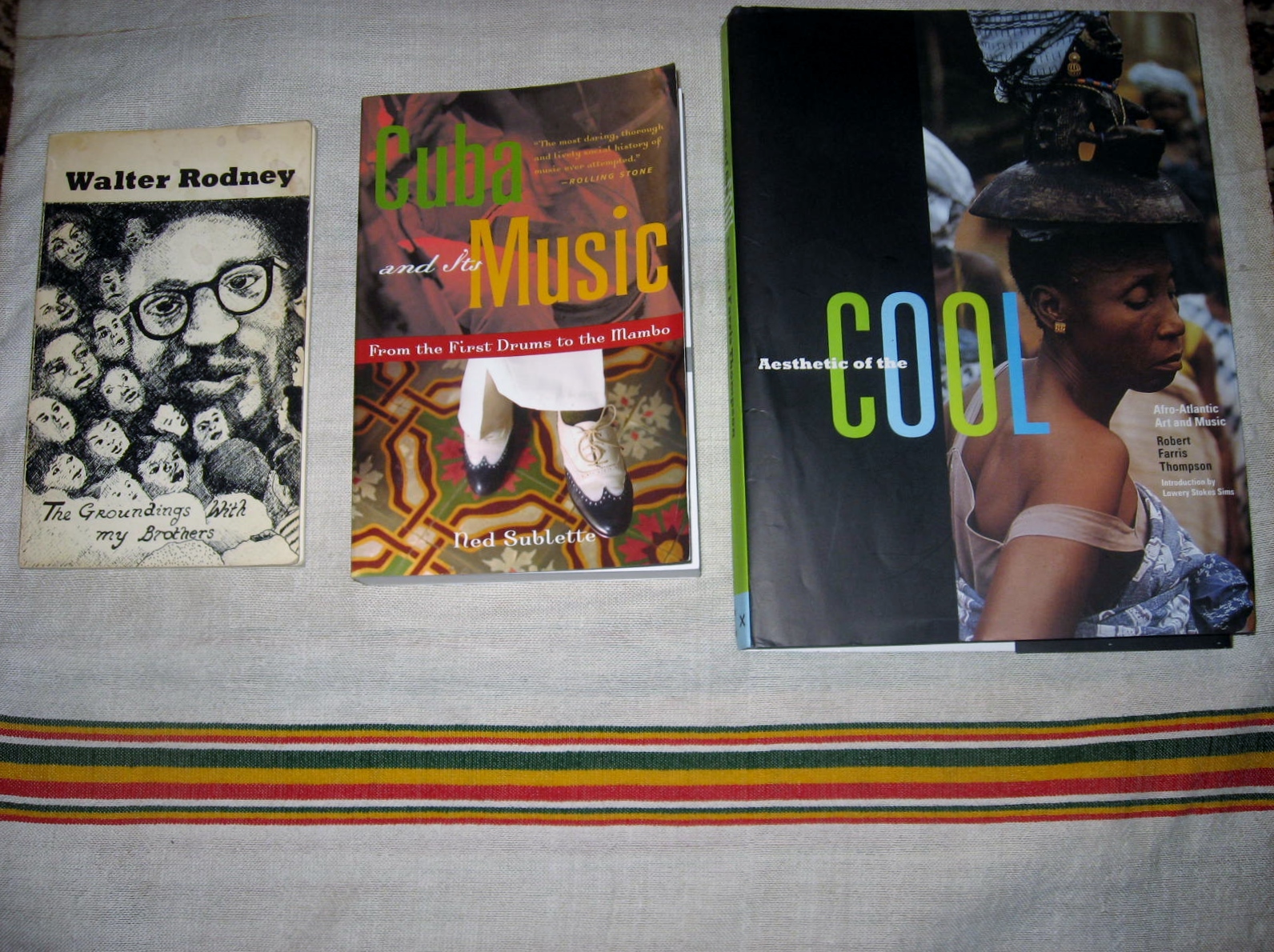
Cultural anthropologist and author on Cuban musical history Fernando Ortiz pointed at its early presence in rural Cuban folk and traditional music, while another author on Cuban music, Ned Sublette, noted in his work ‘Cuba and its music : from the first drums to the Mambo’ (I mentioned this same book in earlier posts on this blog), that around 1852 the güiro also started to be used more in dance orchestras (i.e. in concert halls), at that time as a novel instrument for upper classes. The classical composer Louis Moreau Gottschalk (1829-1869) from New Orleans, but residing in Havana, was according to Sublette the first one to use the güiro in concert music (along with also typically Cuban “maraca” shakers), in a concert he gave in Puerto Rico in 1858. Its folk use is much older, of course.

Either way, the güiro has an important place in specifically Afro-Cuban music genres, such as the originally East Cuban Son, which in turn gave much of its base characteristics to what we know as Salsa music, wherein the güiro is likewise much used. This goes – as can be expected – with specific patterns, to fit the “clave” (old Spanish for “key”): a rhythmic key pattern (2/3 or 3/2) forming the structure of traditional Afro-Cuban music (and much traditional African polyrhythmic music). There is within the whole of Afro-Cuban music variety, as well as space for improvisation, with the güiro, but mostly its patterns are relatively “fixed” or standard, because it has to fit a clave-based frame.

Considering the different tonality the güiro offers – long, extended scrapes and short ones, by moving up and down with the stick – a common pattern in Cuban genres as Son is for instance: long-short-short-long. Thus: a long “scrape” on the One and Four, of a 4/4 bar, interchanged with short ones in between, on the 2 and 3, sounding like: Trrrrrrrrr Tr Tr Trrrrrrrrr. Or the long scrapes on the 1 and 3, when you count in double time (One-AND-Two-AND-Three-AND-Four). Some may recognize this common “long scrape-short-short-long” pattern from e.g. Son, Salsa or Latin songs. Other Caribbean/Latin American genres have other patterns, in Puerto Rican Bomba (4/4 based), the long scrape is at the end of the bar, after three short ones, for instance. The güiro and related scrapers have also an own place and patterns within Colombian music genres, such as Cumbia.

It is somewhat simplified, I admit. This because I will not delve in its many variations and uses in Cuban or Latin American music too deep: there are for those interested many instructional videos on YouTube, or theoretical studies elsewhere regarding the use of the güiro in Latin American music. This basis is still necessary here, however, as a point of departure for the main theme of this post, I wish to expound on: the use of the güiro in Jamaican reggae music.

JAMAICAN MUSIC

It is also used in reggae music, and in fact quite commonly. It is not so remarkable that Cuban instruments are heard in other genres. After all, the well-known instruments of Afro-Cuban origin, the bongos, congas, maracas shakers, and other instruments, have spread globally, including throughout Latin America and the Caribbean, but also to the US, Europe and elsewhere. These instruments by now can be found in many genres, also in the Western world.

Jamaica is moreover even in the same region as Cuba, as a “bordering” island, and with a population with mainly African roots (like many Cubans, and known Afro-Cuban instruments). People who know something about the history of Jamaican popular music might know that Cuban music influenced reggae, since the Ska genre developed (around 1960), and in earlier folk genres in Jamaica (Mento). Cuban musical instruments travelled to Jamaica. Partly because of its relative proximity, but there also were many Jamaican migrant labourers in a period (earlier 20th c.), working in Cuba’s sugar industry, and returning to Jamaica. Some of the Skatalites band members, influential in Ska, were born in Cuba, or even had a Cuban parent (like Rico Rodriguez), as were other Jamaican artists active since the 1950s and 1960s, like Laurel Aitken. Rita Marley was also born in Cuba. Mortimer Planno, a known Jamaican Rastaman, was born in Cuba too. In other words, linkages were there, even beyond a select group of travelling musicians, or music spread through media (discs, radio).

Even without such proximity or extra linkages, Cuban music itself of course has travelled to the US and throughout the Caribbean and Latin America, influencing genres and musicians. This occurred already since roughly the 1930s. Besides this, percussionists in Jamaican music were, like those in other genres, often internationally and broadly oriented: the Brazilian “Cuíca” drum – a friction drum, with a stick being rubbed – can also be heard in a number of reggae songs since the 1970s.

Cuban music thus travelled internationally since the early 20th c., but not just throughout Latin America, leaving also influences in US Black music genres as jazz, rhythm & blues, funk, soul a.o. For that reason, the güiro can be heard on occasion in these genres as well, sometimes to add a Cuban, “latin” or “salsa” touch, sometimes even in structurally rhythmic roles: It can be heard for instance in songs by Curtis Mayfield (e.g. 'Superfly'), several Motown songs, songs by Marvin Gaye, and others. The güiro even found its way in European classical music; it can be heard in ‘Le sacre du printemps’ (1913) by Stravinsky.

In British pop music (albeit influenced by Black music) it is also found, such as in David Bowie’s ‘The Man Who Sold the World’, where the güiro seems to follow a basic salsa pattern during the verses of the song.

All interesting, but what about reggae? A genre I more or less specialized myzelf in over the years. I wrote already that it is quite commonly used in Jamaican and reggae music, because I heard it in several reggae songs by different artists. I also know of its use in older Jamaican genres (Mento, Ska, Rocksteady..).

An early example of its use in Ska was in the Wailers song, sung by Bunny Wailer, a slow ska tune called ‘Let Him Go’ (1966). A güiro is used (alongside other Afro-Cuban percussion) in this song, although quite “buried in the mix”, so to speak, so not very prominent, yet softly audible. The musicians were the Skatalites, and it was recorded at Studio One. What’s interesting is that later versions of this song, such as by Bunny Wailer himself, still faithfully maintained this (subtle) güiro use.

The Cuban connections of the Skatalites notwithstanding, the güiro use in Jamaican music became even more prominent after the Ska period, since Rocksteady developed (around 1966), and especially when Reggae arose, since about 1968. This can, I think, be related to a certain musical attitude increasing since the early 1970s, when Rastafari began to influence Reggae more strongly.

What has this to do with specifically the scraper/güiro? Well, in the so-called Roots Reggae period from around 1973 onward, a focus on African roots and Rastafari translated in lyrical messages, but also musically in several ways: in the increased use of hand drums and other percussion, for instance. Musical experimentation, and perhaps simply Reggae’s tempo slowing down, influenced the space for more percussion. I also think that active, talented percussionists of name like Bongo Herman (Herman Davis), Skully (Noel Simms), Sky Juice (Chris Blake), Sticky (Uzziah Thompson), and others came at their peak in this period. These percussion players were very active session musicians playing on many Jamaican records in especially the 1970s and 1980s. These percussionists were broadly, internationally oriented, while also connected to Africa, Rastafari, and local, acoustic folk music and percussion/drumming.

All these factors combined can explain, I argue, the increased variety and presence of percussions in Jamaican records since the 1970s. The Nyabinghi, kete-based hand drums, used among Rastafari adherents, became very commonly used in Roots Reggae music and on records, but also other hand drums of Afro-Cuban origin (conga, bongos) or Afro-Jamaican origin, African djembe’s, as well as other rhythmic, percussive “Africanizing” folk-like sounds like rattles, shakers, wood blocks, bells, the cuíca, and, yes, also scrapers and güiros.

Interesting is that some noted, by the way, that the Cuban güiro (made from gourd/calabash) became most often the scraper of choice on Jamaican records. Metal scrapers like used in Merengue or Brazilian reco-reco’s are heard in comparison much less in reggae, for some reason. Indeed this may be simply because internationally, the Afro-Cuban calabash-based “güiro” as such is the best known scraper, maybe because of its links to Salsa.

Anyway, this güiro scraper appeared on many Jamaican reggae records of the 1970s and 1980s, and not just on a few, or as a novelty thing. In fact, it became commonly used on recordings of many bands and artists, including the better-known ones: Culture, the Wailing Souls, Burning Spear, Hugh Mundell, the Twinkle Brothers, the Wailers, Max Romeo, the Congos, Israel Vibration, the Itals, Gregory Isaacs, Peter Tosh, Lee Perry etcetera etcetera. Not in each song, but it recurred regularly. This leads to the assumption that the best-known percussion players at the time (Bongo Herman, Sticky, Skully, Sky Juice and others) usually at least had a güiro at their disposal during studio work. Alongside of course other types of commonly used “professional” percussion instruments (e.g. tambourines, wood blocks, agogo, kete/binghi drums, bongos, djembe’s, shakers, rattles, vibraslap, shekere, cabasa etcetera).

That is what I appreciate about percussion playing: the variety of sounds possible from different smaller and larger instruments, with diverse, multicultural origins. Africa, as musically the most “percussive” continent, is the source or roots of most percussion instruments, but many can be found in other continents as well (Asia, Americas, Europe..).

It is interesting to note that specifically the Cuban güiro is used in many reggae songs, as is its historical cultural context. On the other hand it is not that remarkable: like I said: percussion players tend to use different, and several, percussive instruments in many genres, and many musical influences travel internationally, especially also relatively influential Cuban music.

Therefore, from now on, I will move away from detached and abstract theoretical elaborations, and focus more on where the enjoyment of music ultimately lies: in concretely experiencing music and songs. Getting in the groove, so to speak. Through examples I will illustrate some differing uses of the güiro in Jamaican reggae songs: how it fits in the rhythm and whole song. This I can compare to its use in e.g. Cuban or Latin American music.

Not just for his post, but also out of personal interest, I have studied before what “güiro patterns” I encountered in reggae songs. This had an educational as well as practical purpose for me: I compose, but also play with other musicians, adding percussion to reggae-based jam sessions, on occasion. Trap drummers, bass and guitar players, often keyboard players or horns as well, tend to play on such occasions, often existing reggae songs (or improvizing around them). When I take a scraper, like my wooden agogo or a güiro, it is therefore good for me to know some common patterns in reggae.

Yet, the question is: are there actually recurring güiro patterns in reggae from, say the 1970s and 1980s? Or is its use more whimsical and unfixed? The instrument was used so commonly in reggae, that an exhaustive study would require much more than a blog post or even an extensive article: a voluminous book would be required.

I can therefore not be exhaustive here, but will give some examples in reggae (especially from the 1970s and 1980s) of the use of the güiro scraper, and will hint at some common threads.

EXAMPLES

Producer Lee “Scratch” Perry is an extravagant and influential artist, who had an own studio for a period in Jamaica, called the Black Ark, wherein he stamped his own mark on albums and records by many Jamaican artists recording there, with a peak in the later 1970s: the Roots Reggae period. With some artists he came in conflict (related to finance or otherwise), but artists (even these) recognized him as a genius - even if also as a person also at times strange or “mad” - and saw the Black Ark as a haven of musical creativity and freedom. Perry, though, said in a recent documentary I saw that musicians had to follow fully his musical frame in his studio.

Anyhow, I liked that Perry in his musical productions seemed to favour more percussion use than other producers. He even mixed it quite prominently in the mix (not buried amid other sounds, as other producers). A well-known reggae song included a güiro quite prominently, and was produced by Perry: Max Romeo’s ‘Chase the Devil’ (1976). This was part of an album ‘War Ina Babylon’, that also in other songs (such a the title track) included the güiro scraper. Interesting is that the güiro, to the basic “bass-drum-rhythm guitar” reggae rhythm of ‘Chase the Devil’ adds a simple, but effective rhythm pattern (three short scrapes on One-AND-Two..), creating a “swinging” polyrhythmic feel. Listeners feel this, so the güiro is part of the appeal of this quite popular song. On the album ‘Heart of the Congos’ (1976), by the Congos – by many regarded as a classic -, also recorded at the Black Ark, the güiro joins the varied percussion, being especially prominent on the song ‘Solid Foundation’.

On the finely produced album Colombia Colly (1976) by Jah Lion, also recorded at Black Ark, the güiro is quite present, most notably on the song ‘Bad Luck Natty’. Just another example, but overall Perry productions can be said to favor the use of güiro. Interestingly, along with, but also compared to, other percussion instruments.

Perry’s work with the Wailers is also interesting. The early version of ‘Small Axe’ (recorded in 1970), sung by the well-known Bob Marley, later rerecorded for Island records, included an interesting güiro rhythmic pattern throughout, also crucial for the rhythmic feel of the song. This güiro pattern did – unfortunately – not survive later versions for the Island label: the güiro can thus no longer be heard in later versions of ‘Small Axe’, notably the one on the Wailers’ album ‘Burnin’ (1973).

Often rather “drowned in the mix”, güiros can also be heard in important albums by another reggae icon: Burning Spear: such as on some songs of the 1978 ‘Social Living’ album (percussion by Sticky), on the “jazzy” ‘Man in the Hills’ album from 1976 (on which Burning Spear/Winston Rodney plays also percussion himself), on which I especially liked the güiro pattern on the song ‘Groovy’, where it helps shape the riddim/groove. It plays a three-two pattern around the snare drum accent on the 3 (of 4/4), with a long scrape as tasteful finish.

Likewise around the snare drum accent in reggae on the Third beat (or on the Second, when counting in double time) is the nice güiro in Gregory Isaacs’ classic ‘Soon Forward’ (1979), a varying, multifold güiro pattern, ending with a longer scrape. Somewhat soft in the mix, but still crucial. Here, a “metal” scraper seems to have been used (as well).

It furthermore varied per album, artist, or producer how often the güiro sounds can be heard on reggae records. Like I already mentioned, the way it is mixed also influences how “prominent” the güiro sounds, dependent perhaps on personal mixing preferences in the studios. The legendary Culture band, with the late Joseph Hill as singer (and occasional percussion player), made quite often use of the güiro, though on some albums more than others. The same can be said of the Twinkle Brothers (e.g. to crucial effect on a groovy song like ‘Big Bam Bam’ from 1975), and the Wailing Souls. The latter’s classic album (one of my favourites, by the way) ‘Fire House Rock’ (1980) figures the güiro quite prominently on great songs like ‘A Fool Will Fall’, and ‘Kingdom Rise, Kingdom Fall’, mostly with crucial, “swinging” counter-rhythms, adding to a nice, polyrhythmic feel. The güiro pattern on ‘Kingdom Rise, Kingdom Fall’ is not too complex and threefold and circular (long scrape-short scrape-long scrape), but what is funny is that it seems to fit the lyrics: the short scrape on the AND between the 2 and 3 (just before the snare drum accent) consists of an upward motion (Kingdom Rise!)., after which follows a longer downward motion. So.. rise and fall, haha.. This can of course be coincidence.

Quite well-known songs by the band Culture, then, like ‘Jah Rastafari’ (1979), ‘It a Guh Dread’ (same period), ‘Land We Belong’, ‘Cumbolo’, ’Love Shines Brighter’ (and other songs), also have likewise crucial roles for the güiro in the whole musical, rhythmic whole. These tend to add rhythmic patterns around the drum accent, though often a longer scrape rests on this drum accent. Again the güiro on these songs is crucial for their feel, to differing degrees, depending (again) on its relative audibility in the mix, or distinctiveness. On ‘Cumbolo’ a guitar partly does the same pattern as the güiro, making it less unique, for example.

The beautiful song ‘Jah Is The Way’ (1981) by Israel Vibration also has creative, varied güiro patterns (interchanging faster and slower/short and long scrapes), making this strong, emotive song even more interesting. Also a strong song is the Mighty Diamonds ‘Africa’ (1976), wherein a güiro is also important. Intestingly, here the güiro “departs” from the snare drum accent.

Whether playing around it, toward it, or departing from it: that snare drum accent on the Third count remains crucial of course, in structuring the song: the drum is the heart beat of reggae music, and it is not called an “accent” for nothing. In several songs, nonetheless, a güiro scrape falls on the same Third drum count, but without disturbing it.

Peter Tosh’s ‘Glass House’, from the 1983 Mama Africa album, has a 2-4 (short scrapes) güiro pattern, with the 4-part directly after that Third Count snare drum accent. It starts on the AND between 3 and 4..

I can give many more examples, but I cannot fail to mention a particularly great example of güiro use in reggae: Leroy Sibbles’emotive, soulful tune called ‘Jah Soon Come’ (1980). The güiro is quite prominent in this song (and relatively loud), contributing to the song’s strength. It is a bit similar, though, to a güiro pattern used before on Culture’s ‘Jah Rastafari’, but that does not spoil it.

As I write this, recently Jamaican reggae artist Trevor Junior deceased. He is not the best known artist, maybe, but made some great Roots and Early Dancehall tunes, especially in the 1980s. His good ‘I and I Time’ (1984) also included the nice and crucial contribution of a güiro: adding a “swinging” feel and going “toward” the drum accent. Its pattern finishes, as other ones, with a long scrape.

Like I mentioned, the güiro is often used throughout reggae. The digital era that influenced reggae increasingly since the later 1980s was of course not so dominant that live music recording (including percussion) halted, but it diminished it somewhat. Somewhat modernized Roots Reggae kept being made (New Roots), and percussionists Sticky or Skully played also on 1990s and 2000s albums by younger artists like Everton Blender, Richie Spice, Sizzla, Etana, Bushman, Luciano etcetera. Percussion can still be heard in reggae riddims since 1990, including on some songs the güiro, though more often “buried” in fuller mixes (including since the 1990s more digital effects and sounds). A later album by Culture, namely ‘Payday’, from 2000, still makes much use of the güiro, for instance.

Another example: a “big tune”, actually a hit in the reggae world, Richie Spice’s ‘Earth A Run Red’ (first released in 1998) also features the güiro instrument among other percussion (by Bongo Herman). Again, somewhat “drowned” in the mix, but audible.

Besides these later records, I probably did not mention some other crucial reggae songs from the 1970s or 1980s, or even from before, that had crucial roles for the güiro. I think my overview is nevertheless a quite representative sample. The use of the güiro on another classic reggae album ‘Africa Must Be Free by 1983’ (1975) by Hugh Mundell, is finally also worth of mention, I think. Fun fact: it is the first instrument - after the drums - heard on the album’s opening song (‘Let’s All Unite’). More often the güiro appears early on (“opening” as it were) in reggae songs.

It is further important to point out, I think, that globally still the best known reggae artist, Bob Marley and his band the Wailers, did unfortunately not make much use of the güiro. Also other “percussion” was relatively subdued on later Bob Marley albums. This might relate to commercial considerations by Island and Chris Blackwell, perhaps deeming foregrounding such Afro-Caribbean acoustic percussion not appropriate for the tastes of Western Rock “cross over” audiences. It is their loss, I would say. Bob’s percussion player (Alvin “Seeco” Patterson) therefore found most of his contributions (often still nice on occasion) very soft or “buried” in the final mixes of songs. Anyway, even in many Bob Marley songs with more audible percussion, more often e.g. wood blocks, or shaker instruments (incl. the cabasa) can be heard, and the güiro relatively less.

Still, there are some “later” Bob Marley songs that have an audible güiro in them, even if not very loud in the mix or a bit “drowned” sonically. Examples I can give are ‘Africa Unite’ (from the Surival album), and several songs from the Uprising album (‘Bad Card’, ‘We and Dem’ and others).

CONCLUSION

What can I conclude from this examination? This especially in relation to an earlier question I posed: are there “fixed” or even recurring güiro patterns in reggae, as is known for Son/Salsa, Merengue, Bomba, Cumbia and other Latin American styles? Not that in these Cuban and other genres there is never variation or improvisation with the güiro, it is just a bit more common that set patterns are followed per genre (Trrrrrrr-Tr-Tr-Trrrrrrr in Salsa, for example); it has to be relatively tighter to follow the rhythmic “clave” frame.

The answer can be short: there is no such “fixed” or prescribed pattern for the güiro in reggae. It simply has a freer role in reggae. Yet, I noted that per song there are patterns that are set and recur throughout the song in proper timing. In most reggae songs with the güiro a tight pattern is followed from the beginning to the end of the song, differing perhaps from verse to chorus, but repeated. There is thus a structure behind this güiro in each song and tightly followed patterns: only..these patterns differ per reggae song. It is not fixed throughout the entire genre, as applies to e.g. Salsa.

Overall, the güiro scraping sound adds (obviously) “texture” to reggae songs and riddims sonically, increasing variety in sound and depth. Jamaican percussion players like the mentioned Sticky, Skully, and Bongo Herman in interviews made an analogy between their percussive contributions to reggae and the adding of spices and seasoning to food: to make its flavour “nicer” and more complete.

Moreover, the güiro’s function tends in most reggae songs to be rhythmic more than for “effect” or “mood”, explaining the repeated (rhythmic) patterns that relate to the main (One Drop or Rockers) rhythm set by the drum, bass, and rhythm guitar in reggae music. Interesting is that the güiro use differs a bit per song: on some songs it provided “counter/cross rhythms”, “answering” to (yet interlocking with) other rhythms, in the age-old sub-Saharan African polyrhythm tradition (that also influenced the “clave” and Afro-Cuban music). A tradition also coming from the Bantu-speaking areas in Africa, or Southern-Nigerian-Benin regions, where the predecessors of the Cuban güiro (probably) came from.

On the other hand, in its origins Jamaican music was also influenced by the more “swinging” traditions of Rhythm & Blues, and Jazz, including “off-beat” phrasing, around main rhythms. This tradition relates according to some more to the Griot parts of Africa (Mali, Guinea) influencing the Blues in the US, with Islamic and string instrument influences mixed with African rhythmic traditions (see my previous post). This is still a bit “polyrhythmic”, you can say, but in another, moderated way. Anyway, it led to the musical concept and term “swinging”, playing around the main beats, characteristic of Rhythm & Blues from the US in the 1950s that once influenced Jamaican Ska. Such swinging or “shuffling”, can be found in reggae. So..also on how the güiro is used on some reggae songs, including “off-beat” accents (i.e. on the AND between counts ) throughout, giving a kind of “R&B feel”.

In certain cases, the güiro partly follows the bass line, which is another possible use, such as on Gregory Isaacs’ ‘Cool Ruler Come Again’, whereas on ‘Mr. Know It All’ (1979) by the same Gregory Isaacs the güiro has a more prominent, as well as independent and improvizing role.

All this differs per reggae song, however, and this variety (cross-rhythm or swing?) is yet another intriguing aspect of the güiro use in reggae music.

On a final note: even I as a percussion aficionado must admit that it would be too simplistic to state that merely the use of a güiro – or other added percussion, for that matter – makes a song by itself better: it depends of course on its use within the whole. In most cases I find it tends to add nice "spice", though. I do sincerely opine, furthermore, that the use of the güiro in reggae songs is mostly to good effect, and that several great reggae songs – some of those I consider “classic” – include the güiro as quite prominent. At least as a nice “touch”: or even: a “finishing” touch. That must mean something..

vrijdag 1 januari 2016

From Walter Rodney to African origins

‘The groundings with my brothers’ (1969) is an insightful book by Walter Rodney, that I enjoyed to read. For several reasons. Walter Rodney was a Black Power activist from Guyana, also a scholar, and known as Left-wing/Marxist. Besides that the book, dealing with Walter Rodney’s views in relation to Jamaica (and the wider Caribbean) in and around the 1960s, is in itself in my sphere of interest, actually reading it, it engaged me even more. The book itself was originally written in 1969.

First of all, Rodney’s analyses of broader world politics and White dominance, colonial history and neo-colonial present, at the detriment of the Black and other coloured peoples of the world, are eloquent as well as intelligent. He associates this de facto White Power with Capitalism, which shows his ideological stance, perhaps. In the same vein he applauds Cuba, describing Cuba since 1959 as a place where White Power has been defeated. While there are some arguments to be placed against this, most other analyses by Rodney in the work seemed to me correct, well-informed, and realistic. I also liked his way of expressing and writing. I never felt I was reading a one-sided, ideological hardliner with a vindictive, narrow mind – even common among some self-proclaimed Left-wing or “humanitarian” activists –, but rather a rebellious yet open-minded, intelligent, sensible, and emphatic thinker, with a good sense of humour, making his writings very readable. Rodney is also a good writer in the literary sense; he knows how to conjure images well, for instance.

He points at contacts with Rastafari adherents in Jamaica in this book, respecting them as representative of suffering and rebellious Jamaican Black people, oppressed historically by White Power, and now by Black leaders and politicians also essentially serving this global White Power structure. He points at censored “Black Power” books in Jamaica. Several works were forbidden in Jamaica, not just Malcolm X’s Autobiography.. the same applied to works by Stokeley Carmichael or Eldridge Cleaver. This ban was oddly ordered by the government of a Black prime-minister, Hugh Shearer. Walter Rodney himself, incidentally, was also forbidden entry into Jamaica when he returned to Jamaica (he worked at the University of the West Indies in Kingston, Jamaica), after a trip to Canada, also for spreading such unwelcome Black Power ideas. He refers to his ban to return in this work as well.

WITHIN AFRICA

An insightful and recommendable book, therefore, ‘The groundings with my brothers’. Besides this, parts of the book surprised me pleasantly. Strictly speaking parts of the book can be deemed “departures”, although they remain relevant to the overall theme of Black consciousness and pride of African descent. In one chapter, chapter 4: ‘African history and culture’, Rodney seeks to contradict European claims of Africa as uncivilized as opposed to Europe, as part of a pro-White propaganda, and therefore elaborates on historical evidence of developed civilizations on the African continent, before slavery and Europeans. He relates the history and characteristics of ancient civilizations in Africa: Ethiopian Christianity, Kush, Egypt, but also other ones. This I found interesting, and in a sense original. Not totally original, but quite, and appropriate, I think. Walter Rodney was focussed on both Africa and the Americas, and - before him - Marcus Garvey already connected mentally the parts of the world strongly, Africa being of course the motherland/the roots of Black people in the Americas.

This sometimes took the form, though, of abstract – albeit positive – symbols of the African roots, with not always very detailed studies of different African regions, countries, cultures, and internal differences developed over time, landscapes or other aspects. Even among some Black nationalists such knowledge stayed behind of knowledge of other regions of the world, though this is not always their fault. In a British colony as Jamaican much was taught about Britain and Europe, and less about Africa. Many Black people also often tend to know more about the geography of the place where they actually live (e.g. Jamaica, USA), which to a degree is understandable.

I myself have by now studied and read many scholarly works on Caribbean history, specifically also on people of African descent in the Caribbean, social development etcetera. I have read a lot about slavery and other historical aspects in the Caribbean, also to a lesser degree quite a lot about the same topics in Brazil, Latin America, or the US. I found and find this an interesting theme, and I learned a lot.

There was, however, one “elephant in the room”, as the expression goes, that went not totally unnoticed, but still was ignored too often, I think. I am referring to the African origins. The situation in Africa as it developed before enslaved Africans ended up in the West: not just generally or abstract, but more detailed. Walter Rodney’s more detailed attention to the long history of Africa, and differences within – and similarities throughout - Africa, was therefore refreshing. I found it educational and insightful. Not all was new to me, but some things certainly were, or explained better than what I read/heard before. For instance the difference between the savannah or semi-arid “Western Sudan” regions between Senegambia, through Mali, Guinea, and northern parts of Ghana, Ivory Coast and Nigeria on the one hand, and on the other: the area with tropical rainforests more to the South of this, notably on the coasts of Ghana, Benin (Dahomey), Nigeria, Cameroun, as well as the large Congo region. In these latter dense forest areas, distinct, more isolated and small-scale societies developed, quite logically, than in the more accessible parts. The latter, more Northern-lying parts had more cosmopolitan societies, with more travelling (by horse) and contact possibilities over longer distances, including with Northern Africa. Islam penetrated this part also much more than the more South-lying “forest” parts, like Congo or southern Nigeria for instance. This fact, while logical in a sense, still intrigued me. Mainly because I know – and learned - that enslaved Africans to the West came from both these areas – or border areas between them.

To put it shortly, after having read about and studied what science has up to now found out about the numbers of slaves forcibly brought to the West, their region of origin or at least embarkation in Africa, relative differences etcetera, I think it is time for me now to know more about those regions within Africa beyond this. More specifically, in its relations with surviving African culture in the Americas, a theme which continues to hold my interest as well.

Walter Rodney discusses this African history primarily to point out that Africans should not be ashamed of their roots, as they were not less-civilized than the boastful European colonizers claiming this. ‘The groundings with my brothers’ is not a very extensive work, and is partly a manifesto, so it should be placed in that context.

ORIGINS

I have read other works, though, that have more detailed, and very insightful elaborations on the different parts of Africa where enslaved Africans came from: slaves came from different parts of Africa, depending on time period, colonizer (British, Portuguese, French, Spanish, Dutch etcetera), and even specific colonies or region within these. Portugal had “access” to Angola for instance, colonizing it prior to the development of Brazil. That many of the slaves going to Brazil came from the Angola region, thus comes as no surprise, but also in Brazil African slaves came from a variety of regions. The English, Dutch, French, Spanish, Portuguese and others got their slaves from different parts of Africa. Sometimes slaves from specific African regionsconcentrated in specific areas in the Americas, or time periods.

Rodney for instance mentions famous, influential – if relatively unknown – African kingdoms in both the Western Sudan and coastal regions (Mali, Benin, Kongo, Buganda, as already mentioned Axum/Ethiopia, Egypt a.o.), yet he also states (I cite from the book):

However the majority of Africans lived in small societies and these must also be seriously studied. Sometimes, it is felt that only in large political states one can find civilisation and culture, but this is wrong, and in the great political states of Europe and America today many human values have been destroyed; while even the smallest African village was a place for the development and the protection of the individual. Certain things were outstanding in the African way of life, whether in a small or large society. These distinctive things in the African way of life amount to African culture. Among the principles of African culture the following are to be noted : hospitality, respect (especially to elders), importance of the woman (especially in cases of inheritance), humane treatment of law-breakers, spiritual reflection, common use of the land, constant employment of music (especially drums) and bright colours”. (Rodney, ‘’The groundings with my brothers’, p. 36/37).

Quite a lengthy citation, but I find it crucial and interesting for this essay. I really recommend to read the entire work by Rodney. Written in 1969, these statements were quite ahead of their time, at a time when many Black people in the West knew little about Africa.

CUBAN MUSIC AND NED SUBLETTE

I also quote it to point to one African cultural aspect, studied in another, more recent book I would like to discuss: music. Specifically Cuban music and its African origins. I mean the book ‘Cuba and its music : from the first drums to the Mambo’ (2004), written by Ned Sublette (himself a musician).

I have mentioned this book already on my blog here and there, but here I focus on the attention Sublette gives to ancient African culture before it came with slaves to the West. He places the emphasis on enslaved Africans ending up in Cuba, but compares with other places in the Americas. Moreover, he describes African cultures, including the differences per region within Africa (Western Sudan versus “forest” Africa) Walter Rodney also alluded to. Sublette focuses here on music, which is one of my passions too, and I found it an insightful and good read.

Notably, Sublette (who is from the US) compares (historical) Afro-Cuban music with African-American (Black US) music, noting differences. He explains this partly because of different colonial policies. Drum use was more strictly forbidden for African slaves in Protestant (US, British) slave regimes – seeing it as a way to communicate rebellious messages (justly), while authorities in Cuba were a bit more lenient about continued drum use (in specified organizations and under conditions): drum music could therefore continue and live on in Cuba more, leaving traditional percussive African music relatively more intact among the different African ethnic groups in Cuba (Yoruba, Congo, Calabar a.o.).

This ban on drums is only a part of the explanation of musical differences, Sublette stresses. He also indicates that the region of origins of enslaved Africans ending up in different parts of the Americas played a cultural role. He argues that to what is now the US relatively more slaves came from Western Sudan Africa, what he also calls “griot Africa”, more Islam-influenced, stretching from around Senegambia, through present-day Southern Mali to Northern Nigeria, whereas slaves in Cuba came relatively more from “forest” Africa, the area from around Yorubaland (now Southwest Nigeria and Benin) to Cameroun and further to Bantu-speaking areas, such as the Congo area, down to Angola and Mozambique. According to slave trade figures, he has a point, but simplifies or generalizes it a bit: there were parts of the southern US where quite some slaves came from the “forest” Congo or Igbo (SE Nigeria) areas, but on a general level he seems partly right.

There is an interesting irony here. The Spaniards were shortly before engaging in colonialism - spurred by Columbus’ “discovery” - for a period Islam-influenced and even Islamized (not all, but many local Spaniards converted to Islam in that period). Spanish culture remained Islam-influenced after this (the Christian reconquest), even if outwardly fanatically Catholic. Spanish authorities at one point, however, for religious reasons sought to avoid importing too many slaves “raised with Moors” as it was formulated – i.e. too Islam-influenced (like those from the Mali and Senegambia areas)- , preferring those from “forest” areas further South (present-day South Nigeria, Benin, Congo, Angola). This policy was not always maintained – and of course religious zeal was a cover-up for economic, colonial goals for these Spaniards, as it was for other European colonizers. Nevertheless, it caused that the more percussive “forest African” cultures of the Yoruba, Congo and others – with a bigger emphasis on drums musically/culturally – entered Cuba more, whereas Africans in the US came more from Islam-influenced cultures, with less drums, or polyrhythms, and more string instruments. Like the griots used.

Also this is partly true, but again a bit too simplistic, I opine: looking at musical structures the different parts of Africa still share musical values (revolving around rhythm itself, for instance) – as well as other connected spiritual values – that are found less outside of Africa. In other words: musical principles are shared between the whole of sub-Saharan Africa, in a region as wide as from Southern Mali to Angola and Southern Africa - part of a broader, shared African aesthetic – that neither the Islam nor European colonialism or Christianity could fully replace. Nor slavery, for that matter. Walter Rodney also referred in general terms to these shared African values throughout the continent.

There were different influences within Africa though. Broadly speaking, though, it seems to explain well why some differences exist between more percussive Afro-Cuban music (genres like Son and Rumba) - giving the world well-known, now globalized African-based drum instruments like the Conga and Bongos – and US Black music, such as the Blues, more based on string instruments (and with the Black US folk use of the Banjo and the fiddle). String instruments in Cuba tend to be more often associated with Spain or Moorish culture. Beyond instruments, also the structure differs: Cuban music is based on the “clave” (old Spanish for “key”) as a way to connect several simultaneous rhythms. US music – like in the Western Sudan area – is less polyrhythmic, depending more on “swing”. “Swing” is of course, simply said, playing around the beat and bars, which in a way is also a polyrhythmic tendency. Such “swing” is originally absent in Cuban genres as rumba or blues, now only found in US-influenced mixed styles. Perhaps Afro-Cubans had enough in their music itself to be polyrhythmic (basic rhythm, several “answering” rhythms etcetera) and needed not to “play around” the beats/rhythmically with each instrument. That is also a way you can look at it.

Another aspect Sublette’s distinction seemingly fails to take into account is that drum music in the form of common Djembe’s (goblet-shaped, goat-skinned drums) combined with two-sided large bass drums called “Dunduns”, as well as other less known drums, can be found in this Western Sudan region as well. These tend to be played with more polyrhythmic patterns, and exist besides the “string” and other instruments associated more with the Griot caste (the Djembe tends not to be), in the same region. The Djembe’s origins are associated with the Mali Empire region, stretching from Senegambia to Guinea and South Mali. In an earlier blog post on the Ashiko, I noted that there seems to be no evidence (that I found, at least) of Djembe-like drums (with that shape) transported to the Americas, while other traditional African drums have variants in the Americas (even if under different names). I still wonder why, though it can depend on several historical factors surrounding enslavement, or the Djembe’s own history.

Interesting to read, Sublette’s book, though I find Sublette exaggerates his point at times a bit, and is regarding some aspects deficient. His writings in this 2004 book are however overall definitely interesting, especially also regarding the musical and cultural (and spiritual) differences between main African ethnic groups in Cuba: the Yoruba, the Fon/Dahomey (the Fon also had a large influence of Haitian Vodou, by the way), the Congo, the Calabar and others, which he sketches insightfully. These cultures helped to shape Afro-Cuban music genres, along with Spanish (and a few French) influences. Interesting facts I thus learned (assuming Sublette had good sources), and did not know yet: “Congo” slaves in Cuba more often came from more Northern-lying parts of the Congo region (e.g. what is now D.R. Congo), when compared to those in Brazil (more from what is now Angola). To be sure, Angolan slaves also went to Cuba, historical evidence shows, only apparently relatively less. Also the fact that Yoruba slaves in Cuba, tended to come (mostly) from other parts in Yorubaland than those ending up in Brazil was new for me.

ROBERT FARRIS THOMPSON

A third work I can mention is also one that I referred to already in other blog posts: ‘The aesthetic of the cool : Afro-Atlantic art and music’ (2011), by Robert Farris Thompson, actually a collection of several of Farris Thompson’s writings on African culture and its continuity in Afro-American cultures. He focuses more on the shared characteristics throughout Africa and a shared African aesthetic, part of which he describes as “mystic coolness” as a crucial concept: combining contradictions through transcendence, simply put.

In light of this specific post, it is relevant to note that while Sublette emphasizes the differences between, say, Blues from the US, and Cuban genres like the Rumba and Son, Farris Thompson emphasizes their deeper, cultural similarity. At the same time, however, Farris Thompson pays more attention to what Sublette termed “forest Africa”, especially from the Congo region, also as being foundational for Afro-American cultures, more – he argues – than cultures from e.g. the Western Sudan (Mende-speaking for instance). So he makes a distinction in a way too. Overall, he points at shared characteristics throughout African music, which I think makes sense. Even the most Islamicized ethnic groups or regions in the Western Sudan region (Senegal, and the Hausa for instance) never fully abandoned underlying African cultural principles, tending to develop an own “Africanized” variant of Islam, such as the Marabout (e.g. Baye Fall) movements in the Senegambia and other regions. On the other hand, to be topical, the recent extremist Boko Haram terror in the Hausa area of Northern Nigeria, however points in another, more “Arabophile” or politicized variant of Islamic fundamentalism, away from African values.

Justly, Farris Thompson describes the entire sub-Saharan African musical culture as “percussive”. Also the Ethiopian Orthodox Christian tradition includes drums and rhythm, for example. Non-drum or –percussion instruments, like string or other instruments, tend to be played rhythmically as well in sub-Saharan Africa, differentiating it from European musical cultures (more based on harmony and chords), or Asian musical cultures, according to some more centered on “melody”. A perhaps useful, yet partly simplistic distinction: music from all cultures know the three basic elements of harmony, melody, and rhythm..it is a just matter of relative emphasis.

Walter Rodney pointed out in general terms, in the earlier citation, that “the constant employment of music (especially drums)” is important in both larger and smaller African societies. Interestingly, Farris Thompson, from arguably another entry point (he is a White scholar, with no explicit social or activist agenda), elaborates on what this importance of music in Africa in detail consists of, what values are behind it. Sublette, more a musician than a scholar, is more detailed in a geographical sense, in the said book, focussing on Cuban musical history, with some wider comparisons.

These three people thus all write (or: wrote) on Africa and its culture, from different perspectives. All three are not necessarily always right in every single fact or analysis, though seem overall correct and seem to have studied what they make public, and checked the veracity. Such mistakes in Walter Rodney’s manifesto can be forgiven more easily, in my opinion, than works presented as scholarly by White, privileged scholars assuming authority. This is the irony: that someone shows he is really intelligent when he admits ignorance on certain matters, and acknowledges a need to learn more.

JAMAICA

Finally, I return to Jamaica, also central in Walter Rodney’s ‘The groundings with my brothers’. Rodney describes the Jamaican situation in and prior to 1969 mainly sociopolitically – of course. The same applies to the Rastafari movement he mentions: this movement stems certainly from Black Power ideas, and from Marcus Garvey’s ideas on Black pride and resistance, social aspects Walter Rodney relates to. Rastafari, however, also has spiritual and cultural aspects that cannot be caught by political ideologies or “isms”, commonly eschewed by most Rastas.

This, and the studies I mentioned before this in this post, begs the following question: is Afro-Jamaican culture more influenced by “griot/Western Sudan” Africa, or more by “forest” Africa? Several historical aspects must be analyzed when answering this question. Jamaica was a British colony, and drums tended to be banned more strictly by the British, when compared to e.g. the Spanish in Cuba. Overall, historical evidence generally confirms this, although also among Jamaican planters there were some differences or exceptional cases of leniency where drums were (under conditions) allowed to be played by slaves in certain periods.

Another aspect is the African origin of the slaves in Jamaica. An interesting theme in and by itself. Historical records show that about 40% (estimates differ a bit per historian) probably came from the Gold Coast area (now Ghana) speaking mostly Akan or related languages. About 25% probably from the Igbo area around what is now Southeastern Nigeria. Many slaves in Jamaica spoke Igbo. Also about 25% came from the Congo region, speaking Bantu languages like Kikongo, Benguela and other. The remaining (about) 15% came from other areas, such as the Senegambia, or Dahomey region. Yoruba were present in Jamaica too, but relatively less than what is known for Cuba.

In conclusion, most enslaved Africans in Jamaica came from what Sublette called “forest Africa”, though parts of Ghana are a border area with the Western Sudan. Most of Ghana was however never Islamicized, even if the Akan and Ashanti at times adopted some aspects from Islamic cultures to the North (yet not the religious complex). Present-day Ghana is nominally mostly Christian, with a minority of about 17% Muslims, mostly living in the North of Ghana (North of Akan-/Twi-speakers).

Polyrhythmic traditions, one can thus conclude from this, these Africans from forest areas mostly brought to Jamaica. Yet the British colonial authorities and most planters in Jamaica forbade using drums. Polyrhythmic drumming could however live on secretly in cases, and among the Maroon settlements of free, escaped slaves in remote areas, as well as among other groups, such as indentured Africans after formal slavery.

This influenced spiritual/religious music in Jamaica, like Kumina, Burru, Pocamania, also outside the Maroon areas. It partly also shaped popular music, even those genres that developed under Black US influences in urban areas: the genres Ska (appearing around 1960), and Rocksteady, and Reggae. The latter two in turn partly derived from Ska in the later 1960s. Common knowledge holds that Ska was a Jamaicanized version of R&B (especially the New Orleans variant) Jamaicans heard on radios and in sound systems. This “Jamaicanization” includes own folk, percussive traditions, naturally, making it thus more polyrhythmic. The Africa-centered Rastafari movement later would influence Jamaican popular music toward a more African musical aesthetic, including in percussive patterns. Kete and other drums used in Rastafari drumming and chanting gatherings - called Nyabinghi - influenced Reggae music in its drumming and rhythm. Rastafari (a social and spiritual movement) and Reggae (a “secular” Afro-Jamaican popular music genre) remain separate things, but keep influencing each other.

Finally, in its formative stages around 1960, Ska was shaped by several musicians before this playing jazz, Mento or other Jamaican folk styles, as well as Cuban-influenced music. Some of these early Ska musicians (of the Skatalites band) were even born in Cuba, such as Laurel Aitken, Roland Alphonso and Rico Rodriguez, mostly born from Jamaican parents (or at least one of them) migrating to Cuba for work in a period. These Afro-Cuban influences added in some way also to a developing polyrhythmic feel in Jamaican popular music since the 1960s, or to the more rural Mento genre, found more in rural Jamaica before this.

If there is any sense to Ned Sublette’s distinction (a bit too sharp in my opinion, I already said) in his book, it can be concluded that Jamaica is, musically, somewhere “in-between” the griot/Western Sudan” tradition, like the Blues culture of the Black US, and the “forest African”, more polyrhythmic and percussive tradition, also found in Afro-Cuban genres. Perhaps the same "in-betweenness" applies to other parts of the Caribbean region as well.

Most significant, however, beyond all these relative differences, is that this shows that a broader African culture and identity has survived in the Americas, in spite of deracination, attempts of cultural annihilation, dehumanization, oppression, and extreme hardships. Of course this is also rebellion and resistance.