Posts tonen met het label Black Power. Alle posts tonen

woensdag 3 september 2025

NOI, Garvey, and beyond

Funny how things go..

As I got into Reggae music around my 11th year, and since then learned more about the associated Jamaican culture, “Black Power” as such I first encountered in Marcus Garvey and Reggae lyrics.

Yet, around the same time (Late 1980s), more US influence came through television and mass media, in the Netherlands. Hearing about Malcolm X, the Nation of Islam, Minister Farrakhan, and movements where Rappers belonged to (5% nation), I initially thought they were “trying to imitate” Jamaicans, or – nicer said – “were inspired”, by e.g. Marcus Garvey, or even Rastafari.

I was even right, to a degree. The influence of Marcus Garvey – active in the US since 1917 into the 1920s -, and his movement, were present in all these US Black Power movements, including the Nation Of Islam (NOI).

Yet, they worked out in different ways. As I later focused on Malcolm X as person, the Nation Of Islam became a backdrop, though I still learned something about the NOI, and its ideas.

There were also differences with Garvey, I noticed. For one, Garvey was not a Muslim, but neither (as a Christian) religiously aimed: his goals were social and political, keeping religion more in the private sphere, though still criticizing “pro-White” religious teachings in general.

Beyond this: what are the differences between the Nation Of Islam, and e.g. Rastafari, why ‘Islam” , Black nationalism, etcetera?

A good excuse, moreover, for me to study the Nation Of Islam more in detail, for comparing, with what I have studied already in detail: connecting knowledge I acquired, personal reflections.. the synthesizing essence of the “essay”, in short.. While learning myself along the way..

NATION OF ISLAM

My knowledge about the US organization the Nation Of Islam (henceforth: NOI) was – to be honest – “medium”, and here and there sketchy. Reading more and more about it, I saw more dimensions: “zooming out” or “bird’s view”, to put it in either digital or pre-digital terms. I could compare better with what I have read about and by Marcus Garvey, and general history.

Tellingly, the aspects in which the NOI differed from “mainstream Islam” were aspects that shared similarities with Garvey and Rastafari, but also with ancient African folk beliefs. While the Islam is seriously adhered to, and even seen as the “original religion of Black people” (which – IMHO – is at least a debatable claim, though some want to believe it), at the same time the NOI’s Islam serves similarly as Catholicism once did among Yoruba African slaves in Cuba and Brazil in colonial times, simply as a mask and “front” to hide own beliefs.

STORIES

Own interpretations, deviations are all parts of “story telling”, and history of mankind has taught us that a “good story” can connect masses of people to external, then internalized, goals. For better or worse, certainly. The Bible being a prime example. Also Fascism, Communism, and other totalitarian regimes, – after all - had stories that convinced many, to bind the populace.

There’s a lot of quite imaginative “storytelling” within the NOI I noticed, with several story lines, creatively describing the history of mankind and races. Originally, in the NOI’s teachings, Whites were a race created by an evil scientist on a Greek island named Patmos (strange detail..), lacking all virtues of the original (Black) man, and having only vices and wickedness in them, therefore at one time banned by the supreme being to Western Asia (actual Europe) to live in caves. This view was later sidelined, but was also what Malcolm X was taught, as he entered the NOI: whites were a race of devils.

Absurd?, maybe; racist?, probably; vindictive?, certainly.. but still a creative and powerful story, in some sense. Of course, more nonsensical stories can be found within the NOI, as well as some more positive and plausible ones. In essence, that is the same with the Bible. The strength of Christianity lied in the engaging story: it convinced, and was well-written. The Bible had good, thrilling “plots”.. But.. is what the Bible relates all true, did it really happen? Some scientists doubt that, even beyond the obvious absurdities like Moses splitting a sea, or Jesus walking on water. It is still a good story/plot, and culturally interesting. Moreover: it is of course about the “symbolic” value, the metaphorical meanings, not to be taken literally. Some fools do, though (in all religions).

The latter also applies to the NOI, in my opinion, interesting cultural response through stories/storytelling, but in this case a clearer symbolic, and “social” role and response, namely to the racist conditions and inequalities disfavoring Blacks in the US. That gives it a dynamic, “activist” vibe. One of self-protection, making it more understandable, and – in a sense – more benign.

MAINSTREAM ISLAM

The interesting “off-shoot” of the NOI, “the Five-Percent Nation”, founded in 1964, in the 1970s growing among Black youths, was also nominally Muslim, but strayed even further from mainstream Islam as such. Its (the Five-Percent Nation's, as well as the NOI's) views of Black self-sufficiency and pride are echoes of Garvey, whereas their idea that each Black man is a god, goes toward the Rastafari concept of “I and I”, e.g. God/Jah “within man” (inna man).

Likewise, the NOI has a different view on the “afterlife” than in mainstream Islam, emphasizing more to live good today, with Rastafari adherents having similar ideas, though probably earlier in time. This allows a more activist stance during one’s actual lifetime, more seeking one’s rights while living.

This sets Islam as older (and Arab) religion apart from such later emancipation movements. Islam began as an ideological religious movement among some Arabs on the Arabian peninsula, and became a spreading, conquering religion.

The Garvey movement and NOI were mostly occupied with finding and defending oneself, one’s own group. Seemingly, the Islam served to give “structure” to such goals, for the NOI, while Marcus Garvey kept religion out of his movement, though considering himself a Christian (first Methodist, later Catholic).

Religion is essentially “power”, else it would be a loose spiritual movement, so adding Islam to Black Power probably provided that power base.

For the same reason, though more gradual, the Early Rastafari adherents, largely fitted their views in a Biblical context, and Christian world view, as common in Protestant-dominated Jamaica. A sense of stable power.

Garvey, however, focused on economic organization and international organization of all Black people as source of “stable power” for the UNIA movement. Though not just that: Garvey left religion out of it, but origins certainly not: Africa as Black motherland became equally a (desired) power base, once freed from colonialism.

Therein lies the crux of the difference between the NOI in the US, and the Garvey movement, of which Rastafari can be seen as a branch: the role of Africa, the motherland/continent of origin.

BIGGER WHOLE

Marcus Garvey famously and eloquently said: “ I won’t give up a continent for an island” (meaning Africa for Jamaica). This was later quoted in some Reggae song lyrics by Rastas.

This answers to common human, psychological needs to belong to “bigger wholes”, which is healthy when it is natural. Unhealthy when it is fiction, and only effective for so long, crippling over time, as it alienates someone from oneself.

That psychological need for “a bigger whole” was among the NOI answered by the Islamic faith, after abandoning the “repatriation goal” to Africa, while recognizing the African roots as (merely?) “something of the past”. That is less natural, and not even historically totally correct. Islam originated on the Arabian peninsula by Arabs, then spreading with armies conquering toward North Africa, further into Asia, and even reaching parts of Europe (Iberia, Sardinia, and Sicily).

The connection with Africa – of Islam - is therefore more indirect, as the North African countries “converted” to Islam, were before that Christian, without even European imposition.

This is a fictional element that need not be destructive for a movement, but is nonetheless distracting from truth. Only focusing on the truth secures a strong, lasting foundation.

Eventually, the NOI “gave up on the continent Africa”, as in its pleading for separatism, and a separate homeland for African Americans, it meant (even explicitly stated) a separate state for Black people “on American soil”.

Another key difference, thus, with Garvey’s UNIA movement, which kept aiming at repatriation to an independent Africa. The Rastafari movement in Jamaica, one of the heirs to the Garvey movement maintained that.

AFRICA

Is one Black Power movement therefore better than the other? Mutabaruka describes Rastafari as a “Black power movement with a theological nucleus”. In itself true, but when comparing – as I do now – with the NOI, a word should be added: “with an OWN theological nucleus ”, namely on Haile Selassie – many Rastas consider divine - and Ethiopia, while reinterpreting the Bible. NOI copied an Arabic religion, adapting it also a bit to its own needs, but maintaining its tenets and banner.

The abandonment of a focus on Africa in the NOI started quite early in the movement. The NOI claims that the early precursors of the NOI were the enslaved Africans who were Muslims in parts of the US. A reference to Africa, where parts in the wider Sahel region – from Senegambia to Northern Nigeria -, were Islamicized earlier by Islamic invaders, mixed in within the local culture. This occurred before English, French, Portuguese, Dutch, and so on, got their slaves from there.

While it is true that Africans from those Islamic areas ended up in the US – even relatively more than in Latin America -, they were still not the majority among enslaved Africans in the US, who mostly had other “religions”, “beliefs”, spirit/nature religions before Christianized. The Mississippi Delta was a region in the US South where relatively many “Senegambia/Guinea/Sahel” Africans ended up, having an interesting echo in the Blues, and guitar playing (and the swing/shuffle feel).

Another caveat is that – as many who travelled through different parts of the Islamic world can tell you – that Islam in African countries like Guinea, Senegal, Mali, parts of Ivory Coast, northern Nigeria, Cameroun, parts of Burkina Faso, etcetera, is evidently an own, local, “free” interpretation of the Islam, especially when analyzed beyond the superficial “main pillars”, upheld there too (5 times prayer a day, no alcohol, women dressed with veils and modestly, no public nudity/sexuality, fasting, diet, etcetera). Islam is in Guinee/Sahel Africa mixed with own African traditions. Also among, e.g. the Hausa (a quite numerous ethnic group, also in neighbouring Niger) in northern Nigeria, although a violent Islamist group like the Boko Haram seeks to enforce a stricter Islam.

While – musically - the Mississippi delta Blues, and “swing” in other US Black music styles echo and reflect the heritage that Africanization of Islamic influences (like e.g. “string” instruments) of the rich Guinea region “griot” (travelling musicians) tradition, the Nation Of Islam (NOI) apparently did not attempt such a cultural Africanization, even over time leaning more to the “Orthodox Islam”, the original “Arab model”, so to speak. This also came to the fore in the Malcolm X movie by Spike Lee.

AFRICAN CULTURE

What about more historically accurate alternatives, one might ask? Just like among some Rastas, directly African-derived spirit religions, surviving now in Haitian Vodou, Santería (Cuba), Candomblé (Brazil), or Obeah (Jamaica), known “spirit possession” religions seem to be viewed as backward and “devilish” within the NOI.

Among Rastas, Haile Selassie, and “old” and indigenous Ethiopian Christianity seemed a better foundation, or just some Biblical/Christian aspects “from an African perspective”.

This disdain of Vodou-like actually African religions within some Black Power movements is interesting for its connotations. Of course it relates to a cultural inferiority complex, because of the colonial and slavery past. It also has to do, however, with an already mentioned “stable power base”, and the idea of/believe in "one supreme God". The old-fashioned, rather conservative views on male-female relations within the NOI and (to a lesser degree) among some Rastas – with the man as “head” of the household, women serving him and dressing modestly and behaving sexually conservative, of course are also found in the Bible and the Quran (and Hadith: extra, oral accounts of Mohammed). Stable, strong families, must be the idea, but with a patriarchal structure of male dominance, even bordering misogyny at times.

There’s the idea that matriarchy – or mother/female dominance within families – within Black US (and Jamaican) culture arose from the disruption of family ties due to slavery conditions. This is partly true. Many of the enslaved Africans, though, came from areas in Africa with quite matriarchal, often polygamous cultures, even with polyandry (one woman having several men), and loose relations between even those sharing children. The “extended family” was in such cultures much more important than that Western “nuclear family” idea. Partners (even sharing children) often even did not live together (separate places for women and men, with occasional, let’s say “visits”, haha).

This was the case in many societies from Southern Ghana to Central Africa, which the Islam reached less. North of it (the Sahel zone), remnants of this were somehow fitted in Islamic male patriarchy standards.

In short, male dominance was originally not the family culture in much of Africa, also parts where many slaves came from (percentages dependent on colony: Ghana, Benin, Nigeria, Cameroun, Congo, or Angola).

Some historians even claim that colonizing Spaniards of the time of Columbus were more patriarchal culturally than Yoruba or Congo men in that time, ending up as slaves in Spanish colonies (often brought and sold by other Europeans), or many Amerindians, due to Spain’s religious (Catholic and Moorish/Islamic) conquest history, both upholding male patriarchy and “machismo”.

Further relevant facts: the enslaved Africans in Jamaica came for over an estimated 40% from the (non-Islamic) Ghana region, while Afro-Cubans in nearby Cuba for about 40% from the Congo region, and in also nearby Haiti Africans from the Benin/Togo area were dominant..

To the US went/were brought quite some Senegambian and Guinee-region slaves – Islamic-influenced before -, but also many from non-Muslim areas (many from Igboland, Nigeria, for instance).

The legitimacy of choosing the “Islam”, by the “Black Power movement” NOI, seems thus weak, at best. The NOI thus chose mostly fiction over reality. This is dubious, in my opinion. It betrays political, hidden goals, without knowing what’s hidden.

Reality is the African origins, from which African Americans (and Afro-Caribbeans, of course) were forcibly taken. Reality is however also “cultural heritage”. Culture is very much neglected in political discourse, probably because it is “feared” as too free and liberating for the masses, especially folk culture.

Rastafari is reasonably connected to culture, also to African retentions in Jamaica. While an African retention like Obeah is by some criticized as “devilish” magic, African remnants are in many small and big things in Jamaica, with a “Western” or British superficiality, or even influence, but always mixed.

The connection of Rastafari with Jamaica’s rich musical tradition (and notably Reggae), and Bob Marley’s global fame, brought Rastafari influence in Reggae music, and more African-derived percussion, for example. Subtly woven through Reggae music (and its precursors), the African polyrhythmic and harmonic musical heritage has, by the way, always been present and essential to it.

In addition, the “back to nature” focus of many Rastafari-adherents, with communal self-sufficiency and natural living, also draws on African traditions, long-lost in most of Europe and the Western world since its modernization and industrialization.

The NOI also has acquired economic power and ownership of businesses – along Garvey’s lines –within Black US, but simply fitting in the US capitalist society, without even much of a “cultural” change.

These contradictory aspects in the NOI were forgotten with extremely communicative and intelligent leaders like Malcolm X, keeping it together.

IDENTITY

In time, however, the “slippery slope” of “identity” politics slipped in the NOI, with as effect a superficial and political “identity”, totally detached from (lived ) culture stemming from an actual history. This can have – temporarily – a beneficial, emancipatory effect, but can go terribly wrong, especially with totalitarian regimes. After all, the German Nazi’s had as political identity “the Aryan”: a superior Germanic race, that should rule the world (according to them).

I now also live in a country (the Netherlands) said to have (like Germany) mostly a Germanic/Teutonic (ethno-historic) origin, and in time I got to wonder: what is this own Dutch, originally Germanic (in English also Teutonic) culture? Maybe some countries, like England, the Netherlands, and Germany modernized and industrialized too soon too much to maintain much “original culture”, and the Nazi’s replaced that, indoctrinating the people with a mythical, absurd “racial supremacy” notion, at the cost of others.

Nowadays, despite hidden ancient, Germanic cultural “remnants” (beyond the language), the Netherlands people are international, even imitating aspects of other cultures: from the US (even Black culture), more Southern parts of Europe with presumably more “temperamental” and “life-enjoying” people, or other parts of the world. I noticed this identity crisis – in hindsight – among White Dutch people I encountered, trying to “out-Black” me, because I (of South European descent) showed some appreciation for Black culture: a Reggae t-shirt or patch, for instance. For some odd, mistaken (slightly psychopathic) notion they considered themselves “gatekeeper” (for having more Black friends, maybe?), a phenomenon - White gatekeepers of Black culture) still found here and there. Seems almost like politics.

I guess that “culture” keeps the mind softer and opener than politics..

A Black Power movement based on Vodou-like beliefs would be strange – or to be honest: I would find it funny and intriguing -, but without going so far, still a fruitful, open-minded balance can be found, as is achieved in the Rastafari movement, lacking authoritarian, strict rules.

A balance seems most reasonable in the case of the African Diaspora in the West: colonial past, adapted to other societies, but knowing one’s roots. Realistic about one’s history, roots and routes.

The NOI – for all its interesting aspects – seems to deny some “realistic” aspects, but that is just my opinion, and it’s their prerogative..

IMPLICATIONS

Still, this choice to “abandon” Africa, the continent, as focus among the largest “Black Power” group in the US, the NOI, can have in my opinion negative connotations. For one, it replaces solidarity with the brothers and sisters on the African continent, with a semi-fictional one with the Arab world. You notice this even in the Palestina protests. Fine, and even noble, that Black people feel solidarity with the Palestinians’ cause, and critique Israel’s harsh, brutal, and discriminatory policies in Gaza and elsewhere. Too often, though, these same “selective” activists do not mention what happens elsewhere in the world, such as Africa, with genocides also having occurred or attempted in Sudan (e.g. Darfur) – some say still going on - , and some brutal regimes and violent conflicts here and there (I mentioned already Boko Haram).

Could it be that the fictive/symbolic alignment with the Islam as a “Black man’s religion” – popularized by the NOI – made many turn a blind eye to whatever is done in the name of Islam in Africa, especially when combined with a nice, melanin skin? Could it be that superficial?

People in Islamic (Northern) Sudan call themselves “Arabs”, while clearly mixed with Black Africans, pointing at cultural annihilation and depreciation of Africa and its people. Not unsimilar to what occurred among some African-descended people in the Americas. In the Dominican Republic, most people are mixed (mostly Spanish-African) and Mulatto-like, but long upheld a vague “Hispanic” identity, derived from European Spain. This differed among Dominicans (some saw themselves as mixed also culturally), but was the political norm. The same in Jamaica, where the political elite long fought the Afro-centric Rastafari movement, including even brutal repression and raids up to the 1960, and customary discrimination even into the 1970s. A “Black British” culture aimed at the Anglo-Saxon world, was the proscribed norm for the populace, it seemed.

BLACK-WHITE

Another negative implication is the Black-White discourse. In my opinion, this has gotten out of hand. In the early stages of emancipation it had a function, and even a positive, path-making one, as also Marcus Garvey used that dichotomy (albeit in his days (1910-1930s), also with now old-fashioned terms like Negro and Coloured).

Garvey however never forgot or abandoned the connection of “Black” with Africa.. Despite the politically (and historically) correct now common moniker of “African Americans” for US Blacks (along the lines of Irish American, Italian American, etc.), in common parlance “Black” and “White” is still the norm, not even just among stand-up comedians, for comedic effect (of variable quality in my opinion, though sometimes funny, I must admit).

This seems innocent, and just words, but psychologically can legitimize superficiality of skin color, over a rich African heritage, from even way before slavery. Even the interesting history from “way before Islam came to Africa (7th c. AD)” for that matter.

In my opinion, one’s sense of its (true) origins and culture makes one truly stable and stronger, and even more balanced. Ironically, also more open-minded, as less involved in “politicized oppositions”.

If you know “who you are”, as some put it, you are honest and spiritual enough to show sincere interest in the true beings of other humans – and other cultures! – as well, without games or hiding.

You also are more able to step out spiritually of the “rat race” of Western politics and economics, and apply other worldviews, with distinct, more natural and communally based lifestyles, also found in the African tradition, and applied (in their own way) by e.g. Rastafari adherents in Jamaica or elsewhere.

Also, in different ways, Vodou practitioners in Haïti, or those Afro-Cubans involved in Santería (Yoruba-based) or Palo Mayombe (Congo-based) spiritual faiths, kept open their mind for “alternatives ways of looking at Western culture ”, the (in this case) Catholic colonizers forced on them.

CULTURAL IDENTITY

Sometimes forming one's own personal cultural identity is a matter of “taking the best of both worlds”: I have known in Cuba some (pitch-) black Cubans – who would physically hardly stand out in Lagos or Kinshasa -, who only spoke Spanish proficiently -, and who could quote some poems by Spanish poets (like Federico García Lorca), and even from the famous Spanish novel Don Quichot – while at the same time attending Santería gatherings, and dressed in African/Yoruba attire on occasion, or playing Batá drums.

Rastafari artist and radio personality Mutabaruka also said in an interview that he tries to get the best of both worlds (Western modernity/technology and Africa), and learn about different parts of the world, while at the same time seeking to expand (also in his radio show) the knowledge about Africa and its history in Jamaica and beyond. It broadens one mind, in short, also to compare better internationally.

Though there were interesting and open-minded intellectuals within the Nation Of Islam (NOI) in the past and present – knowledgeable about global affairs, and sometimes say something sensible about it, even Louis Farrakhan – most of its rhetoric deals with the US situation.

Even if this is often just and right criticism of a certainly racist system and society in the US (and also other Western countries, for that matter) – keeping African Americans back structurally -, I think the knowledge of an own origin, and knowledge of one’s culture, offers more ways to deal with this, in an enduring, fruitful way, than playing along with that superficial (colonially inherited) game of “skin colour”. Even if your color is used against you, you can stand above that with pride in your own culture, your actual history, as a “true identity”. True self-assurance and true self-confidence.

That is also the power of a “story”, but more importantly: an indestructible power base in “truth” and love.

vrijdag 1 januari 2016

From Walter Rodney to African origins

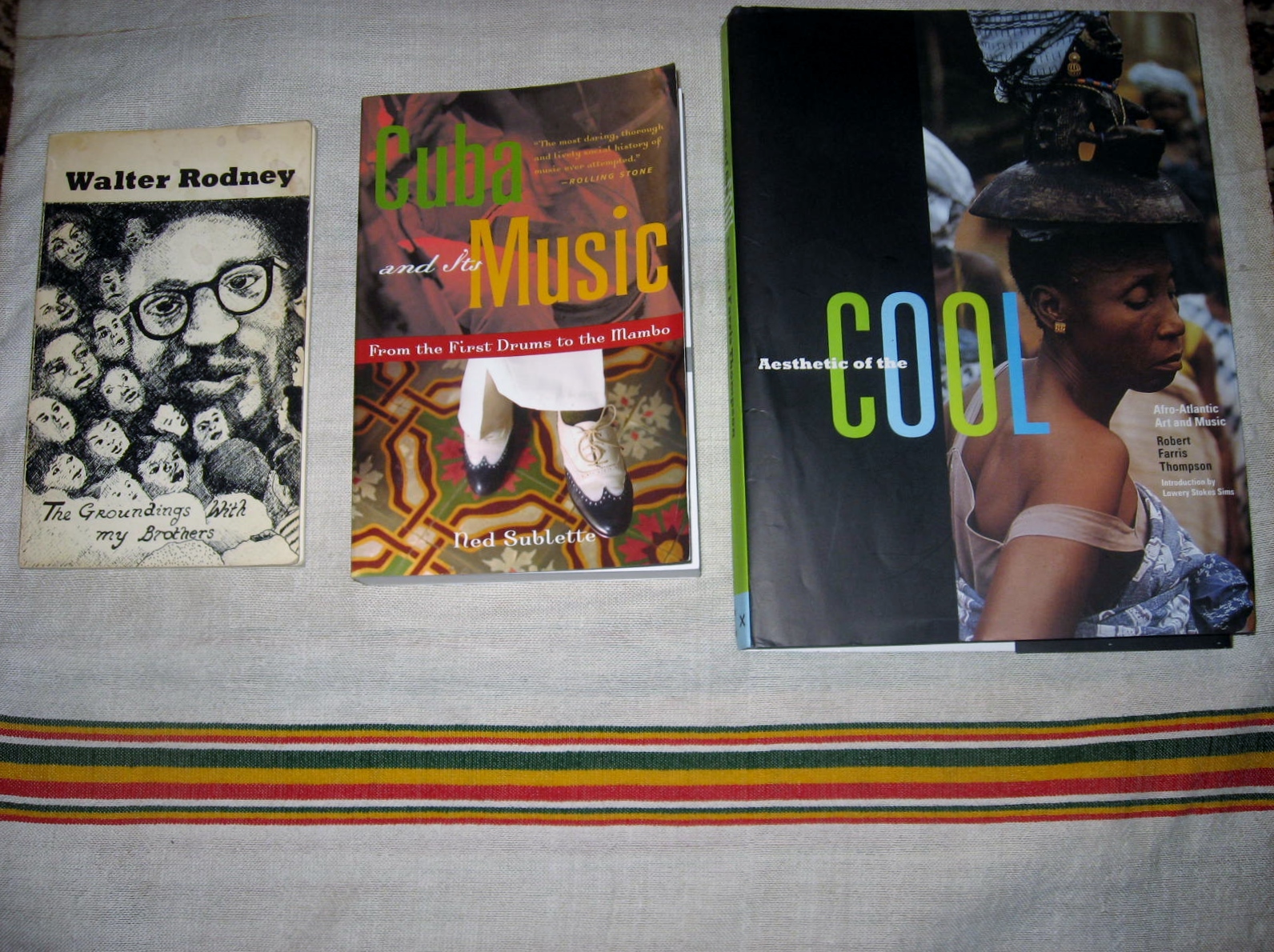
‘The groundings with my brothers’ (1969) is an insightful book by Walter Rodney, that I enjoyed to read. For several reasons. Walter Rodney was a Black Power activist from Guyana, also a scholar, and known as Left-wing/Marxist. Besides that the book, dealing with Walter Rodney’s views in relation to Jamaica (and the wider Caribbean) in and around the 1960s, is in itself in my sphere of interest, actually reading it, it engaged me even more. The book itself was originally written in 1969.

First of all, Rodney’s analyses of broader world politics and White dominance, colonial history and neo-colonial present, at the detriment of the Black and other coloured peoples of the world, are eloquent as well as intelligent. He associates this de facto White Power with Capitalism, which shows his ideological stance, perhaps. In the same vein he applauds Cuba, describing Cuba since 1959 as a place where White Power has been defeated. While there are some arguments to be placed against this, most other analyses by Rodney in the work seemed to me correct, well-informed, and realistic. I also liked his way of expressing and writing. I never felt I was reading a one-sided, ideological hardliner with a vindictive, narrow mind – even common among some self-proclaimed Left-wing or “humanitarian” activists –, but rather a rebellious yet open-minded, intelligent, sensible, and emphatic thinker, with a good sense of humour, making his writings very readable. Rodney is also a good writer in the literary sense; he knows how to conjure images well, for instance.

He points at contacts with Rastafari adherents in Jamaica in this book, respecting them as representative of suffering and rebellious Jamaican Black people, oppressed historically by White Power, and now by Black leaders and politicians also essentially serving this global White Power structure. He points at censored “Black Power” books in Jamaica. Several works were forbidden in Jamaica, not just Malcolm X’s Autobiography.. the same applied to works by Stokeley Carmichael or Eldridge Cleaver. This ban was oddly ordered by the government of a Black prime-minister, Hugh Shearer. Walter Rodney himself, incidentally, was also forbidden entry into Jamaica when he returned to Jamaica (he worked at the University of the West Indies in Kingston, Jamaica), after a trip to Canada, also for spreading such unwelcome Black Power ideas. He refers to his ban to return in this work as well.

WITHIN AFRICA

An insightful and recommendable book, therefore, ‘The groundings with my brothers’. Besides this, parts of the book surprised me pleasantly. Strictly speaking parts of the book can be deemed “departures”, although they remain relevant to the overall theme of Black consciousness and pride of African descent. In one chapter, chapter 4: ‘African history and culture’, Rodney seeks to contradict European claims of Africa as uncivilized as opposed to Europe, as part of a pro-White propaganda, and therefore elaborates on historical evidence of developed civilizations on the African continent, before slavery and Europeans. He relates the history and characteristics of ancient civilizations in Africa: Ethiopian Christianity, Kush, Egypt, but also other ones. This I found interesting, and in a sense original. Not totally original, but quite, and appropriate, I think. Walter Rodney was focussed on both Africa and the Americas, and - before him - Marcus Garvey already connected mentally the parts of the world strongly, Africa being of course the motherland/the roots of Black people in the Americas.

This sometimes took the form, though, of abstract – albeit positive – symbols of the African roots, with not always very detailed studies of different African regions, countries, cultures, and internal differences developed over time, landscapes or other aspects. Even among some Black nationalists such knowledge stayed behind of knowledge of other regions of the world, though this is not always their fault. In a British colony as Jamaican much was taught about Britain and Europe, and less about Africa. Many Black people also often tend to know more about the geography of the place where they actually live (e.g. Jamaica, USA), which to a degree is understandable.

I myself have by now studied and read many scholarly works on Caribbean history, specifically also on people of African descent in the Caribbean, social development etcetera. I have read a lot about slavery and other historical aspects in the Caribbean, also to a lesser degree quite a lot about the same topics in Brazil, Latin America, or the US. I found and find this an interesting theme, and I learned a lot.

There was, however, one “elephant in the room”, as the expression goes, that went not totally unnoticed, but still was ignored too often, I think. I am referring to the African origins. The situation in Africa as it developed before enslaved Africans ended up in the West: not just generally or abstract, but more detailed. Walter Rodney’s more detailed attention to the long history of Africa, and differences within – and similarities throughout - Africa, was therefore refreshing. I found it educational and insightful. Not all was new to me, but some things certainly were, or explained better than what I read/heard before. For instance the difference between the savannah or semi-arid “Western Sudan” regions between Senegambia, through Mali, Guinea, and northern parts of Ghana, Ivory Coast and Nigeria on the one hand, and on the other: the area with tropical rainforests more to the South of this, notably on the coasts of Ghana, Benin (Dahomey), Nigeria, Cameroun, as well as the large Congo region. In these latter dense forest areas, distinct, more isolated and small-scale societies developed, quite logically, than in the more accessible parts. The latter, more Northern-lying parts had more cosmopolitan societies, with more travelling (by horse) and contact possibilities over longer distances, including with Northern Africa. Islam penetrated this part also much more than the more South-lying “forest” parts, like Congo or southern Nigeria for instance. This fact, while logical in a sense, still intrigued me. Mainly because I know – and learned - that enslaved Africans to the West came from both these areas – or border areas between them.

To put it shortly, after having read about and studied what science has up to now found out about the numbers of slaves forcibly brought to the West, their region of origin or at least embarkation in Africa, relative differences etcetera, I think it is time for me now to know more about those regions within Africa beyond this. More specifically, in its relations with surviving African culture in the Americas, a theme which continues to hold my interest as well.

Walter Rodney discusses this African history primarily to point out that Africans should not be ashamed of their roots, as they were not less-civilized than the boastful European colonizers claiming this. ‘The groundings with my brothers’ is not a very extensive work, and is partly a manifesto, so it should be placed in that context.

ORIGINS

I have read other works, though, that have more detailed, and very insightful elaborations on the different parts of Africa where enslaved Africans came from: slaves came from different parts of Africa, depending on time period, colonizer (British, Portuguese, French, Spanish, Dutch etcetera), and even specific colonies or region within these. Portugal had “access” to Angola for instance, colonizing it prior to the development of Brazil. That many of the slaves going to Brazil came from the Angola region, thus comes as no surprise, but also in Brazil African slaves came from a variety of regions. The English, Dutch, French, Spanish, Portuguese and others got their slaves from different parts of Africa. Sometimes slaves from specific African regionsconcentrated in specific areas in the Americas, or time periods.

Rodney for instance mentions famous, influential – if relatively unknown – African kingdoms in both the Western Sudan and coastal regions (Mali, Benin, Kongo, Buganda, as already mentioned Axum/Ethiopia, Egypt a.o.), yet he also states (I cite from the book):

However the majority of Africans lived in small societies and these must also be seriously studied. Sometimes, it is felt that only in large political states one can find civilisation and culture, but this is wrong, and in the great political states of Europe and America today many human values have been destroyed; while even the smallest African village was a place for the development and the protection of the individual. Certain things were outstanding in the African way of life, whether in a small or large society. These distinctive things in the African way of life amount to African culture. Among the principles of African culture the following are to be noted : hospitality, respect (especially to elders), importance of the woman (especially in cases of inheritance), humane treatment of law-breakers, spiritual reflection, common use of the land, constant employment of music (especially drums) and bright colours”. (Rodney, ‘’The groundings with my brothers’, p. 36/37).

Quite a lengthy citation, but I find it crucial and interesting for this essay. I really recommend to read the entire work by Rodney. Written in 1969, these statements were quite ahead of their time, at a time when many Black people in the West knew little about Africa.

CUBAN MUSIC AND NED SUBLETTE

I also quote it to point to one African cultural aspect, studied in another, more recent book I would like to discuss: music. Specifically Cuban music and its African origins. I mean the book ‘Cuba and its music : from the first drums to the Mambo’ (2004), written by Ned Sublette (himself a musician).

I have mentioned this book already on my blog here and there, but here I focus on the attention Sublette gives to ancient African culture before it came with slaves to the West. He places the emphasis on enslaved Africans ending up in Cuba, but compares with other places in the Americas. Moreover, he describes African cultures, including the differences per region within Africa (Western Sudan versus “forest” Africa) Walter Rodney also alluded to. Sublette focuses here on music, which is one of my passions too, and I found it an insightful and good read.

Notably, Sublette (who is from the US) compares (historical) Afro-Cuban music with African-American (Black US) music, noting differences. He explains this partly because of different colonial policies. Drum use was more strictly forbidden for African slaves in Protestant (US, British) slave regimes – seeing it as a way to communicate rebellious messages (justly), while authorities in Cuba were a bit more lenient about continued drum use (in specified organizations and under conditions): drum music could therefore continue and live on in Cuba more, leaving traditional percussive African music relatively more intact among the different African ethnic groups in Cuba (Yoruba, Congo, Calabar a.o.).

This ban on drums is only a part of the explanation of musical differences, Sublette stresses. He also indicates that the region of origins of enslaved Africans ending up in different parts of the Americas played a cultural role. He argues that to what is now the US relatively more slaves came from Western Sudan Africa, what he also calls “griot Africa”, more Islam-influenced, stretching from around Senegambia, through present-day Southern Mali to Northern Nigeria, whereas slaves in Cuba came relatively more from “forest” Africa, the area from around Yorubaland (now Southwest Nigeria and Benin) to Cameroun and further to Bantu-speaking areas, such as the Congo area, down to Angola and Mozambique. According to slave trade figures, he has a point, but simplifies or generalizes it a bit: there were parts of the southern US where quite some slaves came from the “forest” Congo or Igbo (SE Nigeria) areas, but on a general level he seems partly right.

There is an interesting irony here. The Spaniards were shortly before engaging in colonialism - spurred by Columbus’ “discovery” - for a period Islam-influenced and even Islamized (not all, but many local Spaniards converted to Islam in that period). Spanish culture remained Islam-influenced after this (the Christian reconquest), even if outwardly fanatically Catholic. Spanish authorities at one point, however, for religious reasons sought to avoid importing too many slaves “raised with Moors” as it was formulated – i.e. too Islam-influenced (like those from the Mali and Senegambia areas)- , preferring those from “forest” areas further South (present-day South Nigeria, Benin, Congo, Angola). This policy was not always maintained – and of course religious zeal was a cover-up for economic, colonial goals for these Spaniards, as it was for other European colonizers. Nevertheless, it caused that the more percussive “forest African” cultures of the Yoruba, Congo and others – with a bigger emphasis on drums musically/culturally – entered Cuba more, whereas Africans in the US came more from Islam-influenced cultures, with less drums, or polyrhythms, and more string instruments. Like the griots used.

Also this is partly true, but again a bit too simplistic, I opine: looking at musical structures the different parts of Africa still share musical values (revolving around rhythm itself, for instance) – as well as other connected spiritual values – that are found less outside of Africa. In other words: musical principles are shared between the whole of sub-Saharan Africa, in a region as wide as from Southern Mali to Angola and Southern Africa - part of a broader, shared African aesthetic – that neither the Islam nor European colonialism or Christianity could fully replace. Nor slavery, for that matter. Walter Rodney also referred in general terms to these shared African values throughout the continent.

There were different influences within Africa though. Broadly speaking, though, it seems to explain well why some differences exist between more percussive Afro-Cuban music (genres like Son and Rumba) - giving the world well-known, now globalized African-based drum instruments like the Conga and Bongos – and US Black music, such as the Blues, more based on string instruments (and with the Black US folk use of the Banjo and the fiddle). String instruments in Cuba tend to be more often associated with Spain or Moorish culture. Beyond instruments, also the structure differs: Cuban music is based on the “clave” (old Spanish for “key”) as a way to connect several simultaneous rhythms. US music – like in the Western Sudan area – is less polyrhythmic, depending more on “swing”. “Swing” is of course, simply said, playing around the beat and bars, which in a way is also a polyrhythmic tendency. Such “swing” is originally absent in Cuban genres as rumba or blues, now only found in US-influenced mixed styles. Perhaps Afro-Cubans had enough in their music itself to be polyrhythmic (basic rhythm, several “answering” rhythms etcetera) and needed not to “play around” the beats/rhythmically with each instrument. That is also a way you can look at it.

Another aspect Sublette’s distinction seemingly fails to take into account is that drum music in the form of common Djembe’s (goblet-shaped, goat-skinned drums) combined with two-sided large bass drums called “Dunduns”, as well as other less known drums, can be found in this Western Sudan region as well. These tend to be played with more polyrhythmic patterns, and exist besides the “string” and other instruments associated more with the Griot caste (the Djembe tends not to be), in the same region. The Djembe’s origins are associated with the Mali Empire region, stretching from Senegambia to Guinea and South Mali. In an earlier blog post on the Ashiko, I noted that there seems to be no evidence (that I found, at least) of Djembe-like drums (with that shape) transported to the Americas, while other traditional African drums have variants in the Americas (even if under different names). I still wonder why, though it can depend on several historical factors surrounding enslavement, or the Djembe’s own history.

Interesting to read, Sublette’s book, though I find Sublette exaggerates his point at times a bit, and is regarding some aspects deficient. His writings in this 2004 book are however overall definitely interesting, especially also regarding the musical and cultural (and spiritual) differences between main African ethnic groups in Cuba: the Yoruba, the Fon/Dahomey (the Fon also had a large influence of Haitian Vodou, by the way), the Congo, the Calabar and others, which he sketches insightfully. These cultures helped to shape Afro-Cuban music genres, along with Spanish (and a few French) influences. Interesting facts I thus learned (assuming Sublette had good sources), and did not know yet: “Congo” slaves in Cuba more often came from more Northern-lying parts of the Congo region (e.g. what is now D.R. Congo), when compared to those in Brazil (more from what is now Angola). To be sure, Angolan slaves also went to Cuba, historical evidence shows, only apparently relatively less. Also the fact that Yoruba slaves in Cuba, tended to come (mostly) from other parts in Yorubaland than those ending up in Brazil was new for me.

ROBERT FARRIS THOMPSON

A third work I can mention is also one that I referred to already in other blog posts: ‘The aesthetic of the cool : Afro-Atlantic art and music’ (2011), by Robert Farris Thompson, actually a collection of several of Farris Thompson’s writings on African culture and its continuity in Afro-American cultures. He focuses more on the shared characteristics throughout Africa and a shared African aesthetic, part of which he describes as “mystic coolness” as a crucial concept: combining contradictions through transcendence, simply put.

In light of this specific post, it is relevant to note that while Sublette emphasizes the differences between, say, Blues from the US, and Cuban genres like the Rumba and Son, Farris Thompson emphasizes their deeper, cultural similarity. At the same time, however, Farris Thompson pays more attention to what Sublette termed “forest Africa”, especially from the Congo region, also as being foundational for Afro-American cultures, more – he argues – than cultures from e.g. the Western Sudan (Mende-speaking for instance). So he makes a distinction in a way too. Overall, he points at shared characteristics throughout African music, which I think makes sense. Even the most Islamicized ethnic groups or regions in the Western Sudan region (Senegal, and the Hausa for instance) never fully abandoned underlying African cultural principles, tending to develop an own “Africanized” variant of Islam, such as the Marabout (e.g. Baye Fall) movements in the Senegambia and other regions. On the other hand, to be topical, the recent extremist Boko Haram terror in the Hausa area of Northern Nigeria, however points in another, more “Arabophile” or politicized variant of Islamic fundamentalism, away from African values.

Justly, Farris Thompson describes the entire sub-Saharan African musical culture as “percussive”. Also the Ethiopian Orthodox Christian tradition includes drums and rhythm, for example. Non-drum or –percussion instruments, like string or other instruments, tend to be played rhythmically as well in sub-Saharan Africa, differentiating it from European musical cultures (more based on harmony and chords), or Asian musical cultures, according to some more centered on “melody”. A perhaps useful, yet partly simplistic distinction: music from all cultures know the three basic elements of harmony, melody, and rhythm..it is a just matter of relative emphasis.

Walter Rodney pointed out in general terms, in the earlier citation, that “the constant employment of music (especially drums)” is important in both larger and smaller African societies. Interestingly, Farris Thompson, from arguably another entry point (he is a White scholar, with no explicit social or activist agenda), elaborates on what this importance of music in Africa in detail consists of, what values are behind it. Sublette, more a musician than a scholar, is more detailed in a geographical sense, in the said book, focussing on Cuban musical history, with some wider comparisons.

These three people thus all write (or: wrote) on Africa and its culture, from different perspectives. All three are not necessarily always right in every single fact or analysis, though seem overall correct and seem to have studied what they make public, and checked the veracity. Such mistakes in Walter Rodney’s manifesto can be forgiven more easily, in my opinion, than works presented as scholarly by White, privileged scholars assuming authority. This is the irony: that someone shows he is really intelligent when he admits ignorance on certain matters, and acknowledges a need to learn more.

JAMAICA

Finally, I return to Jamaica, also central in Walter Rodney’s ‘The groundings with my brothers’. Rodney describes the Jamaican situation in and prior to 1969 mainly sociopolitically – of course. The same applies to the Rastafari movement he mentions: this movement stems certainly from Black Power ideas, and from Marcus Garvey’s ideas on Black pride and resistance, social aspects Walter Rodney relates to. Rastafari, however, also has spiritual and cultural aspects that cannot be caught by political ideologies or “isms”, commonly eschewed by most Rastas.

This, and the studies I mentioned before this in this post, begs the following question: is Afro-Jamaican culture more influenced by “griot/Western Sudan” Africa, or more by “forest” Africa? Several historical aspects must be analyzed when answering this question. Jamaica was a British colony, and drums tended to be banned more strictly by the British, when compared to e.g. the Spanish in Cuba. Overall, historical evidence generally confirms this, although also among Jamaican planters there were some differences or exceptional cases of leniency where drums were (under conditions) allowed to be played by slaves in certain periods.

Another aspect is the African origin of the slaves in Jamaica. An interesting theme in and by itself. Historical records show that about 40% (estimates differ a bit per historian) probably came from the Gold Coast area (now Ghana) speaking mostly Akan or related languages. About 25% probably from the Igbo area around what is now Southeastern Nigeria. Many slaves in Jamaica spoke Igbo. Also about 25% came from the Congo region, speaking Bantu languages like Kikongo, Benguela and other. The remaining (about) 15% came from other areas, such as the Senegambia, or Dahomey region. Yoruba were present in Jamaica too, but relatively less than what is known for Cuba.

In conclusion, most enslaved Africans in Jamaica came from what Sublette called “forest Africa”, though parts of Ghana are a border area with the Western Sudan. Most of Ghana was however never Islamicized, even if the Akan and Ashanti at times adopted some aspects from Islamic cultures to the North (yet not the religious complex). Present-day Ghana is nominally mostly Christian, with a minority of about 17% Muslims, mostly living in the North of Ghana (North of Akan-/Twi-speakers).

Polyrhythmic traditions, one can thus conclude from this, these Africans from forest areas mostly brought to Jamaica. Yet the British colonial authorities and most planters in Jamaica forbade using drums. Polyrhythmic drumming could however live on secretly in cases, and among the Maroon settlements of free, escaped slaves in remote areas, as well as among other groups, such as indentured Africans after formal slavery.

This influenced spiritual/religious music in Jamaica, like Kumina, Burru, Pocamania, also outside the Maroon areas. It partly also shaped popular music, even those genres that developed under Black US influences in urban areas: the genres Ska (appearing around 1960), and Rocksteady, and Reggae. The latter two in turn partly derived from Ska in the later 1960s. Common knowledge holds that Ska was a Jamaicanized version of R&B (especially the New Orleans variant) Jamaicans heard on radios and in sound systems. This “Jamaicanization” includes own folk, percussive traditions, naturally, making it thus more polyrhythmic. The Africa-centered Rastafari movement later would influence Jamaican popular music toward a more African musical aesthetic, including in percussive patterns. Kete and other drums used in Rastafari drumming and chanting gatherings - called Nyabinghi - influenced Reggae music in its drumming and rhythm. Rastafari (a social and spiritual movement) and Reggae (a “secular” Afro-Jamaican popular music genre) remain separate things, but keep influencing each other.

Finally, in its formative stages around 1960, Ska was shaped by several musicians before this playing jazz, Mento or other Jamaican folk styles, as well as Cuban-influenced music. Some of these early Ska musicians (of the Skatalites band) were even born in Cuba, such as Laurel Aitken, Roland Alphonso and Rico Rodriguez, mostly born from Jamaican parents (or at least one of them) migrating to Cuba for work in a period. These Afro-Cuban influences added in some way also to a developing polyrhythmic feel in Jamaican popular music since the 1960s, or to the more rural Mento genre, found more in rural Jamaica before this.

If there is any sense to Ned Sublette’s distinction (a bit too sharp in my opinion, I already said) in his book, it can be concluded that Jamaica is, musically, somewhere “in-between” the griot/Western Sudan” tradition, like the Blues culture of the Black US, and the “forest African”, more polyrhythmic and percussive tradition, also found in Afro-Cuban genres. Perhaps the same "in-betweenness" applies to other parts of the Caribbean region as well.

Most significant, however, beyond all these relative differences, is that this shows that a broader African culture and identity has survived in the Americas, in spite of deracination, attempts of cultural annihilation, dehumanization, oppression, and extreme hardships. Of course this is also rebellion and resistance.

woensdag 2 december 2015

Black emancipatory movements : documentaries

Recently (27 November 2015) I saw the documentary ‘The Black Panthers: vanguard of the revolution’, as part of the International Documentary Festival Amsterdam (IDFA) of 2015.

The documentary in itself was good. I found it informative in a broad way. Good documentaries, I find, ultimately answer questions while at the same time raising them. Perhaps it is better to say “arouse interest”, because there is not much use in raising questions if you do not answer them.

HISTORY

The Black Panther Party was founded by Huey Newton and Bobby Seale in 1966 in Oakland, California, and represented one of the several groups and movements in the US, part of Black Power: resisting against White structural racism, oppression and racial inequality. These movements came especially to the fore in the 1960s, although Marcus Garvey’s movement and large organization, the U.N.I.A. (Universal Negro Improvement Association), set up in the US since 1917, pioneered Black Power much earlier already.

The specific aims of the Black Panther Party were quite practical. There were connections of the founding members with other Black movements, and founding members were inspired by Malcolm X. Yet, at first the Black Panther Party used the “right to bear arms” in US law to defend themselves, and specifically to patrol against police brutality against Blacks in Oakland. In time, of course, this goal broadened to addressing all social injustices and oppression with armed response, underpinned by a socialist, Marxist philosophy of anti-capitalism. Overthrowing the US capitalist government became one of its stated goals. The Black Panther Party functioned and existed from 1966 to 1982. During this time there came more and more internal conflicts, and not least the harsh repression by the FBI and US government (and police forces). Edgar B. Hoover of the FBI had a cynical role in this, as he had toward other Black Power movements (including earlier in Garvey’s).

The documentary portrayed this turbulent history well, including interesting images and historical film fragments, and interviews with members in this period. I personally got more insight in the Black Panthers’ history; I knew much less about the Black Panthers than about Marcus Garvey and his movement – which I studied much more -, but also less than about the civil rights movement, or the Nation of Islam. A welcome addition to my knowledge, you can say. As racially motivated police brutality in the US persists today and has become more of an issue recently – i.e. reached more media – the said origins of the Black Panther party is relevant again.

The documentary stayed superficial in certain regards, perhaps inevitably, but still a pity. The very core was explained very good though, and especially the repression by the US government and FBI was worked out well. Other parts less. What inspired the founders (e.g. other Black leaders and ideas) got scant attention, as did the aftermath (what and who the Black Panthers eventually themselves inspired).

The Black Panthers were not religiously inspired, looking mainly at social conditions. They were also more activist than “cultural”, you might say. They were, however, ideologically inspired by Marxism in their goal of revolution. Black upliftment was, beyond this, their main goal, though it intertwined with Marxist, anti-capitalist goals. Of course “race” and “class” intersect, and it can be reasonably argued that the Western capitalist system is by definition oppressive and exploitative of Black people. Still, as Marcus Garvey already noted, the mixing of race and class interests can obfuscate deeper race-based inequalities.

OTHER BLACK POWER MOVEMENTS

I note that a main difference between the Black Panthers and other Black movements, is the Black Panthers’ lack of focus on either the cultural and spiritual aspects of Black people. The Nation of Islam is of course more religious, though the choice of the Islam as source of Black/African identity can be deemed inappropriate from a historical point of view. Long an Arab-led religion, Islam for a long time discriminated against Black Africans, and enslaved them over time in great numbers. It came from outside of Africa, did not develop organically within it. To this day, lighter, Arab looks (as the ones who brought the Islam) are more favoured in countries like Egypt and Sudan, whereas African traits are often culturally despised.

On the other hand, Martin Luther King’s Protestant branch of Christianity was likewise non-African in essence (though Christianity in itself was longer present in Ethiopia than in Europe).

The Nation of Islam (NOI) took in fact a distance from Africa, the ancestral continent of Black people, among other things by abandoning the goal of repatriation to the motherland, unlike the earlier Marcus Garvey movement. Like the Black Panthers, the NOI chose to focus on US conditions and contexts, whereas Garvey kept thinking international and geopolitical: with the African continent as crucial for both identity and upliftment.

RASTAFARI

It is this last aspect that continues in the largely Marcus Garvey-inspired Rastafari movement, which arose in Jamaica (where Garvey was from), since the 1930s. Jamaican poet and intellectual Mutabaruka described the Rastafari movement as a “Black Power movement with a theological nucleus”. That “nucleus” being the worshipping and adhering of Haile Selassie, former Emperor of Ethiopia, following Garvey’s prophecies of a redeeming African King that would be crowned. Rastafari developed along with this also other, own spiritual ideas, that – like other spiritual ideas – gave people meaning and support in their lives.

Some atheists, nonbelievers – or believers in other faiths - criticize such spiritual/theological ideas as irrational or escapist. This is what I call “opportunist arguments”. Why are such ideas more irrational than supernatural ideas like those of a higher being – God - somewhere in the sky (apart from man kind), the notion of – or rather: “belief in” - a heaven after death, the Bible as true and holy, the Pope as God’s representative on Earth, or the worship of Jesus as son of God (with little “hard evidence” of his actual existence as historic figure)?

Besides this, they miss the point. The interesting thing about Rastafari in relation to other spiritual/religious movements - but also in relation to other Black Power movements - is that it centers on and upholds Africa in hailing and worshipping Haile Selassie, and by upholding Marcus Garvey. Also, by still clinging to the goal of, if often eventual, repatriation to the motherland Africa. The Nation of Islam does not do this as much, focussing on the US context, though it recognizes the African origins of Black Americans. Also other movements, focussed more on local events, combined often with for instance localized (Black US) forms of Christianity.

Yet, the local and practical is real life, you might say. Indeed, in the documentary it became clear that the Black Panthers were not really “culturally nationalist”, nor spiritual, in that sense, but were involved in (effective) social work and aid for Black people, including improved housing, employment, economic improvement, getting out of poverty etcetera, as part of its programme. Certainly recommendable and praiseworthy. Its focus on Marxism, and Black Power, however, made achieving such goals impossible in the White, Capitalist-dominated US. Hence the repression as detailed in the documentary.

It can be argued that Communism is also foreign to Black people. Marcus Garvey called Communism (something along the lines of) “a White man’s solution to problems created by the White man”. He seemed to favour capitalist methods. Later “anti-capitalism” as it came to the fore in Rastafari did not take the form of Communism, but rather of natural living and self-sufficiency on a small scale (Garvey pleaded for self-sufficiency, but on a large scale).

AFRICA’S ROLE

It seems to me sensible that “racial pride”, and self-respect and self-love of Black people, cannot be separated by the continent of origins, Africa. It is the most appropriate source of identity. Certainly, throughout the Americas, African-derived religions like Vodou, Santería, Winti, and Candomblé celebrate the African heritage culturally, but not in a broader political or socially critical way. While members of Vodou-like groups tend to mutually aid one another, it is not a broader, comprehensive social, activist response to social depravation and poverty of Black people in societies and nations. They tend to be solely spiritual, which of course is valuable and supportive for people in and by themselves.

I find it therefore unfortunate that when such comprehensive, more activist Black Power movements did develop, notably in the US, the African cultural heritage was more or less abandoned, especially after Garvey. It is true, that individually many African-Americans focussed culturally on Africa, retraced their origins, adopted traditional African clothing, food ways, or other African cultural customs (wearing the dashiki, African drums), especially also in music. This is however mostly fragmented and not concerted. The geographical focus remains on the US or the Americas.

Marcus Garvey said that “a tree without good roots cannot bear good fruit”, as well as “if you don’t know your past, you don’t know your future”. He promoted self-love and love for the Black people’s race and African origins. Rastafari’s distinction among other Black Power movements pays homage to that philosophy, by focussing on Africa. Crucially: not just as something of the past, but also of the present and future.

Rastafari hereby remains a source to draw on, harassed by “Babylon system” (as Rastas call Western oppressive forces), but loose enough to avoid being “squashed” by it. That’s in a sense the power of spirituality that purely materialist (capitalist, Marxist) or activist movements ultimately lack.

BLACK PANTHERS AND CUBA

Back to the Black Panthers: Wikipedia and other sources had much more detailed information on Black Panther founders Huey Newton, Bobby Seale, and later prominent member Eldridge Cleaver, when compared to the documentary. Both Newton and Cleaver found in certain periods exile in Castro’s Communist Cuba. Also Malcolm X showed in words respect for Fidel Castro.

My own study of and experience in Cuba (where I also have been several times between 2001 and 2006) taught me that there were policies in Cuba under Fidel Castro that advanced large parts of the Afro-Cubans. This limited racial inequalities in some ways, and improved – albeit with differing degrees of success - food security for poor Cubans (to which most Afro-Cubans belonged), as well as housing. That is in itself positive. At the same time, like all Cubans, Afro-Cubans were kept very “dependent” in the Communist police state, with a dictatorship, censorship, and moreover, a subtle racial inequality favouring white Cubans, that still persisted, and persists to this day. The Castro brothers look phenotypically White (and are mainly of Spanish – Galician/Canarian descent), and many others in high Party circles are still disproportionately White as well. So racism and discrimination against Afro-Cubans persists in present-day Communist Cuba, also in specific (“egalitarian”?) Communist activities as such.

CARLOS MOORE

A writer who gave much attention to this continuing racism in Communist Cuba since the 1959 Revolution in Cuba, and in the course of Castro’s reign, is the Cuban-born Carlos Moore. He is Black and his parents were migrants from the British Caribbean (Jamaica a.o.), but he was born in Camaguey, Cuba in 1942.

As happened more often, he first sympathized with what the Revolution promised to improve for poor and Black people, yet during his participation he noted that racism and discrimination against Afro-Cubans persisted. He even argued that this was supported by Castro’s “integrationist” policies. After incarceration, he fled to France in the 1960s, and later settled in Brazil. In his book ‘Castro, the Blacks, and Africa’, from 1988, Moore elaborates his critique of Fidel Castro’s use of the “race” issue in his foreign policy. Mostly, he regards this pro-Black stance of Castro more as co-optation and opportunistic powerplay, rather than as a totally sincere commitment. This is a serious accusation, of course, going against the grain of the idolizing of Fidel Castro by many of the “fashionable Left”, even some Black people. Moore spoke with Malcolm X, and even the latter said that he sadly did realize that even in Communist Cuba White Cubans did not let Black Cubans get to the top. Yet, Malcolm X despite this still thought strategically about how to use Castro’s stated policies and aid, such as in Africa, truly in the favour of Africans and Blacks. Use Castro before he uses us as Blacks, so to speak..

On the exile of Black Panther leaders Elridge Cleaver and Huey Newton in Cuba, Moore gives some attention in the mentioned book, though not much. He points out that Cleaver also objected to the racism in Cuba when he lived there (he settled there in late 1968), and like Newton he over time fell out of favour with the Castro regime (official reason: ties with the CIA though Black Panther members), and went to another country after that (Cleaver went to Algeria). Politics is a vicious game.

Apparently the “white man’s solution” Communism can be as oppressive and exclusionary toward Blacks as Capitalist systems.

BURKINA FASO

Another documentary I saw during the International Documentary Festival Amsterdam (IDFA) of 2015 related to one specific African country, Burkina Faso. It was called “The siren of Faso Fani‘ (2014), and was set in the city of Koudougou in western Burkina Faso, where a locally maintained textile company was a period successful, resulting in wealth in Koudougou (the third city in size of the country), and economic improvement. All that was based on local products and skills. One must realize the political context, then. Thomas Sankara, the progressive, Marxist-inspired president from 1983 to 1987, set in motion policies independent from former colonizer France, the IMF, and the World Bank (the Western Capitalist world, so to speak), by nationalizing industries. Koudougou, with the large Faso Fani factory, became the textile capital of Burkina Faso.

How this industry waned in Koudougou was the subject of the documentary. After the coup against Sankara, and his murder in 1987 - he had local middle-class and foreign interests as enemies - the country in time came in a recession. In this context the IMF and World Bank supplied their well-known (notorious) “aid/loans under conditions”, to release Burkina Faso from a debt. Even a European country, like Greece, knows this burden now, like many developing countries did and do. The textile factory in Faso Fani came also under foreign control and was “modernized”: most workers in it suddenly lost their job. Many among these were in an advanced age, and became poor and in insecure conditions. Several went back to rural towns. What came across well in the documentary, I thought, was the sensed importance of “job security” for the workers. United workers of Faso Fani even offered to work under lower wages just to keep their job. The bosses however already had decided, and did not need the workers, as they could produce more cheaply with modern machines. They did not care about the future of these workers.

The example of self-sufficiency by Faso Fani (before it all changed) admittedly bore a Marxist mark, yet the textile factory then seemed to function and provided income and security in Koudougou. Sankara imitated some practices from Cuba, but I do not know whether the rigid Communist “low maximum wages” (as in Cuba) was also adopted, or that workers could earn more money. Sankara can either way be praised for several beneficial developments in Burkina Faso he set in motion, even if not long in power, regarding women’s emancipation and equality, for instance. Yet, as said, the IMF, dominated by Western Capitalist countries “took over”, and changed the course, benefitting their own interests.

This historically grown worldwide inequality is likewise a result from the colonial history, and European (later also US) colonial dominance. This hampers the self-sufficiency of developing countries, and hinders a true independence that also Marcus Garvey promoted for Africa.

Other documentaries at the IDFA had as topic (as documentaries in other years) “other” types of African dependence on Europe and the West, namely through foreign aid and international cooperation (poverty alleviation). While seemingly less “interested” or egocentric than the IMF and such, it is argued that such foreign aid also keeps Africa dependent.

All this shows the significance of an international Black Power perspective (like Garvey’s and Rastafari’s) in fighting race-based inequalities, preferable over a too limited, local one, as the Black Panther Party had (especially in its early stage). The local should on the other hand not be ignored entirely, of course.

BLACKFACE

Another documentary that I very recently saw also deals with race and, well, Black people. It was not as part of some festival, and one did not need to buy a ticket. It was a short documentary made public on the website of CNN (cnn.com) since Monday, the 30th of November of 2015. It is called ‘Blackface’, and is made by African American filmmaker Roger Ross Williams. The documentary is about a Dutch holiday tradition known as Sinterklaas, a “carnivalesque”, bishop-type figure giving presents to children each 5th of December. This festivity includes a dressed-up “Blackface” figure called Zwarte Piet (“Black Pete”), being “helpers” (servants) of this Sinterklaas.

This Blackface portrayal of Black people is stereotypical and racist. The connotations with slavery are evident. As Blackface (minstrel) theatre stereotyping Black people, have been discredited in other countries like the US and Britain (though such racist “minstrel” shows were still on TV only some decades ago in Britain), the maker Williams was shocked to still find such blatant racism in a country he thought to be relatively progressive. Williams investigates this further in this documentary, speaking with people against it and defending it.

See it here: http://edition.cnn.com/videos/tv/2015/11/25/digital-shorts-blackface-dutch-holiday-roger-ross-williams-orig.cnn/video/playlists/digital-short-films-t1-for-specials-page/

As I live in the Netherlands, this was hardly new to me. The critique against this racist caricature has been formulated before by Black Dutch activists like Quincy Gario and others, in recent years also through the larger Dutch mass media. What is new is the international perspective by Williams (who lives in the Netherlands with a Dutch man, by the way), in English, and on the CNN website. Maybe this international exposure brings about change.

In the context of this essay of mine, it can be seen as an objection against a local practice of racism, like the Black Panthers objected against police brutality and profiling in at first Oakland, California. It deals however more with “image” and culture, in this case a specific holiday tradition. In comparison to worldwide racial inequality, actual brutality and violence, and racist power structures, it may seem a bit trivial.

Yet.. what is trivial? When one looks at what this tradition represents and symbolizes, it is in fact quite serious. Essentially, such stereotypes degrade and “dehumanize” Black people, portraying them as half-witted slaves. This is a remnant of the likewise “dehumanizing” colonial past, including slavery. Also the Netherlands was of course as a colonial power once involved in slavery of Africans. The Netherlands further has quite some “Black” inhabitants, that understandably feel offended by this tradition of Blackface, and even in a sense excluded from the Dutch nation, which apparently is only defined as White. The “Black Pete” figures at least seem to confirm this, not aided by the fact that this tradition is hardly adapted, even after Black protests. The fact that Black people, including children, were and are teased (better: “bullied”) by some Dutch people calling them “Black Pete”, shows that the tradition is not that innocent. It furthermore, as said, alludes to stereotypes of Black people from the slavery era.

This same history of slavery kept Black people back up to this day, and which - along with wider colonialism - perpetuates in the racial inequality we find in the present-day world: Africa for instance still being economically largely dependent on the West, as the example of Burkina Faso showed. Perpetuating such stereotypes is therefore lamentable, especially as part of a party for children. At the very least, it is insensitive. In this sense, this local issue surely relates to international racial inequality and racism.

CONCLUSION

All these movements I discussed in the above text – either social, activist, cultural, or spiritual - are responses. Much human behaviour is of course, but in these cases they consist of responses of Black people to (historical and present) “dehumanization” and discrimination. The goals being emancipation, justice, and redemption. Goals consist further of regaining humanity, equality, and self-love, in order to achieve mental well-being, essentially, through (regaining) confidence in self. In this, identity, spirituality, ideals, and psychology somehow come together, as part of a very human quest for both meaning and harmony. Also, the need to belong to a larger group of like-minded people is all too human.

Some of these movements over time received increasingly (sincere) sympathy or even support from non-Black people. Perhaps inevitable in today’s world of globalized culture and media. The Black Panthers, in its time, also got some liberal White professed sympathizers who considered their cause to be just, for instance.

This understandably met and meets with mistrust among some Black people in these movements. Especially, because it is not always clear whether it is just that, sincere sympathy and support (beyond race), or whether it is rather “co-optation” by more powerful groups in society, otherwise in a position to “switch” back at any time to their more privileged, comfortable lives. If the latter is not the case, and e.g. White people sincerely feel empathy and also find meaning in their lives by joining or supporting such movements.. if they, as part of this, truly try to connect with and understand these Black people and Black (and African!) history, I think it only can be seen as positive.