Posts tonen met het label Walter Rodney. Alle posts tonen

maandag 1 juli 2024

Europe underdeveloped Africa

In an earlier post from 2016, I already discussed a work by Guyanese scholar Walter Rodney, notably his The Groundings With My Brothers (1969). In this book he combined a Black Power and a Marxist perspective, and drew connections with the also rebellious Rastafari movement in Jamaica. He worked in Jamaica at the UWI (University of the West Indies), but came in conflict with Jamaican authorities.

I chose in that post to highlight what he wrote about the African continent and its culture, because I could connect that to other works about music and culture I read, in line with my activities as percussion player. My focus was cultural. True, more joyous a theme, than usually politics or economics: culture we “want”, economy we “must”, I always say.. Though I notice “political animals” among humans exist, who actually enjoy political games and their study and analysis: I am not one of those. Still I think it’s good to study such “cold” themes (colonialism, politics, economics), to understand the current world I live in too.

The best-known work of Walter Rodney has indeed a more political-economical theme, which he wrote a few years later than Groundings With My Brothers, when living in Africa, working as scholar in Dar Es Salaam, Tanzania (the scholar and Black Power activist Rodney had an eventful life, eventually returning to Guyana, where he was murdered by state forces in 1980): this book was ‘How Europe Underdeveloped Africa’, first published in 1972, and I recently could read it. You guessed it: this post is more or less my review and opinion about it.

First and foremost, I conclude that How Europe Underdeveloped Africa was a “good read” (I like Rodney’s clear, attractive, at the same time somewhat humorous writing style), and to take it a step further, also a “necessary read”, a “must read”. The latter for myself, but broader for all people claiming to be Black Power - or Rastafari- adherents. Broader still, for all – what in French are called “tiersmondistes” (“Third World-ists”): mostly Left-wing, multicultural-minded Europeans with a postcolonial guilt complex, but mostly well-intending. I even argue that this book is recommendable for all people (irrespective of ideological leanings) to learn about colonial history and Africa – and therefore the world - , even though in my bitter experience closed minds (even if proved mistaken) are not easily opened, and hard hearts not easily softened..

In my personal past (also professionally), I have already studied colonial and slavery history, so not all was new to me, but professionally I was focused on the Americas, less on colonial developments in Africa. Walter Rodney’s book is precisely about that. The title, How Europe Underdeveloped Africa, is rather summarizing or self-explanatory, and indeed “to the point”.

MARXIST

It is good to point out that Walter Rodney had/has a certain Marxist perspective, and definitely anti-capitalist. His focus is – at the same time – on modernization and progress. He sees state socialism as preferred direction, differing in that from anarchists, as well as from more “return to nature” and self-sufficiency answers of other anti-capitalists. Most Rastafari (though there are internal differences) tend to be the latter type of anti-capitalists, arguing that “isms” and “schisms” (capitalism, socialism, whatever) are Western, or: "Babylonian", schemes, systems to dehumanize people, in a totalitarian manner.

History has – in hindsight – proven the Rastafari movement more right than Rodney’s (albeit relatively open-minded) Marxist ideas. Capitalism is exploitation – very simply put – by capital- and means-owners, resulting in lacking freedom and dependency of the majority of the working populations. The Communist regimes that arose, however, such as the former USSR, the Eastern Bloc, now still China, Vietnam, North Korea, and Cuba, are not known as “free societies” for their populations, and not just in biased Western (“capitalist”) propaganda. Personally, I have most experience in Cuba under Fidel Castro. I have visited it several times, befriended Cubans, and speak Spanish.

Besides personal experiences some might have, also what we hear through media about Chinese repressive totalitarian policies restricting and controlling people, the treatment of minorities in China, repression in Tibet, etcetera, may put doubt in heads of even the staunchest (neo)Marxist or Communist apologist, about whether what’s called “real existing communism” actually is a success “for the people”. Older Eastern Europeans I spoke to (i.e. old enough to remember Communism before 1990) were neither positive about the restrictive Communist societies, even those with more or less socialist anti-capitalist ideas themselves. Only Croatian and Serbian people I spoke with, had some positive memories of Communism, but Yugoslavia had a mild, open variant of it (even allowing free international travel) under Tito (who for that reason came into conflict with the much stricter Stalin: they say Stalin even tried to get Tito killed).

HISTORICAL MATERIALISM

Be that as it may, Rodney’s critique of capitalism-driven colonialism in Africa by European powers, the main theme of How Europe Underdeveloped Africa, seems very sensible to me, the history well-explained, using the proven, in itself valuable method of “historical materialism”. This last method is – ideally – a way of letting history speak for itself, and therefore can exclude many biases and hidden interests, cloaked falsely in scientific jargon. I appreciate that about it. Later (e.g. in dictatorial Communist regimes) historical materialism as method also got polluted with propaganda and biases, including simplistic, self-interested distortions.

Rodney is too intelligent and open-minded for the latter propaganda nonsense, rendering more neutral historical accounts, very engagingly told, of how colonialism by European powers took place in Africa, and its effects.

These negative, halting effects (overall: underdevelopment) of Africa stem, he insists, from capitalism’s inherent exploitative base, but not just that. Racism and earlier colonialism also played important roles in shaping policies in Africa, he also shows.

This book, thus, deals with this whole process, from early colonialism, and to the infamous Berlin Conference (1884/85), during which European countries subdivided Africa (further) among themselves. Africa was then largely colonized, until independence struggles gained some success since the 1950s and after.

CAPITALIST MODES

A period of less than a century, this African colonization since the Late 19-th c., but with intense economic changes, and what can be called “capitalist strengthening” in Europe itself through imperial expansion. It followed on periods of mercantilism and (earlier) British colonialism and slavery eventually financing the First industrial Revolution in Britain (Late 18th-Early 19th c.), in turn normalizing “capitalist modes of production” as Karl Marx called it, characterized by private ownership of means of production and wage labour.

He goes on to show - with many telling examples -, how all economic policies or “investments” by the European colonizers of Africa since the later 19th c., were self-interested and exploitative, even harsher than exploitation of capitalist societies in Europe itself: lower wages (relatively) for African labourers in set-up industries, only allowing a passive role as consumers of (European-made) products.. In short: an even more intense cynicism and inequality than wage labourers already faced in Europe, with not even the “modernizing” gains and opportunities that capitalism did in theory produce (despite its exploitative premise) for European economies and even workers (economic individualism).

Foreign investments meant mostly foreign dependency for Africans - Rodney summarizes these policies as "growth without development", based on exploitation for European interests, with no real long-term benefits for Africans. Regarding agriculture, it made "monoculture" dominant in African colonies, e.g.: Gold Coast centered on cocoa, Dahomey (now Benin) on palm, Uganda on cotton, etcetera. This was forced on these colonies for European demands. To quote directly from the book: "Diversified agriculture was within the African tradition. Monoculture was a colonialist invention". Also this had a lasting negative influence.

Alongside this racist “thread” of exploitation, there were of course differences within Africa, dependent on regions, as well as colonizers. Britain, France, and Germany modernized and industrialized (and became “democracies”) earlier, adapting colonial goals to human advancement, including modern patronizing philosophies of (supposed, fake) inclusion, and the “white man’s burden”, aimed (supposedly) at helping Africa and Africans to develop and modernize. Rodney convincingly shows that this was largely hypocrisy.

The tone and indirectness differed from what he calls, quite justly, then more “backward” capitalist nations exploiting Africa, notably Portugal under dictator Salazar (with a Fascist-like ideology), and (though with only small colonies in Africa) Spain under Franco, Italy under Mussolini, but also – of course – the Apartheid regime in South Africa. These did not “sugar coat”, and directly stated the preferred racial inequality and racist presumptions, reminding of equally candid Nazi-examples, especially the White regime in South Africa. Similar harsh exploitation and direct statements on African inferiority were found in Portuguese colonies, albeit mixed with patronizing Catholic missionary goals for Africans, as variants of the “white man’s burden”, hiding harsh exploitation and self-interest behind seeming benevolence and aid.

FEUDALISM

Interesting is also how Africa was developing – or would have developed – before/without European invasions and intrusions. Rodney treats this too in the earlier part of this book, pointing at “organically” developing feudalism in parts of Africa, as societies became more large-scale, hierarchical, and complex (less primitive). Several African states and nations did not need Europe for that, this modernization seemed to develop organically, although the Islamic/Arab world (also foreign, after all) influenced it in some areas. This was a learning experience for me, especially the word “feudalism” and “feudal”. I knew what capitalism and colonialism was, but “feudalism” I had to study a bit more – to define it well for myself - , as a stage in human development.

It turns out that (as stated on Wikipedia) feudalism is: “Broadly defined, .. a way of structuring society around relationships derived from the holding of land in exchange for service or labour”. Of course, this dependency on nobility and “lords” owning land can be seen as serfdom of the masses. Karl Marx said that capitalism in theory enabled these masses the freedom to choose their employer, but in reality did not improve much for these masses, just bringing different, more confusing dimensions to dependency and exploitation. Centralized state/monarchy power and administration usually meant the decline of (inherently regional/local) feudalism.

According to Wikipedia, feudalism flourished in (mainly) Europe between the 9th and 15th c., not coincidentally before Columbus and the start of European colonialism, requiring centralized monarchies. Parts of Europe maintained some feudal aspects (Russia, Eastern Europe), but even pockets in Western Europe (including the South of Spain, from where Columbus sailed, ironically enough), even persisting partly as Spain was colonizing the Americas.

What we now know as “capitalism” thus followed – and came forth out of! – colonialism, especially as more developed societies as of Britain and the Netherlands began colonizing too, investing colonial gains with more foresight in their economies, starting the Industrial Revolution. Some see a link between the Protestant ethic and the rise of capitalism (like in Islam still, Catholicism then forbade “interest” on loans, Protestantism allowed it). Spanish and Portuguese colonizers- or “conquerors” as they were called - wasted a lot of those gains on “stupid” luxuries (palaces in Lisbon, Barcelona, or Seville, or even rural areas), or on limitedly successful agricultural experiments.

Capitalism was fully developed, though, when European powers started to colonize Africa mostly in a later stage in history (19th c.). This colonialism in Africa was therefore clearly capitalist (mercenary/exploitative) in nature, and Rodney – as self-declared Marxist – criticized this, but with an open mind. Of course, he was also critical of inequality or injustice in earlier or other systems (feudalism, but also primitive, closed communities with no individual freedoms), showing his open mind and true interest in humane justice. I respect that.

INDIVIDUALISM

Some economic scholars find the term “capitalism” a misnomer, preferring instead to call it “economic individualism”. Walter Rodney would not agree, and gives some good arguments for it in this book, through various examples. While he in itself appreciates that “individualism” as moral stance or ideology can have a “liberating” value in too collectivistic, strict societies, Rodney indicates how it was soon corrupted by narrow, “bourgeois” owners and elite powers - read: capitalists -, simply only claiming it for themselves (individualism became egoism) and their rights to exploit, but preferring the masses and wage labourers dependent on them.

This inequality was the case in Europe and the Western World, but even stronger and worse in Africa, during this colonial period, and the postcolonial history after it. Rodney’s book does an excellent job in showing this, as economic freedoms or progress for local Africans were deliberately excluded and discouraged from any colonial investments of European powers in Africa. "Growth without development".

Racial prejudice - or persisting assumptions of African inferiority - played a role in this, while further the proven colonial strategy of divide-and-conquer proved useful, in various ways. This could be within families and communities (European colonialism diminished the importance of female labour, relative to male “breadwinners”), and between different ethnic groups within colonies, sharpening tensions to avoid unity against the European invaders.

LEGACY

This relatively short “colonizing period” (though longer in some Portuguese colonies) of about one century (roughly between 1875 and 1975), seemed to have cemented Africa’s postcolonial dependency on foreign investments afterward. Further Western/capitalist/political machinations, and combined historical developments (end of Communism in the Soviet Union by 1990), made this foreign investment with dependency on the West part of global “neoliberalism”, the newest variant of Euro-Western capitalism, building on all previous variants, including “corporatist” (state supporting big private companies) ideas from Fascism (first used by Italian dictator Mussolini, who himself tried to “colonize” Ethiopia - then Abyssinia - in the 1930s).

More involvement of formally Communist China in Africa in economically investing in Africa in recent times, seems to point at change and other trade connections, sometimes but not always more “equal”. So does the increased cooperation between “non-Western” BRICS countries, including South Africa.

All of course – for better or worse – a “far cry” from what Walter Rodney seemed to expect as best economic policy, namely state socialism, planned economies, etcetera.

COMMUNISM

I spent a quite intense period of my life travelling to Cuba between 2001 and 2006, having friends and intimate relationships there. Due to my Spanish mother, I was fluent in Spanish, so could get to know the society in Cuba - then under Fidel Castro - well, also because of the type of relationships I had.. way beyond polite “small talk”, let’s say.

As even some (former or adapted) Communists admitted: the absence of private ownership while having to develop an entire economy and society – on that scale -, requires almost by definition an authoritarian state, operating in a totalitarian manner: the bottom up-ideal (or rhetoric) thus gets abandoned for top-down repression of people’s individual freedoms. Read: “dependency” on, well, just other type of exploiters, oppressors, and bosses, with some “party member” or “politician” now interfering with you instead of – but in the same way as - “Mr. Boss Man”.

My experiences in Cuba (also undergoing an economic crisis, called Special Period, with lost USSR support) in 2001-2006 confirmed this. The bottom was a bit less low (state services for food and shelter, education, and medical care) than in other developing countries, but much broader and firmer. The censorship, lack of free speech or movement, and the highly regulated society, mixed – as usual in dictatorships – with corruption in high and low places. This latter limited the trust between people, while the restrictions on and force used on people had more to do with a type of incarceration and Fascism under another name.

A woman in Santiago de Cuba (Eastern Cuba) who I knew well, worked as teacher but had to assist in other state-led jobs (like harvesting/rural work) when asked, or rather: “ordered”. Refusal would have consequences. She told me, sadly, that she felt as if she was a slave. She was of African descent (Afro-Cuban), making her statement, perhaps even more sad and symbolic.

My own mother – at another time – also told me she “felt she was a slave” when living - and having to work - under dictator Franco in Spain in the early 1960s, and that dictatorship was largely Fascist/Right-wing, mixed with some older reactionary (Catholic) elements. The “backward capitalist” countries of Europe, Walter Rodney referred to in his book How Europe Underdeveloped Africa (Portugal under Salazar had a similar Fascist ideology as Franco in Spain, and Portugal had large colonies in Africa up to 1975).

An excellent book, How Europe Underdeveloped Africa, in my opinion, and Walter Rodney overall an inspiring scholar and activist, but if there is a critique on him possible, it is that he overestimated the democratizing tendencies of state socialism “for the people”. Marxism seems to lack the cynical, egoistic greed and exploitation that capitalism (now neoliberalism) implies, but with a similar power inequality and dependency, on a similar scale, the masses simply are not that much better off or freer.

Marcus Garvey called Communism: “the white man’s solution to problems created by the white man”, implying interestingly also something like “two sides of the same coin”.

This is somewhat in line with the Rastafari movement, developed since the 1930s in Jamaica, influenced by Marcus Garvey, and aimed toward Haile Selassie and Africa. For Rastas, all “isms” are oppressive systems from Babylon (the Western world), calling instead for a natural living, with self-sufficiency in full equality, on a small scale. Other tenets within Rastafari thinking (such as the “I and I” concept, that the divine lives within beings), also strengthen a healthy sense of individual freedom and creativity, as well as a communal focus, make it – you might say – anarchist/anarchic, in some sense. The cultural focus on Africa, and its origin in the Black Power movement, further make the Rastafari movement less “suitable” to fit in the globally current, foreign/”White” economic systems, let alone those bluntly based on exploitation and/or control through totalitarianism, and this happens to apply to both capitalist and communist states and economies.

CONCLUSION

Despite this mild critique and caveat, Walter Rodney showed in How Europe Underdeveloped Africa from 1972 to me to be overall a sensible, perceptive analyst of colonialism in Africa and its effects, writing in a pleasant style (well readable, but also allowing humour and irony). The book is very educational regarding Africa’s development, with negative effects up to the present (as earlier colonialism, of course), somewhat broader: regarding North-South inequalities in the present world.

How Europe Underdeveloped Africa is also educational in a deeper, more philosophical sense, namely as a “bird view” – or in this digital age: “zooming out” – of world history. Earlier scholars, including Eric Williams (in his work Capitalism and Slavery), showed how slavery and colonial gains eventually helped finance the very first Industrialization in the world, in Britain (Birmingham being the first “industrial city” as such) by the Late 18th c. This industrialization – in turn – led to the development of “capitalist modes of production” or capitalism, still dominant in this world, developing via postcolonialism, to present-day (since the 1980s) “neoliberalism”, shaping global policies by Western powers and even some non-Western powers (e.g. in Asia).

We all – as present-day global citizens - live now under such an economic system, in some way. Whether we want to, or not, haha.

This has the same “capitalist exploitation” base, as more harshly exhibited (although often hidden/subtle, especially in British colonialism), due to historical racism, during the period of colonization of Africa (1875-1972), as Rodney describes in this book.

Tragically, the enslaved Africans brought to the West/the Americas (since the 16th c.) - with partly genocidal effects - during slavery and earlier European colonialism, were used and “sacrificed” for not just temporary profit of some individuals or families, but for wider Western economic progress toward wider profit for (racially, geographically) privileged, thus ensuring global inequality between the haves and have-nots.

When slavery was abolished by Britain (1836, later elsewhere), the industrialization and capitalist society was already well-established in Britain. Unfortunately, as How Europe Underdeveloped Africa shows, Africa as continent was a bit later used to “test” or even strengthen this now “capitalist” exploitation for this new, industrialized economy, based on global inequality and Western dominance.

A recommendable book for, well.., one and all.

vrijdag 1 januari 2016

From Walter Rodney to African origins

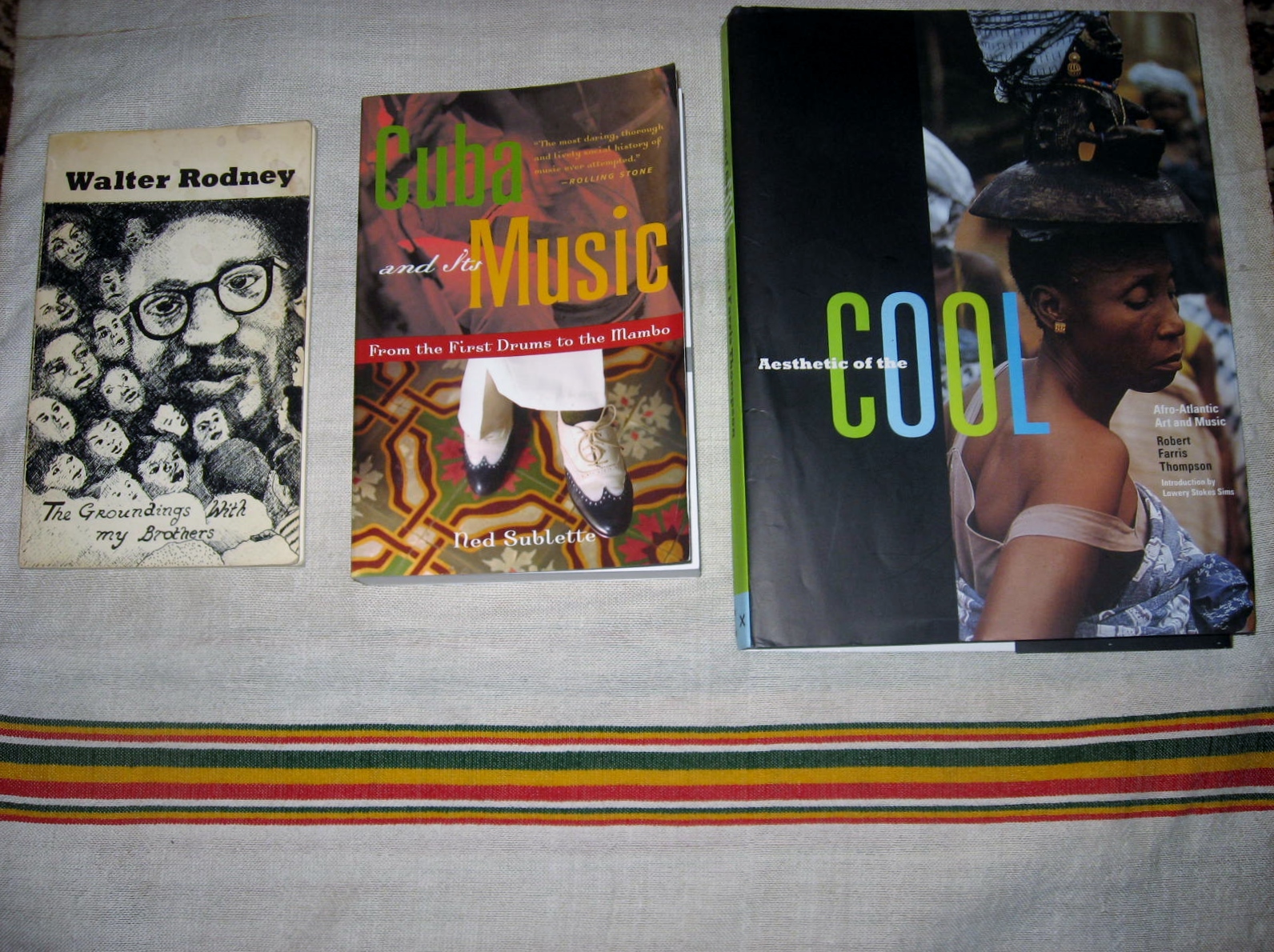
‘The groundings with my brothers’ (1969) is an insightful book by Walter Rodney, that I enjoyed to read. For several reasons. Walter Rodney was a Black Power activist from Guyana, also a scholar, and known as Left-wing/Marxist. Besides that the book, dealing with Walter Rodney’s views in relation to Jamaica (and the wider Caribbean) in and around the 1960s, is in itself in my sphere of interest, actually reading it, it engaged me even more. The book itself was originally written in 1969.

First of all, Rodney’s analyses of broader world politics and White dominance, colonial history and neo-colonial present, at the detriment of the Black and other coloured peoples of the world, are eloquent as well as intelligent. He associates this de facto White Power with Capitalism, which shows his ideological stance, perhaps. In the same vein he applauds Cuba, describing Cuba since 1959 as a place where White Power has been defeated. While there are some arguments to be placed against this, most other analyses by Rodney in the work seemed to me correct, well-informed, and realistic. I also liked his way of expressing and writing. I never felt I was reading a one-sided, ideological hardliner with a vindictive, narrow mind – even common among some self-proclaimed Left-wing or “humanitarian” activists –, but rather a rebellious yet open-minded, intelligent, sensible, and emphatic thinker, with a good sense of humour, making his writings very readable. Rodney is also a good writer in the literary sense; he knows how to conjure images well, for instance.

He points at contacts with Rastafari adherents in Jamaica in this book, respecting them as representative of suffering and rebellious Jamaican Black people, oppressed historically by White Power, and now by Black leaders and politicians also essentially serving this global White Power structure. He points at censored “Black Power” books in Jamaica. Several works were forbidden in Jamaica, not just Malcolm X’s Autobiography.. the same applied to works by Stokeley Carmichael or Eldridge Cleaver. This ban was oddly ordered by the government of a Black prime-minister, Hugh Shearer. Walter Rodney himself, incidentally, was also forbidden entry into Jamaica when he returned to Jamaica (he worked at the University of the West Indies in Kingston, Jamaica), after a trip to Canada, also for spreading such unwelcome Black Power ideas. He refers to his ban to return in this work as well.

WITHIN AFRICA

An insightful and recommendable book, therefore, ‘The groundings with my brothers’. Besides this, parts of the book surprised me pleasantly. Strictly speaking parts of the book can be deemed “departures”, although they remain relevant to the overall theme of Black consciousness and pride of African descent. In one chapter, chapter 4: ‘African history and culture’, Rodney seeks to contradict European claims of Africa as uncivilized as opposed to Europe, as part of a pro-White propaganda, and therefore elaborates on historical evidence of developed civilizations on the African continent, before slavery and Europeans. He relates the history and characteristics of ancient civilizations in Africa: Ethiopian Christianity, Kush, Egypt, but also other ones. This I found interesting, and in a sense original. Not totally original, but quite, and appropriate, I think. Walter Rodney was focussed on both Africa and the Americas, and - before him - Marcus Garvey already connected mentally the parts of the world strongly, Africa being of course the motherland/the roots of Black people in the Americas.

This sometimes took the form, though, of abstract – albeit positive – symbols of the African roots, with not always very detailed studies of different African regions, countries, cultures, and internal differences developed over time, landscapes or other aspects. Even among some Black nationalists such knowledge stayed behind of knowledge of other regions of the world, though this is not always their fault. In a British colony as Jamaican much was taught about Britain and Europe, and less about Africa. Many Black people also often tend to know more about the geography of the place where they actually live (e.g. Jamaica, USA), which to a degree is understandable.

I myself have by now studied and read many scholarly works on Caribbean history, specifically also on people of African descent in the Caribbean, social development etcetera. I have read a lot about slavery and other historical aspects in the Caribbean, also to a lesser degree quite a lot about the same topics in Brazil, Latin America, or the US. I found and find this an interesting theme, and I learned a lot.

There was, however, one “elephant in the room”, as the expression goes, that went not totally unnoticed, but still was ignored too often, I think. I am referring to the African origins. The situation in Africa as it developed before enslaved Africans ended up in the West: not just generally or abstract, but more detailed. Walter Rodney’s more detailed attention to the long history of Africa, and differences within – and similarities throughout - Africa, was therefore refreshing. I found it educational and insightful. Not all was new to me, but some things certainly were, or explained better than what I read/heard before. For instance the difference between the savannah or semi-arid “Western Sudan” regions between Senegambia, through Mali, Guinea, and northern parts of Ghana, Ivory Coast and Nigeria on the one hand, and on the other: the area with tropical rainforests more to the South of this, notably on the coasts of Ghana, Benin (Dahomey), Nigeria, Cameroun, as well as the large Congo region. In these latter dense forest areas, distinct, more isolated and small-scale societies developed, quite logically, than in the more accessible parts. The latter, more Northern-lying parts had more cosmopolitan societies, with more travelling (by horse) and contact possibilities over longer distances, including with Northern Africa. Islam penetrated this part also much more than the more South-lying “forest” parts, like Congo or southern Nigeria for instance. This fact, while logical in a sense, still intrigued me. Mainly because I know – and learned - that enslaved Africans to the West came from both these areas – or border areas between them.

To put it shortly, after having read about and studied what science has up to now found out about the numbers of slaves forcibly brought to the West, their region of origin or at least embarkation in Africa, relative differences etcetera, I think it is time for me now to know more about those regions within Africa beyond this. More specifically, in its relations with surviving African culture in the Americas, a theme which continues to hold my interest as well.

Walter Rodney discusses this African history primarily to point out that Africans should not be ashamed of their roots, as they were not less-civilized than the boastful European colonizers claiming this. ‘The groundings with my brothers’ is not a very extensive work, and is partly a manifesto, so it should be placed in that context.

ORIGINS

I have read other works, though, that have more detailed, and very insightful elaborations on the different parts of Africa where enslaved Africans came from: slaves came from different parts of Africa, depending on time period, colonizer (British, Portuguese, French, Spanish, Dutch etcetera), and even specific colonies or region within these. Portugal had “access” to Angola for instance, colonizing it prior to the development of Brazil. That many of the slaves going to Brazil came from the Angola region, thus comes as no surprise, but also in Brazil African slaves came from a variety of regions. The English, Dutch, French, Spanish, Portuguese and others got their slaves from different parts of Africa. Sometimes slaves from specific African regionsconcentrated in specific areas in the Americas, or time periods.

Rodney for instance mentions famous, influential – if relatively unknown – African kingdoms in both the Western Sudan and coastal regions (Mali, Benin, Kongo, Buganda, as already mentioned Axum/Ethiopia, Egypt a.o.), yet he also states (I cite from the book):

However the majority of Africans lived in small societies and these must also be seriously studied. Sometimes, it is felt that only in large political states one can find civilisation and culture, but this is wrong, and in the great political states of Europe and America today many human values have been destroyed; while even the smallest African village was a place for the development and the protection of the individual. Certain things were outstanding in the African way of life, whether in a small or large society. These distinctive things in the African way of life amount to African culture. Among the principles of African culture the following are to be noted : hospitality, respect (especially to elders), importance of the woman (especially in cases of inheritance), humane treatment of law-breakers, spiritual reflection, common use of the land, constant employment of music (especially drums) and bright colours”. (Rodney, ‘’The groundings with my brothers’, p. 36/37).

Quite a lengthy citation, but I find it crucial and interesting for this essay. I really recommend to read the entire work by Rodney. Written in 1969, these statements were quite ahead of their time, at a time when many Black people in the West knew little about Africa.

CUBAN MUSIC AND NED SUBLETTE

I also quote it to point to one African cultural aspect, studied in another, more recent book I would like to discuss: music. Specifically Cuban music and its African origins. I mean the book ‘Cuba and its music : from the first drums to the Mambo’ (2004), written by Ned Sublette (himself a musician).

I have mentioned this book already on my blog here and there, but here I focus on the attention Sublette gives to ancient African culture before it came with slaves to the West. He places the emphasis on enslaved Africans ending up in Cuba, but compares with other places in the Americas. Moreover, he describes African cultures, including the differences per region within Africa (Western Sudan versus “forest” Africa) Walter Rodney also alluded to. Sublette focuses here on music, which is one of my passions too, and I found it an insightful and good read.

Notably, Sublette (who is from the US) compares (historical) Afro-Cuban music with African-American (Black US) music, noting differences. He explains this partly because of different colonial policies. Drum use was more strictly forbidden for African slaves in Protestant (US, British) slave regimes – seeing it as a way to communicate rebellious messages (justly), while authorities in Cuba were a bit more lenient about continued drum use (in specified organizations and under conditions): drum music could therefore continue and live on in Cuba more, leaving traditional percussive African music relatively more intact among the different African ethnic groups in Cuba (Yoruba, Congo, Calabar a.o.).

This ban on drums is only a part of the explanation of musical differences, Sublette stresses. He also indicates that the region of origins of enslaved Africans ending up in different parts of the Americas played a cultural role. He argues that to what is now the US relatively more slaves came from Western Sudan Africa, what he also calls “griot Africa”, more Islam-influenced, stretching from around Senegambia, through present-day Southern Mali to Northern Nigeria, whereas slaves in Cuba came relatively more from “forest” Africa, the area from around Yorubaland (now Southwest Nigeria and Benin) to Cameroun and further to Bantu-speaking areas, such as the Congo area, down to Angola and Mozambique. According to slave trade figures, he has a point, but simplifies or generalizes it a bit: there were parts of the southern US where quite some slaves came from the “forest” Congo or Igbo (SE Nigeria) areas, but on a general level he seems partly right.

There is an interesting irony here. The Spaniards were shortly before engaging in colonialism - spurred by Columbus’ “discovery” - for a period Islam-influenced and even Islamized (not all, but many local Spaniards converted to Islam in that period). Spanish culture remained Islam-influenced after this (the Christian reconquest), even if outwardly fanatically Catholic. Spanish authorities at one point, however, for religious reasons sought to avoid importing too many slaves “raised with Moors” as it was formulated – i.e. too Islam-influenced (like those from the Mali and Senegambia areas)- , preferring those from “forest” areas further South (present-day South Nigeria, Benin, Congo, Angola). This policy was not always maintained – and of course religious zeal was a cover-up for economic, colonial goals for these Spaniards, as it was for other European colonizers. Nevertheless, it caused that the more percussive “forest African” cultures of the Yoruba, Congo and others – with a bigger emphasis on drums musically/culturally – entered Cuba more, whereas Africans in the US came more from Islam-influenced cultures, with less drums, or polyrhythms, and more string instruments. Like the griots used.

Also this is partly true, but again a bit too simplistic, I opine: looking at musical structures the different parts of Africa still share musical values (revolving around rhythm itself, for instance) – as well as other connected spiritual values – that are found less outside of Africa. In other words: musical principles are shared between the whole of sub-Saharan Africa, in a region as wide as from Southern Mali to Angola and Southern Africa - part of a broader, shared African aesthetic – that neither the Islam nor European colonialism or Christianity could fully replace. Nor slavery, for that matter. Walter Rodney also referred in general terms to these shared African values throughout the continent.

There were different influences within Africa though. Broadly speaking, though, it seems to explain well why some differences exist between more percussive Afro-Cuban music (genres like Son and Rumba) - giving the world well-known, now globalized African-based drum instruments like the Conga and Bongos – and US Black music, such as the Blues, more based on string instruments (and with the Black US folk use of the Banjo and the fiddle). String instruments in Cuba tend to be more often associated with Spain or Moorish culture. Beyond instruments, also the structure differs: Cuban music is based on the “clave” (old Spanish for “key”) as a way to connect several simultaneous rhythms. US music – like in the Western Sudan area – is less polyrhythmic, depending more on “swing”. “Swing” is of course, simply said, playing around the beat and bars, which in a way is also a polyrhythmic tendency. Such “swing” is originally absent in Cuban genres as rumba or blues, now only found in US-influenced mixed styles. Perhaps Afro-Cubans had enough in their music itself to be polyrhythmic (basic rhythm, several “answering” rhythms etcetera) and needed not to “play around” the beats/rhythmically with each instrument. That is also a way you can look at it.

Another aspect Sublette’s distinction seemingly fails to take into account is that drum music in the form of common Djembe’s (goblet-shaped, goat-skinned drums) combined with two-sided large bass drums called “Dunduns”, as well as other less known drums, can be found in this Western Sudan region as well. These tend to be played with more polyrhythmic patterns, and exist besides the “string” and other instruments associated more with the Griot caste (the Djembe tends not to be), in the same region. The Djembe’s origins are associated with the Mali Empire region, stretching from Senegambia to Guinea and South Mali. In an earlier blog post on the Ashiko, I noted that there seems to be no evidence (that I found, at least) of Djembe-like drums (with that shape) transported to the Americas, while other traditional African drums have variants in the Americas (even if under different names). I still wonder why, though it can depend on several historical factors surrounding enslavement, or the Djembe’s own history.

Interesting to read, Sublette’s book, though I find Sublette exaggerates his point at times a bit, and is regarding some aspects deficient. His writings in this 2004 book are however overall definitely interesting, especially also regarding the musical and cultural (and spiritual) differences between main African ethnic groups in Cuba: the Yoruba, the Fon/Dahomey (the Fon also had a large influence of Haitian Vodou, by the way), the Congo, the Calabar and others, which he sketches insightfully. These cultures helped to shape Afro-Cuban music genres, along with Spanish (and a few French) influences. Interesting facts I thus learned (assuming Sublette had good sources), and did not know yet: “Congo” slaves in Cuba more often came from more Northern-lying parts of the Congo region (e.g. what is now D.R. Congo), when compared to those in Brazil (more from what is now Angola). To be sure, Angolan slaves also went to Cuba, historical evidence shows, only apparently relatively less. Also the fact that Yoruba slaves in Cuba, tended to come (mostly) from other parts in Yorubaland than those ending up in Brazil was new for me.

ROBERT FARRIS THOMPSON

A third work I can mention is also one that I referred to already in other blog posts: ‘The aesthetic of the cool : Afro-Atlantic art and music’ (2011), by Robert Farris Thompson, actually a collection of several of Farris Thompson’s writings on African culture and its continuity in Afro-American cultures. He focuses more on the shared characteristics throughout Africa and a shared African aesthetic, part of which he describes as “mystic coolness” as a crucial concept: combining contradictions through transcendence, simply put.

In light of this specific post, it is relevant to note that while Sublette emphasizes the differences between, say, Blues from the US, and Cuban genres like the Rumba and Son, Farris Thompson emphasizes their deeper, cultural similarity. At the same time, however, Farris Thompson pays more attention to what Sublette termed “forest Africa”, especially from the Congo region, also as being foundational for Afro-American cultures, more – he argues – than cultures from e.g. the Western Sudan (Mende-speaking for instance). So he makes a distinction in a way too. Overall, he points at shared characteristics throughout African music, which I think makes sense. Even the most Islamicized ethnic groups or regions in the Western Sudan region (Senegal, and the Hausa for instance) never fully abandoned underlying African cultural principles, tending to develop an own “Africanized” variant of Islam, such as the Marabout (e.g. Baye Fall) movements in the Senegambia and other regions. On the other hand, to be topical, the recent extremist Boko Haram terror in the Hausa area of Northern Nigeria, however points in another, more “Arabophile” or politicized variant of Islamic fundamentalism, away from African values.

Justly, Farris Thompson describes the entire sub-Saharan African musical culture as “percussive”. Also the Ethiopian Orthodox Christian tradition includes drums and rhythm, for example. Non-drum or –percussion instruments, like string or other instruments, tend to be played rhythmically as well in sub-Saharan Africa, differentiating it from European musical cultures (more based on harmony and chords), or Asian musical cultures, according to some more centered on “melody”. A perhaps useful, yet partly simplistic distinction: music from all cultures know the three basic elements of harmony, melody, and rhythm..it is a just matter of relative emphasis.

Walter Rodney pointed out in general terms, in the earlier citation, that “the constant employment of music (especially drums)” is important in both larger and smaller African societies. Interestingly, Farris Thompson, from arguably another entry point (he is a White scholar, with no explicit social or activist agenda), elaborates on what this importance of music in Africa in detail consists of, what values are behind it. Sublette, more a musician than a scholar, is more detailed in a geographical sense, in the said book, focussing on Cuban musical history, with some wider comparisons.

These three people thus all write (or: wrote) on Africa and its culture, from different perspectives. All three are not necessarily always right in every single fact or analysis, though seem overall correct and seem to have studied what they make public, and checked the veracity. Such mistakes in Walter Rodney’s manifesto can be forgiven more easily, in my opinion, than works presented as scholarly by White, privileged scholars assuming authority. This is the irony: that someone shows he is really intelligent when he admits ignorance on certain matters, and acknowledges a need to learn more.

JAMAICA

Finally, I return to Jamaica, also central in Walter Rodney’s ‘The groundings with my brothers’. Rodney describes the Jamaican situation in and prior to 1969 mainly sociopolitically – of course. The same applies to the Rastafari movement he mentions: this movement stems certainly from Black Power ideas, and from Marcus Garvey’s ideas on Black pride and resistance, social aspects Walter Rodney relates to. Rastafari, however, also has spiritual and cultural aspects that cannot be caught by political ideologies or “isms”, commonly eschewed by most Rastas.

This, and the studies I mentioned before this in this post, begs the following question: is Afro-Jamaican culture more influenced by “griot/Western Sudan” Africa, or more by “forest” Africa? Several historical aspects must be analyzed when answering this question. Jamaica was a British colony, and drums tended to be banned more strictly by the British, when compared to e.g. the Spanish in Cuba. Overall, historical evidence generally confirms this, although also among Jamaican planters there were some differences or exceptional cases of leniency where drums were (under conditions) allowed to be played by slaves in certain periods.

Another aspect is the African origin of the slaves in Jamaica. An interesting theme in and by itself. Historical records show that about 40% (estimates differ a bit per historian) probably came from the Gold Coast area (now Ghana) speaking mostly Akan or related languages. About 25% probably from the Igbo area around what is now Southeastern Nigeria. Many slaves in Jamaica spoke Igbo. Also about 25% came from the Congo region, speaking Bantu languages like Kikongo, Benguela and other. The remaining (about) 15% came from other areas, such as the Senegambia, or Dahomey region. Yoruba were present in Jamaica too, but relatively less than what is known for Cuba.

In conclusion, most enslaved Africans in Jamaica came from what Sublette called “forest Africa”, though parts of Ghana are a border area with the Western Sudan. Most of Ghana was however never Islamicized, even if the Akan and Ashanti at times adopted some aspects from Islamic cultures to the North (yet not the religious complex). Present-day Ghana is nominally mostly Christian, with a minority of about 17% Muslims, mostly living in the North of Ghana (North of Akan-/Twi-speakers).

Polyrhythmic traditions, one can thus conclude from this, these Africans from forest areas mostly brought to Jamaica. Yet the British colonial authorities and most planters in Jamaica forbade using drums. Polyrhythmic drumming could however live on secretly in cases, and among the Maroon settlements of free, escaped slaves in remote areas, as well as among other groups, such as indentured Africans after formal slavery.

This influenced spiritual/religious music in Jamaica, like Kumina, Burru, Pocamania, also outside the Maroon areas. It partly also shaped popular music, even those genres that developed under Black US influences in urban areas: the genres Ska (appearing around 1960), and Rocksteady, and Reggae. The latter two in turn partly derived from Ska in the later 1960s. Common knowledge holds that Ska was a Jamaicanized version of R&B (especially the New Orleans variant) Jamaicans heard on radios and in sound systems. This “Jamaicanization” includes own folk, percussive traditions, naturally, making it thus more polyrhythmic. The Africa-centered Rastafari movement later would influence Jamaican popular music toward a more African musical aesthetic, including in percussive patterns. Kete and other drums used in Rastafari drumming and chanting gatherings - called Nyabinghi - influenced Reggae music in its drumming and rhythm. Rastafari (a social and spiritual movement) and Reggae (a “secular” Afro-Jamaican popular music genre) remain separate things, but keep influencing each other.

Finally, in its formative stages around 1960, Ska was shaped by several musicians before this playing jazz, Mento or other Jamaican folk styles, as well as Cuban-influenced music. Some of these early Ska musicians (of the Skatalites band) were even born in Cuba, such as Laurel Aitken, Roland Alphonso and Rico Rodriguez, mostly born from Jamaican parents (or at least one of them) migrating to Cuba for work in a period. These Afro-Cuban influences added in some way also to a developing polyrhythmic feel in Jamaican popular music since the 1960s, or to the more rural Mento genre, found more in rural Jamaica before this.

If there is any sense to Ned Sublette’s distinction (a bit too sharp in my opinion, I already said) in his book, it can be concluded that Jamaica is, musically, somewhere “in-between” the griot/Western Sudan” tradition, like the Blues culture of the Black US, and the “forest African”, more polyrhythmic and percussive tradition, also found in Afro-Cuban genres. Perhaps the same "in-betweenness" applies to other parts of the Caribbean region as well.

Most significant, however, beyond all these relative differences, is that this shows that a broader African culture and identity has survived in the Americas, in spite of deracination, attempts of cultural annihilation, dehumanization, oppression, and extreme hardships. Of course this is also rebellion and resistance.