zaterdag 6 augustus 2011

Word Power

I have a somewhat odd relationship with the country France. Mainly, during my life, I got to see it as the country “in-between”. Purely practical that is. Being half-Spanish and living in the Netherlands, we (I and family) often went to Spain, at first for years by car or bus, and had to go through France, of course a much bigger country than Belgium.

France therefore felt principally like (no disrespect intended) a larger hurdle to overcome. Our minds were not totally closed, and we looked around when we had to sojourn in France. As we usually crossed the border on the west-side, near Irun (Basque country), the “half-way stop” we chose mostly was in the broad south-western area of France: roughly between Poitiers and Bordeaux. I also remember us staying somewhat more to the south, in or near the French Basque country (in Spain itself we still had some way to go). I myself went a time alone to Spain by train, through France, but with the exception of a few hours in central Paris as a stopover, I spent little time in France: I went to see different parts of Spain, and France was a large country I had to pass through. Again, no disrespect for the French, but I had specific interests and connections I chose to focus on because of my background.

Regarding culture and society, France became in my mind the “other” Latin-speaking country. Culturally also between Northern Europe and Southern Europe. Different from the Spain of my maternal background, as well as from the Italy of my paternal background. French is a Latin/Romance language but not one I was very fluent in. Further, there were vague associations of a culture of food, perfume, certain art forms, and fashion I got through media about France.

Recently I chose France – for a change – as a travel destination. Again (see other posts), there is a reggae connection: I flew on Marseille and also wanted to go to Avignon. Nearby Avignon there was, in the village of Bagnols-sur-Cèze, the Garance reggae festival: one of the biggest of Europe. Interesting, big names like Burning Spear, Sly & Robbie, Clinton Fearon (former Gladiators), Midnite, Willie Williams, and others were scheduled to perform. This influenced my decision to go to that part of France. It did hardly define the whole trip, though. I went to travel and see another part of Europe I knew not too much about. Though it is and remains true that “I go where reggae is”, my travelling goals were in this case broader.

The Garance reggae festival is one of the biggest of Europe. It was held between 27 and 30 July in 2011, and roughly around that time I flew to Marseille: the biggest city of the Provence in South France, and the second-biggest in France, with more than a million inhabitants. The biggest port as well. It is historically the oldest French city, founded by Greeks.

Later I would go to inland Provence, to Avignon, nearer to the festival. Avignon itself was known for its theatre culture, and there was during most of July a theatre festival in the town of Avignon, which has about 90.000 inhabitants. I read in Dutch newspaper ‘de Volkskrant’ that this theatre festival’s origin dates back to 1947, then meant to revive post-war French art life.

LANGUAGE BARRIER

I (unfortunately) reencountered a phenomenon throughout all this that I almost forgot about for a time: the language barrier. I’m not fluent in French, had it at school until I was about 20, and learned some, but not extensively. I found out again how it is to not be able to talk freely and extensively, to having many options of speaking your mind, and expressing yourself with the locals. I spoke some French, and at times English, but it went a bit difficult, and remained necessarily too often superficial and practical.

You cannot deny the importance of language. It is related to what some Rastas call “word power”. More existentially, this means that speaking words in itself has the power to create. The Bible even seems to start with this premise: “In the beginning was the word, and the word was God”. As most Rastas find that Jah (or God) is within oneself, and is a living man, you could in some way argue that Jah “in I” is silenced, because of a language barrier. Limited as I life force. To a degree, of course. In any case, you get somewhat excluded from surrounding society and, well, people.

MARSEILLE

Marseille broadly seemed to respond to a northern Mediterranean atmosphere. It is hard to grasp the cultural tenets, though I got an idea. The French culture seems to pay much attention to “the refined”, to “form”, or “style” in the broad sense. This is evident in the French cuisine, as in other, daily customs. Courtesy is also valued high, however superficial. For instance in greeting when entering a store, “bonjour”, and the way how you say thank you. Arguably, in my experience, people in Spain seemed more “informal” in their overall demeanour and behaviour. This is not the same as being “rude”: Spanish seemed just as friendly and respectful, but in another way, maybe comparable to how you talk with your friends or team mates. In France, social customs seemed more distant and formal.

In other ways, Marseille is a modern, multicultural European city. A port-city like Bristol, which I discussed also on this blog. The specific colonial past of France comes to the fore in the type of non-European immigrants. Relatively many from Algeria and Morocco (geographically not too far of course), but also from sub-Saharan Africa, the Comoros Islands, and Vietnam (for a period a French colony as not everyone seems to know). Multicultural means in most cases not living among people of different backgrounds, but rather living quite apart from other ethnic groups, concentrated in specific quarters/neighbourhoods, dominated numerically by specific ethnicities/cultures (or religions). The same applies to other cities in Europe of course.

The area around the main train station St-Charles, not too far east of the Old Harbour and centre of Marseille, is largely inhabited by people originally from the Maghreb: Algerians and Moroccans, with Islam being an important religion.

The Old Harbour (Vieux Port) in Marseille’s centre has a different, more Mediterranean feel from the Harbour I saw in Bristol: lighter, yellow-ish, and less sombre colours than Bristol’s canals and harbours. The Old Harbour – however – is not used as a commercial, industrial port anymore. The modern, economic port is located more to the northern outskirts of Marseille.

A view on Marseille's Vieux Port (Old Harbour)


Architecture can be interesting, because it is the most obvious material sign of a culture and society. The Provence region of South France seems to be characterized by yellow-ish, pink-ish “light” colours: lighter and more southern/Mediterranean than, say, Bristol or Amsterdam. Yet, it is also different from Spanish cities. There were similarities with parts of Italy, but it was neither the same as, say, Pisa, where I have been.

I am however not so much an “architecture buff” as I am a “museum buff” (to use Lonely Planet-travel guide parlance). I like visiting different museums. I did it in Marseille and Avignon as well.

I’ve visited several interesting museums during the trip. In Marseille’s Le Panier quarter (the Montmartre of Marseilles, they say) there was an exhibition on Orientalism in French paintings: how especially French painters saw the Orient: the Middle East, North Africa.

It was very interesting. The term orientalism was of course by Edward Said, who was most probably an interesting and versatile, innovative thinker. One thing bothered me, though, from my perspective. Marcus Garvey – in time preceding Said – broadly pointed at some of the same things or principles as Said, only earlier: how the West saw the rest of the world from their cultural perspective and their (colonial) interests in mind. Garvey focused on the colonial project as it affected sub-Saharan Africa more than the Orient. Garvey receives overall nonetheless much less academic interest than Said. Unjustly, I think.

Furthermore, it is definitely not the case that the Orient was “ravaged” by European colonialism more than sub-Saharan Africa. On the contrary: let us think of the extensive slave trade alone affecting millions in black Africa, by both Europeans and Arabs.

A view on Marseille's Le Panier quarter


After a few days Marseille, I went to Avignon, about 80 kilometres north/inland, on the river Rhone.

AVIGNON

It was “theatre month”- as each July, in Avignon. This means that there are many performances in the several theatres in the town – which has normally about 90.000 inhabitants -, and many artists and performers on the street, most promoting their plays/pieces to be seen in the theatres.

Central Avignon, late July 2011


I found it fun and interesting to see so many street performances. These ranged from musically to visually artistic, the juggling, the acrobatic, the literary, and everything in between. Dancers, capoeira, street dance, a guy dancing with a silver, seemingly floating ball by his hand. Music from Amerindians, to African music - such as from the Senegambia region - , to traditional or classical French, pianists, Flamenco-like Spanish guitar players... Some of it sounded really good.

GARANCE

Then there was the other festival: the Garance reggae festival. Partly unconsciously I wanted to compare it with the other festival I went to in 2010 in Spain: the Rototom reggae festival in Eastern Spain, Benicassim, held in August, discussed also on my (this) blog. In both cases I heard the same: this is the biggest reggae festival of Europe. Of neither festival I went every single day, but having been there substantial parts of the festivals and knowing the programmes, I am quite sure that I can say this: Rototom in Spain (formerly Italy), is bigger than Garance in France. Rototom lasts more days (namely 6) and has more artists and concerts. Concerts that are even relatively long for festivals. Garance, in comparison, lasted 4 days, and the premises/terrain also opened later than in Benicassim/Rototom. There were at both festivals quite some reggae concerts of different artists, of course, which is more important than who is biggest. There were however also organizational differences.

The festival terrain


Another flaw, maybe, of the Garance festival is its somewhat isolated location. It is held in the town Bagnols-sur-Cèze, about 40 kilometers from Avignon. It does not have an own train station (Avignon being one of the nearest), and public transportation is too limited: like Rototom concerts tended to end close to 3 o’clock in the morning, but you cannot get out of Bagnols at that time (save by expensive taxi). That would not be a problem if the accommodation in Bagnols was extensive, but there was few when compared to Benicassim, laying on the much-visited Spanish Valencian coast. Besides this, the Garance festival had no debates or forums: it could have been more intellectual (with more word power?).

Nonetheless - I’m done complaining now - I eventually could go 2 out of the 4 days, and saw concerts of Burning Spear, a Studio One revue (Lone Ranger, Prince Jazzbo, Willie Williams, King Stitt and others). “Oldest living deejay” King Stitt was introduced as no less than “the first rapper in history” (Well, I think...no, that’s maybe a topic for another post). Unfortunately, these latter did not perform with a live band, but with a deejay playing Studio One riddims. The sound was good (though not perfect: I think e.g. the sound of the snare drum – not unimportant in reggae – could be better), and it was still fun to see these deejay-ing veterans.

King Stitt on stage


Burning Spear had a characteristically good show, good band (he tends to take his own band for concerts), and good sound. Winston Rodney is still very active and seems motivated. High points for me included some songs, including the song ‘Marcus Garvey’. I think this song’s “crucial” horns and strong riddim did it, along with its meaning/lyrics. About the Jamaican black leader who receives less attention than Edward Said.


The second day I went to Clinton Fearon (formerly of the Gladiators), rocksteady veteran Ken Boothe, British-based fusion/reggae artist Natty, Jimmy Cliff (I saw only part of it), Sly and Robbie and Junior Reid, and Midnite. Clinton Fearon had a great concert, Ken Boothe was nice, Natty had its moments (not all though), Sly & Robbie was mostly great, and somewhat shortly Junior Reid appeared on stage, which was a good, but later chaotic performance. I saw a large part of the late concert of Midnite (beginning after 1 o’clock at night).

Clinton Fearon on stage


Clinton Fearon and the first part of Sly & Robbie was of these concerts the most impressive to me. Midnite - from the US Virgin Islands - was nice, but they have a distinct, sobre style, which combines the experimental with the laid-back. An acquired taste, perhaps. This no-frills and “reasoning” sound is very much their own and in that sense unique. Yet, after about a half an hour it got somewhat monotonous. Plus it was late, by then.

Screen with main stage concert of Midnite


Furthermore, there were different stands, such as a good place for Ital - Rastafari, natural/vegetarian - food - where I had a great Ital meal with sweet potatoes, and a deejay, with mostly nice tunes and a good sound (Jamaican sound system-style: think high, piled up loud speakers, heavy bass).

Back in Avignon, I visited some museums (again), such as the extensive Curet museum of fine arts with also an interesting Egyptian exhibition along with paintings, and the former Papal palace (for a period Avignon apparently was a “second” Rome). Varied and cultural.

SYMBOLS AND/OR SIGNS?

For the last 3 nights I went back to Marseille, where I had to catch the plane. I visited more museums, such as on the Marseillaise (yes, the song: anthem of the French revolution, and now French national anthem, some maybe can mum it). It was in French, but I got the main content more or less. Interesting were the different versions – and uses - of the song. The next day I went to the Museum of Contemporary Art. The latter was outside the centre and quite a walk (I knew buses went, but I walked), passing the modern Olimpique de Marseille football/soccer club stadium, the Velodrome.

I could have taken the bus and partly the subway/metro to the Museum of Contemporary Art, but I saw on the map exactly how to walk. I find that pleasing somehow: to find my own way. I had to walk the Rue Paradis out to the end (by itself a few kilometres), from the Charles de Gaulle square in the centre where I had breakfast (actually it was 12:30 hours, but hey..). I walked the Rue Paradis out. Near the end of it I wanted to sit down and sought in a side street a place to rest. In a residential street I sat down, I was somewhat surprised (though not too much), to find a drawing of Martin Luther King’s face on a wall.

After resting I walked on on the Rue Paradis. Martin Luther King, “Paradise” street: symbolic it seems. I still had a few kilometres to go. After the Rue Paradis it was not long until I saw the stadium, which appeared somewhat more modern to me than another one I saw recently (of Spanish football/soccer club F.C. Sevilla). Both Olimpique Marseille and Sevilla can be qualified as “big” clubs, playing often in European leagues. For a long time now France fares economically better than Spain, but that is not saying much: Real Madrid and Barcelona are the richest football clubs of Europe. That’s another issue, though.

The Velodrome stadium


After the stadium I went to a quieter, greener part of Marseille, and after a few kilometres I found the Museum of Contemporary Art. It was very interesting and, some may find, comical. Like Andy Warhol and others many contemporary artists use modern-day objects (e.g. cardboard, tubes, car parts) and repackage them, or use other symbols, turning out seemingly “absurd”. Such as the art-work of a big stone “sleeping” in a (broke-down) bed. Contemporary art includes also photography. There were interesting photographs - such as of Dutch-Somali politician/activist Ayaan Hirsi Ali - alongside installations and paintings. Further, there was also a portrait in light (as installation) of Malcolm X from the 1960s.
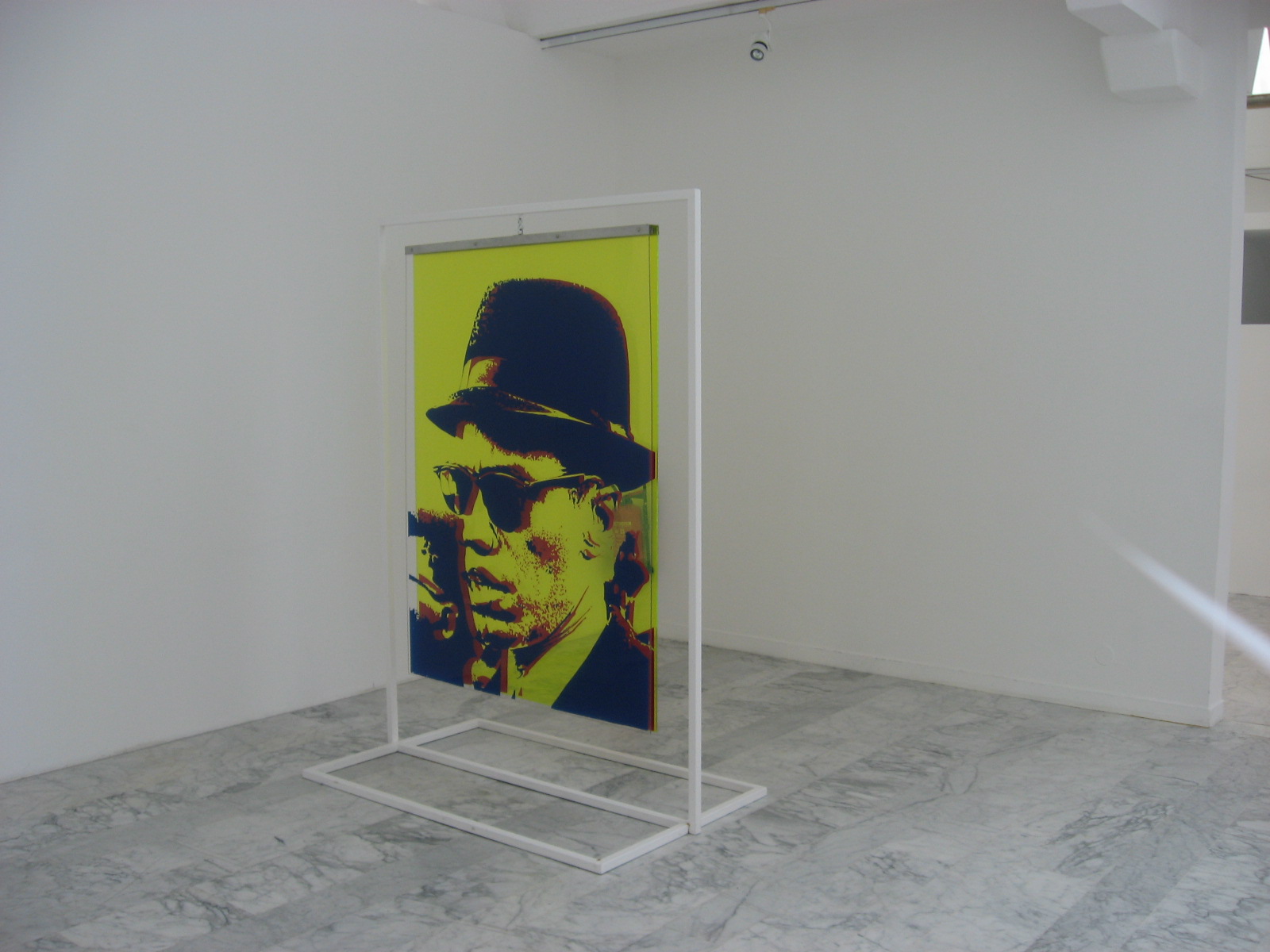
Malcolm X in Marseille's Contempory Arts museum


Marcus Garvey, Martin Luther King, Malcolm X, (Paradise Street, maybe the Egypt exhibition), more symbolic clues! Added to this can be the interesting work ‘King of the Zulus’ by Jean-Michel Basquiat, the Contemporary Art museum held.

More symbols along with this: the evening before I had a tasty dinner at an Ethiopian restaurant, Axum, which was decorated with Ethiopian symbols. The Ethiopian lady who attended me (of the owning family) commented in French on my “Ethiopian” necklace, which included Haile Selassie I and Ethiopian flag colours. I saw this restaurant by chance - believe it or not - (I was looking for another restaurant that was closed). Add this as a symbolic, Rastafari connection to the ones I already mentioned. Mind you, most of these symbols I encountered by chance: I did not expect to see the Martin Luther King drawing in that street. I did not know what to expect in the Contemporary Art museum. I did not plan to go to the Ethiopian restaurant. Maybe I should have. Beyond symbols, were they signs?

View of Rue Paradis


How much did I walk to the Contemporary Art museum, about 5 kilometres? Still, I walked this distance back - past the stadium, Rue Paradis etc. - and did not take the bus. Back at my hotel I was a bit tired, but it was overall worth it, not just because of the symbols and/or signs, but they were part of it.

I strive mostly for rationality, and I think that symbols or signs are not always to be trusted, but here I appreciated the symbolic clues and signs. In the end, as language connects and gives meaning to (also visual) symbols, this can also be seen as a form of “word power”. A power which overcomes any language barrier.

Yet in practice, a language barrier remains annoying though, even alienating. Yet, signs and symbols guided me somehow.

zaterdag 2 juli 2011

Best reggae albums lists

I somewhat avoid giving something like “my personal top 5 or 10” of, for instance, reggae albums. Mainly because of the definitive character of it: personal tastes can change, not all that seems pleasing stands the test of time as well, and new artists and/or new albums appear. Another problem with such lists is that they almost can’t help but being somewhat simplistic, even if words like “my” or “my personal” accentuate subjectivity.

I therefore choose in this post to approach the theme I in itself consider interesting - favourite reggae albums of people - on a “meta” level. I analyse criteria, and do research on the Internet, such as through Google, combined with my personally acquired experience and knowledge as a reggae enthusiast/lover for over 20 years. Something of my personal taste might come through, but hopefully not that definitive.

First of all: how to define “best”? Music has for many mainly to do with emotions, passion, feelings, senses (e.g. of identity, or existentially). This is all too human and in itself not bad. It can be seen even as positive. An ideal picture is that black artists in a developing country make songs that appeal to the hearts and feelings of people of all races and backgrounds, all over the world. In a world of racial and social conflicts, war, and inequality this sounds as a beautiful promise for a better world.

But this may be too ideal a picture: it is not totally unrealistic, it occurs, but is at the same time not very common. Racism and opportunism combines when white rappers or reggae artists do indeed reach more white fans more easily, irrespective of the relative quality. Generally it seems to be the case that people search also in their adored artists ethnic and social similarity with themselves: Europeans often (not always) prefer European music, Africans African or Black music.
Such boundaries are evident but are not that rigid. Reggae’s popularity in Europe, for instance, crosses these boundaries.

Then there is a possible “rational” approach to judging albums, which is (quasi-) scientific and scholarly. Like the “canon” ideas in official academic circles. Though it seems too “cold” when delving into a phenomenon that appeals to emotion like music (as all art). At school we’ve learned the definition of art: “expressions evoking emotions” or “meant to evoke emotions”. This in mind, I still believe a certain rationality can be good when judging musical or artistic quality. Not just inherent quality of works, but also their wider social and cultural significance, their place in history. Also regarding reggae albums this can be very interesting.

CRITERIA

Looking at reggae’s history and sociocultural context an “as rational as possible” approach should include a set of thought-out criteria making sense. These relate to innovative artists and musicians, relative influence and reach, certain “periods”, and of course subgenres.

Reggae originated as such around 1968, following ska and rocksteady. Early reggae between 1968 and around 1972 was somewhat faster than later reggae (and even than some rocksteady). From around 1973 the “roots reggae” period set in, which remained the most popular in Jamaica itself until the early 1980s, representing a creative peak period. In the roots reggae period the Rastafari influence was relatively stronger. Roots reggae kept being made, but in the course of the 1980s the deejaying and “early dancehall” period set in with barer bass and drum riddims, as well as since the mid-1980s more “digital dancehall reggae”, Wayne Smith’s ‘Under Me Sleng Teng’ being known as the first instrumentally digital reggae song (in this case Casio-based). In the 1990s came “later” dancehall, with more digital (sometimes more minimal) riddims, alongside the reusing of older roots and reggae riddims, with deejays toasting or singers singing over them. This reusing of riddims/music of course remains in the present.

Within these general periods innovative and creative artists went their own way, pointing at a healthy individualism in Jamaican musical culture. Thus subgenres within subgenres developed, such as dub, harmony vocal groups, dub poetry, lovers rock and soul-influenced, or African and Jamaican folk-influenced stylings. All had a temporary and relative popularity in periods in Jamaica itself before they reached international popularity. Therefore they should all be included with representatives in any canonical or “best reggae albums” list.

For the sake of argument: let’s say that a “best reggae albums of all time” list includes 20 albums (more would probably be better, but still). A rough distinction would I think ideally be:

*two or three Early Reggae albums (e.g. Toots & The Maytals, Ethiopians) from between 1968 and 1971. One conveying US Black music influences, other of Jamaican folk music like mento, Burru or Pocomania.


*about 10 in total for the broad genre of Roots Reggae since 1973/1974. Further subdivided in:

-harmony vocal groups (Wailing Souls, Abyssinians, Mighty Diamonds, Israel Vibration)
-relatively innovative and influential vocalists (e.g. Dennis Brown, Hugh Mundell, Peter Tosh, Jacob Miller)
-influential, renewing producers: (e.g. Lee “Scratch” Perry, Augustus Pablo, Clement “Coxsone” Dodd and others)
-influential innovative musicians (e.g. Sly & Robbie)
-Rastafari lyrics, as it is often “message music”. Including different branches within Rastafari: Twelve Tribes (e.g. Israel Vibration, Ijahman Levi, Dennis Brown) or more recently influential Bobo Ashanti adherents (Sizzla, Capleton, Lutan Fyah)
-‘Rockers’ (a change within Roots Reggae starting around 1978, with a distinct drumming pattern, e.g. Mighty Diamonds album ‘Right Time’), and Steppers (another musical drum change)


-Dub: instrumental, remixed reggae songs, originated by King Tubby (e.g. Augustus Pablo)
-Dub Poetry (Mutabaruka, Linton Kwesi Johnson)
-Lovers Rock (e.g. Gregory Isaacs)

*Early Dancehall. Many artists in this period were in fact partly in Roots Reggae (also with Rastafari lyrics), (e.g. Half Pint, Barrington Levy, Ini Kamoze, Sugar Minott, Michael Prophet, further Tenor Saw, Yellowman, Charlie Chaplin, Eek-a-Mouse etcetera)

*Digital dancehall (early and new: e.g. Wayne Smith, Prince Jammy, Bobby Digital, Bounty Killer, Elephant Man, Vybz Kartel)


*New Roots on reused (non-digital) riddims, mostly Rastafari-inspired: deejaying/toasting (e.g. Capleton, Louie Culture, Jah Mason), singing (e.g. Luciano, Bushman, I-Wayne, Tarrus Riley, Jah Cure) ,or the in-between “singjay-ing” (e.g. Sizzla, Queen Ifrica, Junior Kelly, Lutan Fyah)

As one may note: this way a list of 20 albums is reached easily, even leaving too many valuable albums out.

Having my criteria set, let’s go to the Internet

RESEARCH

Doing my Internet research on “best reggae albums” lists I encounter several of these lists. Some admit to be subjective personal favourites, and some are very succinct (without explaining stories or anecdotes). Some add such explanations or stories: “it was in the time when I used to go to a club etcetera”. Some more, let’s say ”self-assured” (I’m not saying arrogant) people refrain from everything that points to subjectivity. This can be a sort of authoritarian way of hiding one’s insecurity or lack of knowledge, but can also be – more positive? – their passion or enthusiasm taking the better of them.

A quasi-rational approach is what characterizes this list on this (British-based) website of “top” reggae albums, said to be aimed at “newbies”. I note however a pro-“British reggae” bias.

http://uk.music.ign.com/articles/765/765610p6.html

Since I’m not a newbie to reggae anymore it is maybe difficult for me to judge but I do not agree entirely with the list. Not that these albums are not interesting somehow, but are all these 25 really among the best? Only some artists or albums are in my opinion rightly included, according to my criteria, and from the “defining” point of view: Sly & Robbie, Burning Spear’s ‘Marcus Garvey’, Horace Andy, Mutabaruka, and Lee “Scratch” Perry. I can at least understand these being in a “best of” list.

They are influential, although there are better, historical examples of specific albums. But Daddy Freddy?, Super Cat? Maybe fun, but the top? Or crossover acts like Shaggy or Shinehead? Dubious. Let alone UB40’s ‘Labour of Love’. Really, the best? (the songs on that album are even covers, of which some I consider mediocre cover versions of better originals). Very roughly, subgenres and periods of my criteria are included. Desmond Dekker and Jimmy Cliff represent Early Reggae for instance. Roots, dub and toasting/dancehall is there. Yet, in my opinion not the most representative albums or names. Again, due to a pro-British bias.

In comparison, the journal Mojo’s list of greatest reggae albums makes – I find – more sense.

http://www.rocklistmusic.co.uk/mojo.html

Again, Burning Spear’s ‘Marcus Garvey’, but also rightly included are: Culture, Black Uhuru, Dennis Brown, The Mighty Diamonds ‘Right Time’, Abyssinians...now we’re talking. Good examples of harmony vocals, as well as musically “early rockers” (Right Time), by “early” Sly & Robbie and “later”, modernizing Sly & Robbie (Black Uhuru), dub (Augusts Pablo), and the somewhat underrated classic “Truth & Rights” by Johnny Osbourne.

There are still some head-scratchers on the admittedly more extensive list. Some notable omissions as well: where are Alton Ellis, the Ethiopians, Israel Vibration, Peter Tosh, Little Roy, Mutabaruka, or the Wailing Souls? Still, it comes closer to true reggae, beyond crossover acts.

Then there is:

http://www.amazon.com/Top-Reggae-CDs-All-Time/lm/LS94YDTK9Q78

This Amazon-based list is more subjective, although the inclusion of Jacob Miller is a plus (another notable omission in the former lists), as well as of Bunny Wailer.

Another subjective list has some arguably odd choices which relate to personal taste.

http://www.mademan.com/mm/10-best-reggae-albums-ever.html

Interesting artists and albums, maybe, but not the most representative or original. It lacks some of the periods and subgenres of my criteria.
Then there is this one:

http://www.digitaldreamdoor.com/pages/best_albums-reggae.html

This list is “safely” extensive, but includes, in my opinion justly, names not on the other lists: Hugh Mundell, Itals, Half Pint, and, there they are, the Ethiopians and Alton Ellis. Ijahman Levi and Israel Vibration are on the other hand wrongly left out, I think. Somewhat strange according to me is the choice of albums by some artists. No list seems perfect, I guess. Personally, I prefer Bob Marley’s ‘Uprising’ over ‘Catch A Fire’ but that is my taste. Largely, this list makes sense, according to my, aforementioned criteria.

Mark H. Harris of the Reggae Reviews website (still online but no longer updated: I contributed some guest reviews to this site in the past) has this interesting reggae album list for starters (or “newbies”).

http://www.reggae-reviews.com/4starters.html

Having read many of his reviews I noted that his taste within reggae is comparable, though not totally similar, to mine, but he is without a doubt knowledgeable on the genre. I agree with several of his choices, though it has a slight US-based or US Virgin Islands bias. US Virgin Island-based Dezarie and others are talented artists, no doubt about that. Some non-Jamaican artists can of course be included and the mentioned Chilean band Gondwana’s album ‘Together’ is indeed very nice Spanish-language reggae.

I agree with most album choices, but of the Twinkle Brothers I enjoyed their groovy album ‘Rasta Pon Top’ more than ‘Countrymen’, but that is personal and probably related to my life stage then (“because I used to go to this club where..”..just kidding). Of Bushman I enjoyed the almost-classic album ‘Signs’ more than ‘Nyah Man Chant’ (which still had nice songs), but that’s nitpicking. It’s a good list with maybe only a bias toward the US-based reggae (where the author lives), and toward Roots Reggae, which I admittedly have too, but some more Dancehall or New Roots – like Richie Spice - examples could have been given (they are there in the compilations of course). In Roots there still are some notable omissions, such as Mutabaruka and Culture, which I probably would have included. As I would have Misty In Roots.

Yet overall: if my collection ever got – Jah forbid - lost or stolen this list would be a good starting point for replacing it...

Interesting is the following list from, what I gather, is the Argentina-based version of Rolling Stone magazine of best “international reggae albums”:

http://www.rollingstone.com.ar/1180755

This combines sensible, just, as well as odd choices. The latter include too commercial acts, but even acts that are not really reggae (albeit reggae-influenced): Massive Attack, Police, The Clash, and Taj Mahal. Still, the inclusion of the Mighty Diamonds, Culture, Black Uhuru, Burning Spear, Dennis Brown, even Alton Ellis and Ini Kamoze is good and just, as well as the chosen albums, although of Israel Vibration I would have chosen another album. Also the inclusions of Alpha Blondy, toasting “originator” U-Roy, and the (internationally!) very popular band Midnite (from St Croix/US Virgin Islands) are defendable.

Somewhat mistaken in my opinion is the choice for Gentleman, while Sizzla and Richie Spice are absent, but it is a list of international reggae albums. British reggae band Matumbi was also more commercial than my favourite British reggae act Misty In Roots.

Dancehall, however, is largely absent in this list, but maybe a distinction is made between Reggae and Dancehall. A distinction also found in Jamaica itself nowadays, in charts for instance.

The following shorter list is okay – not perfect – but includes some explanations, lacking from other lists.

http://social.zune.net/music/hub/greatestreggaealbums?culture=en-us

From New Zealand comes the following list:

http://www.stuff.co.nz/entertainment/blogs/blog-on-the-tracks/4803024/10-important-reggae-albums

I consider this list mediocre at best. This is especially problematic, because it is called “important reggae albums”, suggesting objectivity. It includes some representative names that deserve to be included, but even for a short list wrong choices were made. Apparently, vocal harmony from the roots era (Abyssinians, Mighty Diamonds) are not the list maker’s “thing”. The list further shows a bias in favour of Dub and Early Reggae, and somewhat against “not Wailers-related” Roots Reggae, which may be due to a lack of knowledge.

From Germany comes this album list. It is better and more representative than the previous list, but also, perhaps ironically, presented as more subjective (“Meine” is German for “My””).

http://www.amazon.de/Meine-Top-25-Reggae-Alben/lm/2NLB62PQY7THQ

The author is apparently a Black Uhuru as well as Gregory Isaacs fan, and likes Roots Reggae more than (later) Dancehall. However, justly included – even from a more objective point of view - are names like Burning Spear, Ini Kamoze, Wailing Souls, Dennis Brown, and yes also Gregory Isaacs, and Black Uhuru. Also good that it includes the beautiful album ‘Africa’ by Ijahman Levi. Good reggae travels internationally, although since the 1970s Germany already has a quite extensive reggae fan base.


CONCLUSION

Interestingly, specific albums recur most. The most recurrent in the sources I found was Burning Spear’s ‘Marcus Garvey’. Justly so, I think. A good example of original vocalists, Rastafari and Garvey-ite lyrics, and even of harmony vocals as Winston Rodney still combined then with two other male vocalists. These left afterward.


Recurring are Lee ‘Scratch’ Perry’s/the Upsetters ‘Super Ape’ and Dennis Brown’s ‘Words Of Wisdom’. Also justly, I think. The innovating genius of Scratch has been documented enough, and Dennis Brown was a great, original vocalist, as well as a talented songwriter. His vocal style even influenced a whole “school” of later Jamaican reggae singers. This school includes Luciano, Bushman, Natty King and more. Some of these artists also say that Dennis Brown was one of their influences. They still remained original though.


Somewhat less consistently some other albums do recur as well: the Mighty Diamonds’ ‘Right Time’, Culture’s ‘Two Sevens Clash’, the Congos’ ‘Heart of the Congos’, and the Abyssinians ‘Satta Massagana’. Justly so: classic Roots Reggae with strong Rastafari influence, and great harmony vocals. Also, from a bit later historically, Black Uhuru recurs, especially albums when Michael Rose was lead singer. Justly: Michael Rose influenced another vocal “school” in Jamaican reggae, including Junior Reid and Yami Bolo.
Further recurring, a bit less often, is Peter Tosh’s ‘Equal Rights’, the Gladiators ‘Trench Town Mix Up’, and Horace Andy’s ‘Skylarking’. I can understand this as well.

Less recurring – and in my opinion wrongly – are the Wailing Souls, Hugh Mundell, Little Roy, and Ini Kamoze, having put out a few classic albums, I think. Israel Vibration could recur a bit more as well, I think.

Even more rare, Mutabaruka and Misty In Roots. Also unjust, I think. Mutabaruka’s ‘Check It!’ is for instance a great album, plus representative of Dub Poetry. Misty In Roots’ ‘Jah See Jah Know’ is a sincere, strong album. One of the best Roots examples from Britain. Ijahman Levi is another talented artist that could be mentioned more in such lists. The same applies to the unique vocals of Don Carlos. The Ethiopians and Alton Ellis, both skilfully bridging ska, rocksteady, and reggae, are also mentioned too rarely in my opinion.


Finally, New Roots receives not much attention in the lists. Maybe, people think that it is too new to judge if it is lasting, influential talent. This in some cases is reasonable. Yet not in all. The appeal of Sizzla is proven, as is of Richie Spice, Bushman, and Luciano. I-Wayne is not very prolific, but his album ‘Lava Ground’ is almost a classic.

Too much recurring were in my opinion UB40, maybe Bob Marley’s specific album ‘Catch A Fire’, Jimmy Cliff, or Steel Pulse.

This all inspired me somehow: to listen again to some of these artists, sometimes from albums mentioned in lists. I was even stimulated to make such a list of “top reggae albums” myself. I formulated criteria for it, didn’t I? I almost wanted to “answer” these lists with my own. Almost...

maandag 6 juni 2011

Bristol Rock

For the first time in my life I recently went to Bristol, the biggest city in south western England. I visited Bristol - and surroundings – mainly out of a sort of curiosity. Of England I mainly visited London (a few times) and parts of Kent, and I wanted to see also other cities and parts. Plus, near to Bristol was Bath where Haile Selassie I lived when forced in exile after Mussolini’s invasion of Ethiopia.
I combined this trip further with a trip to Cardiff, neither too far from Bristol. Again out of curiosity.
Combined with a somewhat vague curiosity for an English harbour city there was the music scene that I heard of, including not always uninteresting (I know, a moderate complement) acts like Massive Attack and Tricky.

A variety of reasons, you might say. Regarding my favorite musical genre, reggae, - readers of this blog may have noticed this - I knew of the good song Juvenile Delinquent by Bristol-based roots reggae band Black Roots. Worth checking out! Like other British cities, Bristol has a Caribbean (mainly Jamaican) migrant population, I also knew.


As a quite typical port town Bristol of course had a lot of water, canals, bridges, and boats, set in a general North-Western European cultural context and atmosphere. This atmosphere is present in the weather, but also in the architecture and darker colours grey or brown for buildings and streets (or sometimes even interiors). The cultural context is present in its Protestant history, (historically tainted) Germanic/Teutonic traits (in England called Anglo-Saxon or Saxon), and in, for instance, the importance of beer. It is on the other hand also internationally influenced, partly because it is a port.


Water/river view in central Bristol


Some vague similarities were therefore certainly there with similar historical port cities in the Netherlands (where I live), such as Amsterdam or Rotterdam. There were also differences. In architecture, more accidented streets, and socioculturally. I went as said with a general curiosity: it was not - not specifically at least - a “reggae trip” or something like that. Yet still I naturally paid attention to reggae: in clubs, stores, people etcetera, as I went along.

Like other places in former colonizing countries, Bristol’s history is tainted. There is a burden of shame, as since the late 17th c. and especially in the 18th c. the Bristol port was strongly involved in the slave trade. Ships sailed from Bristol to Africa to “load up” Africans as slaves, and carry them to British colonies in the Caribbean. This was part of the so-called triangular trade. For a period Bristol was the main port of England in this slave trade, along with London. Later this role was taken over by Liverpool. African human-beings were treated largely as chattel. Before this whites, especially undesirable ones, were also shipped as servants from Bristol to British colonies in not too good conditions, as Eric Williams describes chronologically in his seminal work ‘Capitalism and Slavery’.

With this past in mind I, while striving for my own mental health to rationality, felt there were bad, demonic spirits hanging over tainted Bristol somehow. Ultimately this could depress me. This feeling did not become too dominant though. Mainly because Bristol is a modern, international, and multicultural city characterized by variety in several ways. It seems even to a degree a hospitable place, open to visitors. It is less touristic – in numbers – than my hometown Amsterdam, yet seemed to accomodate some tourism, or maybe it seemed so because it had a cosmopolitan air.


(Upper) Park street, another (western) part of central Bristol


DEMOGRAPHICS AND RACE

Bristol is multicultural, including an Indian and Pakistani population, relatively many Somali immigrants, West Africans, relatively many from the Yoruba parts of Nigeria, as well as a historically somewhat older West Indian/Afro-Caribbean population. Jamaican and other Caribbean migrants especially came to Britain already since the 1950s.

I found out, e.g. by reading in the Bristol central library, that the West Indian/Caribbean population of Bristol is substantial (slightly above the British national average), though small compared with other British cities. The total of Bristolians called black or black British (including later African migrants, I suppose) is 2,9 % of its (the city) around 433.000 inhabitants. The black population was relatively concentrated in the city’s central St Paul area.
By comparison, Birmingam has a population of 6,7 % black or black British inhabitants. More than double. Manchester about 5,2%. Also the Dutch capital Amsterdam has a relatively high proportion of black (defined as of sub-Saharan origin) inhabitants – including Creole Surinamese, West African immigrants and others - even surpassing proportionally London or Paris.

Despite these figures, Bristol has a relatively important place in black British history. Not only due to the slave trade history, but also in relation to more recent racial tensions and struggles. One of the earliest riots in Britain in the 1980s against racial discrimination by blacks was in Bristol, as well as other protests and appeals against racial discrimination that was quite present in Bristol, such as in housing and job-hiring practices.

On a side note, also the Welsh capital Cardiff, which I also visited one day, has a quite substantial black population. It has even one of the oldest black communities of Britain, also – as in English cities - with historical discrimination and segregation problems.
This background seemed relevant to me as I focussed also on the reggae scene. Reggae “gone international” and to a degree multiracial and multiracial – of course – but is still relatively more popular among blacks in general and maybe more so among people of Jamaican and Caribbean descent. For obvious reasons, you may say. It is and remains Afro-Caribbean music.

BRISTOL AND REGGAE

The focus was further stimulated by a music album I came across and purchased in Bristol, based on the Bristol roots reggae scene: ‘The Bristol reggae explosion : 1978-1983’, a compilation released in 2011. Apparently there had been such an “explosion”, with several recording and performing musical groups of black Bristolians – or racially mixed groups - and an active reggae scene in Bristol itself. According to the sleeve notes that scene diminished after the covered 1978-1983 period. Of the 3 “reggae-minded” clubs in Bristol in that period, for instance, only one presently remains. The period of the album’s songs was by the way one with racial tensions, giving it a social dimension.

I already mentioned the group Black Roots: it is justly included in this compilation, including the song Juvenile Delinquent. This great song seems to me an adequate “calling card” for Bristol-based roots reggae. Other artists and bands include Talisman – quite well-known (also by me) -, Joshua Moses, Restriction and others.

Reggae outside Jamaica, or specifically in Britain, is in my opinion a hit-or-miss affair. My favourite British-based reggae band has always been the roots band Misty In Roots, as I like most of their work, whereas of Aswad and Steel Pulse I only like some of their work. Linton Kwesi Johnson and Mad Professor are further both interesting in their own way. Other British reggae, however, I often find too cross-over or inauthentic to my taste, though not always.

In this light, how do I review this Bristol (roots) reggae compilation? It has a distinctive sound that seems to tipify British reggae (as opposed to Jamaican reggae), but if the songs are good that shouldn’t determine all. The opener Bristol Rock by Black Roots has that sound and a seeming similarity to the “brethren” Steel Pulse from Birmingham. At the same time it does sound to a degree authentically “rootsy” as far as reggae is concerned, and not too bland. The same can be said of the other Black Roots songs on this compilation, which are also catchy and “kept real”.
Joshua Moses sounds quite rootsy as well, ressembling Jamaican roots songs, and having catchy songs. I don’t know if Joshua Moses is still musically active (or alive) after all these years, but he shows talent in his catchy songs on this compilation.

Talisman sounds somewhat more “British”, especially in instrumentation, with songs that seem less catchy and chaotic. It is more difficult to judge as most their included songs are live versions.
Restriction has a British-Jamaican style of toasting vocals that is a matter of taste. It is not too bad, but neither seems too impressive or original (now?).

More “mellow” (lovers rock-ish) songs by the female singer Sharon Bengamin and by Buggs Durrant are not bad and quite catchy.
In fact, almost all songs on this compilation are at least okay, making it not a bad album. Some songs stand out, some I find nice, or just okay, not inaudible, but neither always very spectacular or impressive.

On a side note, I would consider a similar compilation on the Amsterdam reggae scene (also already longer active), historical or present, also very interesting to hear. I know of several Amsterdam-based (roots) reggae artists and bands that are/were active. You never know, maybe it will appear some day...


TRACK LIST:

1. Bristol Rock (Black Roots)
2. Africa (Is Our Land) (Joshua Moses)
3. Run Come Girl (Live) (Talisman)
4. Four Point Plan (Restriction)
5. Tribal War (12'' Mix) (Black Roots)
6. Restriction (Restriction)
7. Pretty Girl (Joshua Moses)
8. Wicked Dem (Live) (Talisman)
9. Nights of Passion (The Radicals)
10. Mr Guy (Sharon Bengamin)
11. Juvenile Delinquent (Black Roots)
12. Baby Come Back (Buggs Durrant)
13. Riot (3-D Production)
14. Dole Age (12'' Mix) (Talisman)

zaterdag 7 mei 2011

Reggae biography time

Several biographies have appeared on Bob Marley by now. The recent work titled ‘I & I : the Natural Mystics: Marley, Tosh and Wailer’ (2011) by Colin Grant, is partly another one, moving thus on a well-trodden path. Yet it is more than that, and is more original.
Actually, it’s a biography of the Wailers, all three original Wailers: including Bunny Wailer and Peter Tosh - to an equal degree - elaborating on the developing relationships between Bunny, Bob and Peter, as well as of these three with other influential persons in Jamaican music and society, such as studio owner Coxsone Dodd, Rasta ”leader” Mortimmo Planno, Joe Higgs, Chris Blackwell and others.

Thus, you get the combined life stories of the three original Wailers who met in the ghetto of Trench Town in Kingston, Jamaica, up to international stardom of Bob and later careers (and lives) of Peter and Bunny. The author, Colin Grant, knows how to write. He has the ability to write engagingly, humourously and at the same time educationally. I noticed this already with one of my favourite books, also by Grant: ‘Negro With a Hat : Rise and Fall of Marcus Garvey’ (2008), a biography of Marcus Garvey.

A difference with the book on Garvey is that in ‘I & I’ Grant interchanges information and stories on the Wailers’ lives with his personal travel experiences in Jamaica. A great skill of Grant is further the way he elucidates the essence of human relationships, in such a way that all dilemmas and complexities of human beings come to the fore in an insightful manner. Jah knows that all three Wailers are/were interesting, strong personalities.

He furthermore places these personal stories in the context of Jamaican history, culture, and Rastafari’s development in Jamaica, including in Trench Town. Rastafari is mostly discussed socially and less spiritually. How the three Wailers “converted” to Rastafari gets attention, but less why. That is a criticism I can give to an otherwise outstanding work.
Bunny Wailer’s and Peter Tosh’s fathers were both ministers of local (Protestant Christian) churches, and were generally raised in a Christian context, as was Bob Marley. The social dilemmas of turning Rasta in conservative Jamaican society are well-described in the book. Rastas were often seen as undesirable outcasts, made to pay social prices for their alternative, rebellious thinking and way of life.

There are thus various threads in this work, skilfully intertwined and combined by Grant, and based on various sources, biographical, press, archival, strictly scholarly etcetera.

Especially on Bunny Wailer's and Peter Tosh's lives and backgrounds not much is widely known. The information on Bob Marley is more known to more experienced “reggae readers”, but is presented from another perspective.

I considered the most interesting parts the Wailers’ dealings with producers, such as Coxsone Dodd, the depictions of ghetto life in Trench Town around the 1960s, as well as the added background knowledge on Jamaican history and on cultural and social customs, such as the value placed on having many children or several women. Information on or anekdotes illustrating Bunny's, Peter's, or Bob’s personal character, attitude or temperament are very interesting to read as well, as are Grant’s memoirs while travelling. How growing up in the ghetto necessarily “roughened” the characters of the Wailers becomes clear, as do influences from other life experiences, such as gaol time for Bunny Wailer (accused of ganja possession).

Rastafari reference in Trench Town, which I visited in 2008. Not far (around the corner) was the “yard” where Bob Marley lived

A well-written and insightful work that may be interesting for Marley “novices”, but also for those who know already more about the Wailers and reggae history.

Still, on a sidenote, a thought repeatedly came in my head, while and after reading this work: it is time for a biography on other “icons” of Jamaican musical history, equally well-written and insightful. I mean, more scholarly, and not superficial biographies. The names Dennis Brown, Gregory Isaacs, Joseph Hill of Culture, Mikey Dread, Lucky Dube, Alton Ellis, Yabbi You, Sugar Minott, Coxsone Dodd, I Roy, Garnett Silk, Augustus Pablo, Hugh Mundell, Jacob Miller, Junior Delgado - all unfortunately no longer among us - come to my mind.

The lack (largely) thereof may be explained by commercial/marketing reasons, problematic often also in academic circles. A market beyond (albeit international) reggae enthusiasts for a more thorough biography on, say, Mikey Dread or Hugh Mundell, should maybe not be exaggerated, but it’s the loss of that wider public. Jah knows that their lives in themselves are surely interesting and multidimensional enough for an insightful elaboration. Even, I think, for a monography/book and not just a shorter article. At least a combined biography (like Grant’s book) seems an option.

The sudden (natural and unnatural) deaths of many of these illustrate issues of their lives. In general, - as one of the world’s sad truths - the poor and hard-working die younger. Drugs (cocaine) or other habits may furthermore exert influence. The causes of these artists' mostly premature deaths ranged from cancer, other, suddenly fatal diseases (cardiovascular, lung-related or otherwise), as well as car accidents (Jacob Miller) or being shot (Hugh Mundell and Lucky Dube). One’s death often – though not always - says something about one’s life, while on the other hand these artists “live on I-tinually”, such as through their music. Well worth biographies!

Several of these deceased artists I mentioned grew up in Kingston ghettoes (Trench Town or other), though there are variations. Joseph Hill came from outside Kingston (Linstead, near Spanish Town I believe), Mikey Dread also (from Portland), while Augustus Pablo had exceptional middle-class ties and an equally exceptional Indian background. How they started in music, their developing career, how they grew up, family and other social relations, personal beliefs: all interesting.

Still, the biggest, international name of reggae remains Bob Marley, that is a fact also in 2011. The biggest and therefore most “marketable” name.
At the very least Colin Grant’s book, by discussing e.g. also Bunny Wailer’s and Peter Tosh’s post-Wailers work, treats Marley in a broader reggae and social context than other biographical works on Bob, adding to its quality, and, perhaps, necessity. Recommendable.


I & I : the Natural Mystics: Marley, Tosh and Wailer: Colin Grant . – 305 p. – London : Jonathan Cape, 2011. ISBN: 9780224086080

zondag 17 april 2011

Close reading/listening Joe Grine

(I Pledge)
True Rasta no deal with slackness, but a deal with blackness.
Rasta a deal with reality, sufferation inna di ghetto, and consciousness. True African and world history. Protesting against Babylon wickedness and indoctrination.


SLACKNESS?

That being said, and while not a fan of slackness, I will however “deal with” or maybe better “treat” a theme in reggae lyrics that may be considered “slackness” from some perspective. I doubt, however, whether this is truly the case. It is at the very least a “lewd” theme.
I continue thus more or less on the sexuality theme of my previous post.

I am talking about “Joe Grine” (or “Joe Grind”) in reggae lyrics. Those in the know might smile in themselves when reading this. For those who do not know: Joe Grine is a term in Jamaican parlance which refers to a “second male lover” of a woman. Typically a man who visits a woman when her regular boyfriend or husband is away. A phenomenon which does not seem that unique, yet remains for some uncomfortable. Or funny.

TABOOS

There aren’t many other themes that trigger so much hypocricy as sexuality. The scandals in the Catholic Church exemplify that. Also the taboos associated with sexuality serve for many to make sex more interesting, more “edgy”. Even if forbidden fruits do not really taste better.

In that light I do not mind too much that lyrics are sexually explicit in themselves. It depends on the way how. I begin to mind, and consider it immoral, when it is demeaning to women, glorifies forced sex or rape, or in another way humiliates a sexual partner.
In the subgenre of reggae, mostly dancehall, that often deals with explicit sex you will not always find such demeaning, humiliating lyrics. Most often they are funny reflections of aspects of reality, namely relationships. What can be criticized, maybe, is the lack of responsibility for the relationship with your (bed) partner, who you lie to, or fool somehow. But hey..both sexual partners tend to be adults who know what they are doing.

Women having several sexual partners is specifically interesting, because the taboo on it is bigger than on “two timing” or multiple partners by men, as it is generally more expected and accepted of (more strongly libido-driven) men. Male domination throughout history eased this acceptance of course. Interesting is also that it differs per culture, and per part of the world. This is related to cultural views on gender relations.
That’s why I find the lyrics on “Joe Grine” (or second male lovers) in reggae so interesting.

RESEARCH

YouTube with its vast and varied amount of music and other videos and films proved very helpful in a type of research I did on “Joe Grine” in Jamaican lyrics. YouTube was however not the only source for songs: I do have an own reggae collection. I relate the topic of Joe Grine in reggae lyrics to what I have learned about gender views in Jamaican culture and society. Again, partly continuing thematically on my previous post.
I try to analyze the different perspectives on the Joe Grine phenomena thus expressed.

One of the catchiest songs about Joe Grine I find to be a song of that title by Madoo from 1980. Irresistibly catchy, a very effective tune on the Far East riddim.


The lyrics are largely descriptive (what a Joe Grine does, including details), but what is the perspective, the emotion behind it? Not easy to tell. Madoo seems to stay neutral in his description. Although the line "all she get fe that is a two-faced tea potty" suggests sympathy for the woman, and critique of Joe Grine's cheapness. There is maybe also an element of fear: “when you think it’s peace and safety, Joe Grine a stretch out your gyal titty” (explicit but rhyming well).

We will take a time leap from 1980 to 2003. From 2003 comes another catchy song – with the same title - by the dancehall group Ward 21. Their, for dancehall, originally combined vocals led to a catchy song on (lord have mercy: it cannot be true that this riddim exists…) the Billy Jean riddim.


Here the Ward 21 guys seem to present themselves as Joe Grine, saying it is the woman’s choice and that the other men should be mad (vex) with her and not with him, who simply knows how to please her: she chose to have several lovers. Less distantly descriptive, more identifying. No moral scrupules was deemed appropriate.

Another example of identification is by Winston Hussey on the “lovers rock”-like (and seemingly Gregory Isaacs-influenced) song ‘(I was a) Joe Grine last night’. It is from 1983, so in time closer to the Madoo than to the Ward 21 song.


More a singer than a deejay/toaster, Hussey tells a funny tale, descriptively but somehow including what can be called “moral dilemmas”. He says how he learned, repenting, better not to mess with another man’s woman, yet at the same time that the almighty Jah protected him against death at the hand of an enraged man. So the moral judgment eventually seems to tip in favour of the Joe Grine.

Again we make a time leap, now from 1983 to 2006. Another artist taking the position of a Joe Grine is Kip Rich. In his 2006 song ‘Joe Grind’ (featuring Delicious) the other (regular or other Joe Grine?) man unexpectedly arrives when she and the woman are “busy”. An unpleasant, tense turn of events for the Joe Grine vocalist in question.


Again a nice, funny song. Also again, identification with the Joe Grine rather than with the jealous cheated-on partner - like both the Winston Hussey and Ward 21 songs.

The tendency to identify with the Joe Grine rather than with the partner cheated on can be explained by the lyrics of another song by female dancehall artist Ikaya and her song, also directly titled ‘Joe Grine’. Largely in Patois (only Winston Hussey’s song is more or less in standard Jamaican English), Ikaya explains how she has an “uptown” man with money for comfort, but a “downtown” (poor parts, ghetto) man to please her well sexually. That reggae and dancehall is since its origins more associated with downtown and the ghetto is hopefully well-known.


This is interestingly in line with my previous post on this blog: incapacity to fulfill breadwinner norms of financially maintaining women, makes poor black men prove their “manhood” instead biologically, i.e. sexually. “Prove I am a man” is also a line in Hussey’s song.

Joe Ranking’s “limitedly slack” song ‘Joe Grine Gal’ is lyrically quite simple on a desire to “wine” a Joe Grine girl/woman. Without deeper layers, it is for this post less interesting. Apparently – if I understand it right – a Joe Grine can also be female.
And yes: maybe to be expected, but there is also a Joe Grind or Joe Grine “riddim”…
So far for YouTube.

I have overall a stronger affection for roots reggae than for dancehall. I do enjoy some dancehall occasionally, however, even with “lewd” lyrics, especially when they have a “joking” and humoristic vibe.
My reggae collection consequently is mainly focused on roots reggae with only some dancehall, but as Joe Grine is a common Jamaican term it appears here and there in lyrics, also in roots reggae or lovers rock.
An example is the song ‘Gimme What Me Want’ on the album From The Roots (2004) by Horace Andy. Horace Andy is a roots veteran, but this song has a dancehall influence.
Joe Grine is in this song part of a list of men (any Tom, Dick, and Harry) chatting up, hitting on a woman, some offering gold chains, a “more wine” (?) man, and a Joe Grine. Horace Andy wants her to give “it” just to him and make these other men “gwaan dem ways” (leave her alone, go their ways). In this sense it is a different perspective as the Joe Grine is seen as a threat or hassle to the vocalist in this case, although along with a series of other male competitors.

GENDER RELATIONS

The Joe Grine phenomenon gives an intriguing insight in gender relations in Jamaican culture. Unfortunately in some countries, Islamic but also non-Islamic cultures and societies (e.g in Hinduist India), adultery by women is condemned much more, and even punishable with death in some cases, when compared to (less-condemned) adultery by men. In comparison, the Jamaican gender situation seems markedly different.

Polygamy among African-Caribbean men is sometimes attributed to African-based cultural origins, but it is actually an anthropological fact – maybe uncomfortable to some - that 70% of the world’s cultures accept forms of polygamy. More for men than for women, though there are exceptions.
Some cultures in sub-Saharan Africa accept degrees of polygamy for both men and women. Or used to, because the arrival of Islam or Christianity in parts of sub-Saharan Africa limited this officially. Islam allows a man to have a maximum of 4 wives but only when a man can maintain them financially. The marital exclusivity, even with several wives, can still contrast with cultural practices. In some parts of Africa where many slaves came from it was long common that men and women lived largely apart in own huts, only coming together in a hut temporarily, mostly for making love. This continues up to recently among Maroons in inland Suriname. This practice seems to assure at least a degree of independence of women as well as men.

But probably in some way slavery influenced it also: male slaves were stimulated to (just) breed and not start steady relationships with female slaves, the latter remaining at the same time “available” for the horny, sexual whims of slave masters or overseers.

However historically to be explained, Joe Grine is a common cultural phenomenon in Jamaica that therefore reflects also in lyrics from different decades.
These often humoristic, loose lyrics furthermore seem mostly in line with another trait common in African-Caribbean cultures: sexuality, while important for manhood, or a certain identity, is not taken too seriously. Neither is it sacralized in an exclusive manner as is common in large, institutionalized religions like Christianity/Catholicism, Islam, or Hinduism. Is it coincidence that women are/were mostly subordinate to men in these religions?
I cannot help but think that not taking sexuality too serious or rigid, while still recognizing its connection to a special bond with a person, may not be a bad idea of these African-Caribbean cultures…

zaterdag 19 maart 2011

Reggae and homophobia

I object to the qualification of current reggae, or even modern dancehall, as “hate music” or “murder music”. This came from gay and other groups protesting against lyrics of some dancehall reggae artists, lyrics considered homophobic and even promoting violence against homosexuals. These Gay Rights groups have, of course, like everyone else, the right to protest or let their objections know about certain lyrics or expressions.
They can say whatever they want, but when some of them exaggerate or make false judgments…the freedom of expression goes both ways. It’s in essence a false accusation of, in this case, a music genre. Besides mentioning specific lyrics by specific artists there were inappropriate generalizations, at least by some.

Every true, seasoned reggae fan knows: overall reggae cannot be called Hate Music or Murder Music: the existence of some slackness and gun lyrics aside, mostly reggae remains quite the contrary: protest music against (gun) violence. Violent lyrics are not absent, but the balance tips strongly to the latter anti-violence lyrics. Besides, part of what seems violent in some Jamaican lyrics is in fact metaphorical, such as the “Bun” (Burn) expression, used as an expression of condemnation, rather than actual call for violence against (burning) certain phenomena.


Generalizations and simplifications, and also misinterpretations. No doubt that the song ‘Boom Bye Bye’ (recorded in 1988) by Buju Banton, early in his career, had anti-gay lyrics and seemed to call for violence. The lyrics are I think discussed enough. It also is true that anti-homosexual lyrics can be found in recent lyrics as well, such as by Shabba Ranks, Capleton, Sizzla, or Bounty Killer, and that several Jamaican artists, also older roots artist, made disparaging comments about homosexuals, or Batty Men (“batty” is Jamaican Patois for buttocks), as gay men are known in Jamaican parlance. These lyrics or expressions are, however, not as common as many think. Not even in modern dancehall. Besides, it strongly differs per artist, regarding the “if” and “how”. Some of these artists even stated publicly – in response to media images – that they do not hate gays. Important nuances.

The homophobia still expressed within reggae and dancehall may be regrettable, but must at the same time be put into perspective. Many countries in this world have outlawed homosexual acts, or are otherwise intolerant toward homosexuality, especially when compared to some European countries, US states, or for instance Canada, that are more liberal in this regard. Jamaica is furthermore a very Christian, especially Protestant, country, besides the influential Rastafari-adhering minority, and the Bible condemns homosexual acts as an abomination, also in quite violent terms.

HOMOPHOBIA

I must admit that I find homophobia an interesting subject, not nice or beautiful, but interesting: what moves people to emphasize their heterosexuality? Why is homosexuality considered and feared as a threat to a cherished sexual order? Not just by elites, but also by common folks?
I can try to be hypocritical, and caress my own ego by saying that I cannot at all imagine that people can be so intolerant, but I’d rather tell the truth. First of all, it also is true that I hate hate, also hate against homosexuals. If two people of the same sex are consenting adults, and both want to have sex with each other, essentially I don’t mind. It’s not my business, in that case.

On the other hand, I can understand homophobia to a degree. Mind you: that is not the same as approving of it.
I won’t tell too much about my experience as a sexually maturing boy, adolescent, young man, and now man, but I can say this: there are many aspects that promote insecurity when you grow up as a man.
Maybe I was unlucky, but I think societal norms, more than biology, made and make woman-man, girl-boy relationships often quite tense. Tense in the sense of a nice challenge, but often also unpleasant and disturbing. There are pressures on men, often from “macho” men around you, to hit on women, find women, often combining this with a very annoying competitive atmosphere. “True love” hereby tends to become secondary. Macho men are often insecure men who brag about their success with women or girls to show they’re better than you.

Yet you feel the same sexual desires within yourself. At a certain age (boys somewhat later than girls, I understood) you inevitably get sexual feelings. As an heterosexual your interest in female bodies, rounder buttocks, breasts, legs, all that, increases.
Set against the “macho” norm – as many women as possible – you’ll find that, well, most of these girls/women who amaze you do not want to be too intimate with you. Some of the more “distant” don’t want to be looked at, or talk with you either. There is a frustration there. This is ideally fulfilled by other girls/women who do want to be intimate with you, compensating the others. Not all boys/men are that successful, however.
I’ve heard men, in later stages, characterizing going to prostitutes as a sort of “failure” or “defeat”. Similarly, turning to your own sex (if you’re not born homosexual) can be seen as a similar “defeat” caused by female rejection.

This type of insecurity stems from competitive, macho norms, as I mentioned, but this in turn stems from decades of patriarchy and male rule over women. For a long time the norm was basically: any woman or girl should be available to a man or boy as he pleases, and should not withhold sex. I’m afraid that this thinking is still deeply ingrained, also in the Western world. It’s partly biological, but mostly socially shaped. If you’re not successful with girls and women, and other men around you are, you feel hurt in your manhood, and feel somehow humiliated.

It is this type of insecurity that can lend itself well for expressions of homophobia.

SLAVERY, RACISM, AND MANHOOD

Let’s return to Jamaica. Due to historical reasons “manhood” has a different, troubled meaning for black men in the Americas. Not just manhood but also womanhood were denied to slaves: their humanity was denied and they were treated as chattel. Socially they were as good as dead. Slave masters, mostly men, and overseers, also mostly men, abused and raped slave women more often than not. English-born Thomas Thistlewood, overseer and later plantation owner in western Jamaica, was a mass-rapist in that he had raped thousands of enslaved black women, i.e. on a regular basis, and other slave masters did not stay far behind. Enslaved men where stimulated to fertilize women, and sometimes slave-owners stimulated that enslaved men raped enslaved women. Procreation of slaves meant more enslaved labourers. Stable relationships or a “father role” for male slaves, meanwhile, were destimulated. Several “demasculinizations” thus took place.

After slavery the position of black people, including men, remained second-class: humanity and manhood kept being questioned.
The Western norm of a patriarchal man taking financially care of a wife and children was (and is) difficult to live up to when you don’t have the means to do so, and are too poor.
Long-denied humanity or manhood because of your race further adds insecurities to black men. These insecurities are historically understandable. It is not an excuse for everything, of course.
The last marker of manhood that remains is the biological one: having children with women, pleasing women sexually, as many women as possible, or having a large penis which (hopefully) all women desire, becomes a source of pride. However stupid this may sound: in a certain socio-psychological situation it makes sense.
Unfortunately, this emphasis on heterosexuality can take the form of homophobia. If you turn gay, you are marginalized all over again from desired norms of manhood.

In conclusion, to common insecurities of a maturing male as a sexual being, are added insecurities stemming from historical and social and racial inequalities.

PEDOPHILIA

By the way: many Jamaican reggae lyrics deal with sexual abuse and strongly attack pedophilia. ‘Child Abuse’ by the veteran roots harmony group Abyssinians is such a song. Jr X’s song ‘Pedophile’ another.


I can from the top of my head recall references in songs by Junior Kelly, Jah Mason, and Chuck Fender (the song ‘Gash Dem’), and others.


Also - many may not know this - Buju Banton’s Boom Bye Bye song originally referred to a man-boys rape case in Jamaica. I hope that most gays also agree with me (and with Buju Banton, most people in Jamaica, and in the world) that sex should be between “consenting adults”. Not with someone who is not ready for sex, does not want it, or does not even know what sex is.
That in Jamaica some pedophilia affairs were explained by some - both Rastas and Christians – as a wicked “batty man conspiracy” (to raise more gays, or to disturb the sexual, natural order etc.) may sound disturbing or unenlightened. On the other hand it also is, in light of the above, understandable.

Perhaps an unpleasant truth, but let’s just say that it is a complex issue…

woensdag 16 februari 2011

To know is to belong?

Not very recently, but I just found out that in 2008 reggae artist Eek-A-Mouse had an outburst of sorts at a press conference at the (2008) Carifest C.A.R.E.S. festival held in New York. It was even described as a “racist” rant, and it is for all to see on YouTube. I missed it at the time itself.


As is to see, Eek-A-Mouse’s rage seems to increase each second. The audio quality is not very good, and linguistic issues (Eek-A-Mouse seems to respond partly in Jamaican Patois) further make difficult to grasp fully what he says. Yet, it becomes clear what he means. “White boys coming into reggae and making money, signed by big labels. Blacks don’t get signed” ”Whites take over reggae” etcetera.
He mentions some white artists who as outsiders got signed by big labels as reggae artists: Matisyahu, UB40, Ace of Base. He even mentions “lighter” skinned Jamaicans thus favoured, even Bob Marley, Sean Paul, and Shaggy, over blacks (Peter Tosh, Dennis Brown etcetera).
His outrage was such that he even left in an enraged state from the table.

I found this interesting, not just because of the sensationalistic, apparently unstable behaviour that seemed inappropriate, but because of what was actually said. The source surprised me somewhat – Eek-A-Mouse is not really known for his very ”socially conscious” lyrics. That aside, I think he is partly right, roughly speaking, and I take up the topic in this post.

I guess the basic question is:

Can white people make “real” reggae?

In 2010 2 works appeared/were published on reggae and related themes, such as Rastafari, and discussed in some ways what can be termed the relevant theme of “cultural authenticity”. This was especially the case with the book ‘Babylon East : performing dancehall, roots reggae and Rastafari in Japan’ (2010), written by Marvin D. Sterling. Another recent work, ‘Time and memory in reggae music : the politics of hope’ (2010), written by Sarah Daynes – a very interesting work by the way – had another main theme, namely Rastafari in reggae music. It did touch also here and there on the topic of (cultural) authenticity, as well as, like the other book, reggae’s international spread.

Reggae and Rastafari’s popularity in Japan is discussed in Sterling’s book. He treats how “blackness” is performed and seen in Japan, the differences between Rastas in Japan and in Jamaica – related to authenticity issues. Interesting is also the chapter on Jamaican perspectives on Jamaican culture in Japan. These perspectives and opinions can differ from accusations of “cultural theft” to appreciative or opportunistic attitudes.

(Jamaican) critiques on Japanese reggae fans or Rastas especially appear related to knowledge, as the book makes clear. Argumentation that I can understand.
I am of the opinion that if one wants to be a true Rasta – and not just one who wears dreadlocks - he or she should know about black history, Haile Selassie, and Marcus Garvey. At least above average.

This brings me to an interesting phrase in the other book, by Daynes: to know is to belong. She used this also in relation to reggae music, reggae history and artists (i.e. belonging to the reggae scene), but the same applies for Rastafari: to know is to belong. There is a link somehow there with cultural authenticity. “Who feels it knows it”: if reggae is originally music from the ghetto, then only those who lived and know ghetto life, or poor people’s lives more broadly, can make true reggae.
On some level I believe that. On another level, however, I consider it too rigid. I know that many reggae fans have a sincere interest in Jamaica, Rastafari, black people, and the way poor people live. Some might become musicians or artists. Sincere interest leads to knowing and thus, to a degree, “belonging”.

This leads to a second, related question:

Is knowing in this case really enough to belong?

On this topic there are as said varied Jamaican critiques, that are sometimes quite comical. After a Japanese sound system, Mighty Crown, has beaten in a competition Jamaican sound systems, artist Bounty Killer commented something along the lines of “is it not more appropriate for Japanese to specialize in karate”. Partly out of spite, for sure, and not without clichés, but it makes clear a sensitive issue. This, like Eek-A-Mouse’s “rant” showed: Jamaicans at times feel sidelined in their own culture.


Similarly, Buju Banton found that the relatively “quick” fame (in the US and elsewhere) of German reggae artist Gentleman, related to the fact that he is white. There are of course several other examples of this.

If a white person makes reggae songs and knows very much about reggae - instrumental/technical musical knowledge -, but at least equally important: the historical background and social and cultural context of reggae, is that enough to qualify him/her as “real”?
What is real or unreal is of course a judgment call. I guess it comes down to sincerity: of the artists themselves, and the “big labels” behind them. Anyhow, if in broad strokes the most famous reggae - i.e. reaching the greatest number of people - is by white, non-Jamaican or light skinned artists, then reggae is all in all misrepresented on a broad scale. It’s black and originally Jamaican music and should be known as such. Anything else is misleading.
This is injustice on a broad level, but it can trigger more personal injustices: white reggae artists can get rich with their music much easier than black reggae artists.

If a white enthusiast likes to add a reggae song or “feel” to his repertoire I think that even Jamaicans do not consider that bad in itself: it depends on the intention. Some reggae “riddims” use Indian or Spanish guitar motives, which can also be seen as “borrowing”. Crossing borders occurs often with music, and creativity is and should be free.

What I conclude out of the books I mentioned, the complaints of Eek-A-Mouse and many others (also more “cultural” artists), and other sources is that intention is very important. As long as there is no misrepresentation or cultural arrogance. Just as important: an equal playing field.

The lack of the latter seems to be the most difficult obstacle. Big labels sign up, maybe for racist reasons, maybe for commercial reasons, artists the inhabitants of their countries (US, Europe) might “recognize” more, i.e. white racially. Making thus this reggae more popular than real reggae. That’s where the misrepresentation and insincerity starts.
If that was the basic message of Eek-A-Mouse (not my favourite reggae artist, by the way) on that press conference, I agree with him.
(Ironically, one of the “whitest” audiences - relatively speaking - on a reggae concert in Amsterdam, and I have been to a lot, was at a Eek-A-Mouse concert.)

Of course, the quality of the songs and music should come first, not some racial identification which in essence is artificial (though widespread). That is a problem in this world: people like to be proud of something without doing anything for it: belonging to a nation, race, or people. But I rebut by repeating: true belonging begins with knowledge. This knowledge is sometimes “lived” and “ experienced” – in the Jamaican ghettos for instance - but also can be acquired, to a degree, by reading or traveling. Or by talking with people. The latter is not unsympathetic, reason for which I do not want to be too rigid for people, like white Westerners or Japanese, who truly have learned about reggae, being their long-time hobby. It is, after all, a form of respect and a compliment for reggae and/or Rastafari.

Another issue: Bob Marley and Sean Paul were both Jamaicans of mixed race, but Bob grew up poor, in the ghetto, while Sean Paul had a middle class (uptown) background. That doesn’t mean that Sean Paul should be forbidden to make reggae or dancehall, or that he can’t make nice tunes (he in fact has) which are appreciated by some. It is just maybe, from some perspective, less authentic, but can be somehow interesting as well. Not all artists take themselves too seriously, while they admit that they are influenced by reggae, like to play it and know about it.
From earlier days the bands The Police in Britain, or Doe Maar in the Netherlands are examples. Manu Chao from France (of Spanish descent) is also partly influenced by reggae. There is of course nothing wrong with that. I’ve heard about Jamaicans who liked songs of Manu Chao and also Gentleman. Even when they like a song, however, I heard Jamaicans criticize or joke about Gentleman’s use of Jamaican Patois (for being, well, inauthentic?).

Some whites or Japanese are accepted more or less as part of the reggae scene: they even work in Jamaica. Producer Frenchie (from, you guessed it, France) and Alborosie (from Sicily) are examples. Frenchie is behind the riddim ‘Jah Powers’ (known as riddim of the nice song Stronger, part 2 by Fantan Mojah - see underneath). The riddim is nice, though some may find it simple because there are few key changes or “bridges”, but it is effective and appreciated. That’s what counts. It also is used for songs of Jamaican artists. Jamaicans are otherwise said actively involved and not sidelined. That is of crucial importance.


Another question remains:

Can you make Jamaican music without Jamaicans?

I think essentially not. Not just by pretending to be Jamaican, anyway. In the said book of Sterling on Japan some Jamaicans were especially critical of Japanese reggae artists who never even met a Jamaican. They had more respect for Japanese men and women who go on vacation, or even extended stays, in Jamaica, including the ghettos and dancehall parties there. Another way to learn beyond mere book knowledge. On the way to belonging?

Maybe another word is also appropriate here: credibility. I guess there is some kind of scale of degrees I can come up with: there is reggae that’s authentic (black Jamaican, ghetto, but no criminal or ginal), and there’s reggae that’s credible (by artists who love it and don’t just use it, irrespective of race). The rest is fake or bandwagonism.
Unfortunately, at present what is most known as reggae among the largest number of people around the world tends to belong to the latter categories of fake or bandwagonism. Luckily there are enough “true” reggae fans around the world also.

A broader philosophical conclusion thus applies here:

Knowledge as well as sincerity are needed to be credible.